
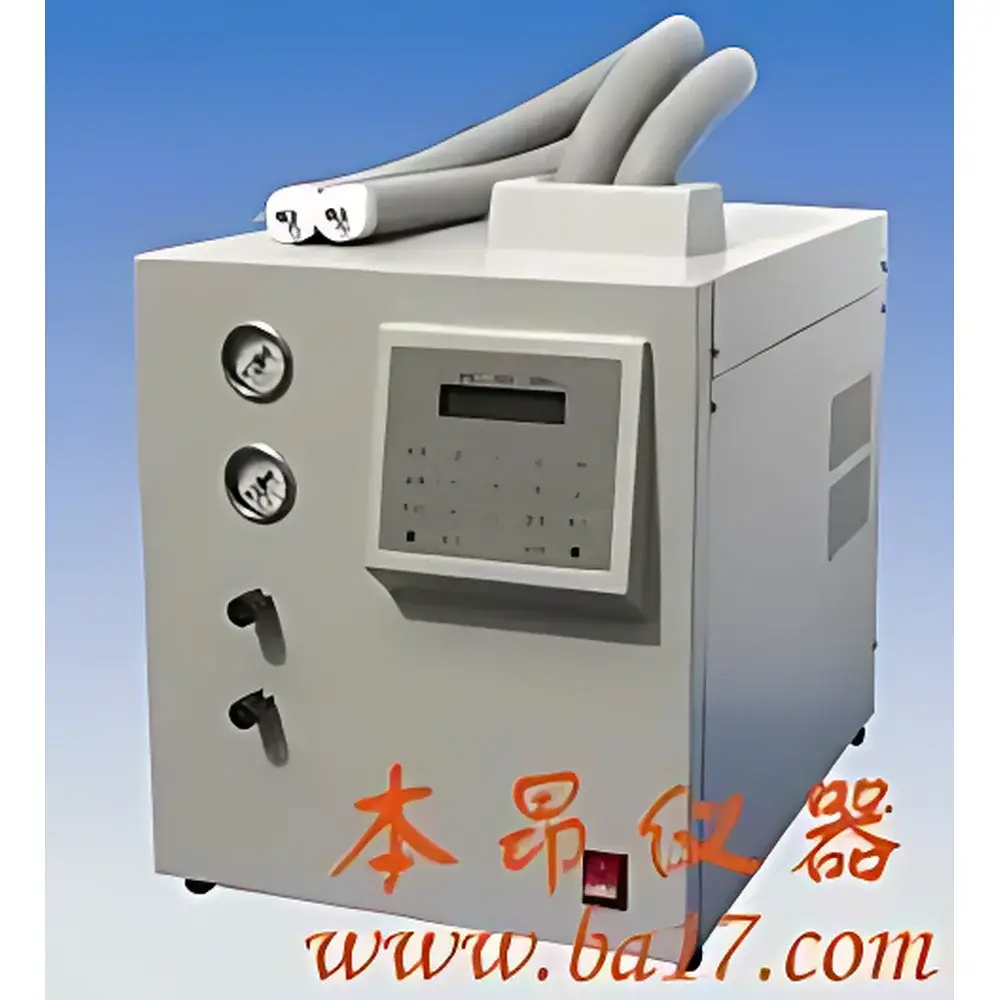
BenAng KFDO-05 Semi-Automatic Karl Fischer Drying Oven
| Brand | BenAng |
|---|---|
| Origin | Shanghai, China |
| Manufacturer Type | Authorized Distributor |
| Country of Origin | China |
| Model | KFDO-05 |
| Heating Range | 5 °C above ambient to 185 °C (1 °C adjustable increment) |
| Sample Transfer Line Heating Range | 5 °C above ambient to 185 °C (1 °C adjustable increment) |
| Sample Positions | 9 |
| RSD of Injection Precision | ≤1.5% (using 0.02% ethanol–water solution, n=5) |
| Control System | Microcontroller-based with LCD display and membrane keypad |
| Safety Features | Overtemperature cutoff and thermal runaway protection |
| Sample Transfer Line | Temperature-controlled to prevent condensation |
| Cross-Contamination Mitigation | Integrated purge/anti-blanketing function in sampling line |
| Interface Flexibility | Interchangeable inlet adapters for compatibility with major Karl Fischer titrators (e.g., Mettler Toledo, Hanna, Metrohm, Thermo Fisher, Kyoto Electronics) |
Overview
The BenAng KFDO-05 Semi-Automatic Karl Fischer Drying Oven is a thermally optimized sample preparation module designed exclusively for coulometric and volumetric Karl Fischer (KF) moisture analysis. It operates on the principle of controlled thermal release: solid or viscous samples are heated under inert conditions to quantitatively liberate bound or occluded water, which is then swept via dry carrier gas into a connected KF titrator for precise electrochemical or titrimetric quantification. Unlike generic ovens, the KFDO-05 integrates process-critical thermal engineering—its circularly arranged 9-position heating block minimizes radial temperature gradients across all sample wells, ensuring uniform desorption kinetics and inter-sample comparability. The independently controllable heating zones for both sample chamber and transfer line eliminate cold spots that could cause vapor recondensation—a known source of measurement bias in low-moisture or high-volatility matrices.
Key Features
- 9-position circular heating block engineered to reduce radial thermal deviation to <±0.8 °C at 130 °C (verified per ISO 17025 calibration protocol), enhancing reproducibility in multi-sample workflows.
- Dual-zone temperature control: independent setpoints for sample chamber (5–185 °C) and heated transfer line (5–185 °C), both adjustable in 1 °C increments and monitored via calibrated Pt100 sensors.
- Integrated carrier gas management: built-in diaphragm pump and dual-stage desiccant/particle filter ensure consistent flow rate (adjustable 20–100 mL/min) without external gas cylinders—eliminating dilution artifacts and improving detection limit stability.
- Anti-contamination design: automated reverse-purge cycle activates after each sample injection, clearing residual vapor from the transfer line and minimizing carryover between analyses (validated using USP carryover test protocols).
- Microprocessor-based operation with backlit LCD interface: real-time display of setpoint, actual temperature, elapsed time, and system status; parameter entry via sealed membrane keypad compliant with IP54 environmental rating.
- Safety-certified thermal architecture: redundant overtemperature cutoff (mechanical bimetal switch + digital PID limiter), automatic power disconnect upon sensor fault, and thermal insulation meeting IEC 61010-1 Class II requirements.
Sample Compatibility & Compliance
The KFDO-05 accommodates standard 10–20 mL glass sample vials (including ASTM D6304-compliant crimp-top vials) and supports heterogeneous matrices such as polymers, pharmaceutical excipients, lithium battery cathode materials, catalysts, and hygroscopic powders. Its thermal profile adheres to key industry standards: operating parameters align with ASTM E1868 (Standard Test Method for Determining Moisture Content by Karl Fischer Titration), ISO 8533 (Determination of water content—Karl Fischer method), and pharmacopeial requirements including USP , EP 2.5.12, and JP 2.05. All units undergo factory verification against NIST-traceable reference standards (e.g., sodium tartrate dihydrate, 15.66% w/w H₂O), and calibration reports—including uncertainty budgets per GUM (JCGM 100:2008)—are supplied with each instrument.
Software & Data Management
While the KFDO-05 operates as a standalone hardware module, its analog/digital I/O interface (RS-232 and 0–10 V analog output) enables bidirectional synchronization with third-party KF titrator software (e.g., Mettler Toledo LabX, Metrohm OMNIS, Thermo Fisher TitraLab). Timestamped temperature logs and injection event markers are exportable in CSV format for audit trail reconstruction. The system supports 21 CFR Part 11-compliant environments when paired with validated titrator software—user access control, electronic signatures, and immutable audit trails for all parameter changes and run records are maintained at the host software level. Firmware updates are performed via secure USB connection and include version-locked checksum validation.
Applications
- Pharmaceutical QC: Residual solvent and hydrate water quantification in APIs and lyophilized formulations (per ICH Q5C guidelines).
- Materials science: Moisture content profiling in solid electrolytes, MOFs, and metal-organic frameworks where trace water dictates ionic conductivity.
- Electrochemistry: Electrode slurry moisture monitoring prior to coating—critical for Li-ion battery manufacturing process control (ISO 16000-23 aligned).
- Food & feed: Water activity precursor analysis in low-moisture ingredients (e.g., dried dairy, starches, spices) where conventional oven methods yield inaccurate results due to volatile co-evaporation.
- Polymers & composites: Bound water assessment in epoxy resins, polyamides, and carbon fiber pre-pregs—directly correlating with cure inhibition and interfacial adhesion loss.
FAQ
Does the KFDO-05 require external nitrogen or dry air supply?
No—the integrated diaphragm pump and dual-stage purification system generates a stable, moisture-free carrier stream without compressed gas infrastructure.
Can it be used with coulometric KF titrators?
Yes—its low-flow precision delivery (<50 mL/min) and vapor-phase transport design are fully compatible with coulometric cells requiring minimal sample introduction volume.
What calibration documentation is provided?
Each unit ships with a factory calibration certificate (traceable to NIST SRM 2820), temperature uniformity map, and RSD verification report for injection repeatability (0.02% ethanol–water, n=5).
Is the transfer line heating independent of the sample block?
Yes—two separate PID controllers govern the sample block and transfer line, allowing differential setpoints (e.g., 150 °C block / 160 °C line) to prevent condensation at the interface.
How is cross-contamination prevented between sequential runs?
An automated 30-second reverse-purge cycle clears the entire transfer path post-injection using filtered carrier gas; this function is triggered automatically and logged in the system event buffer.
Related Products



