
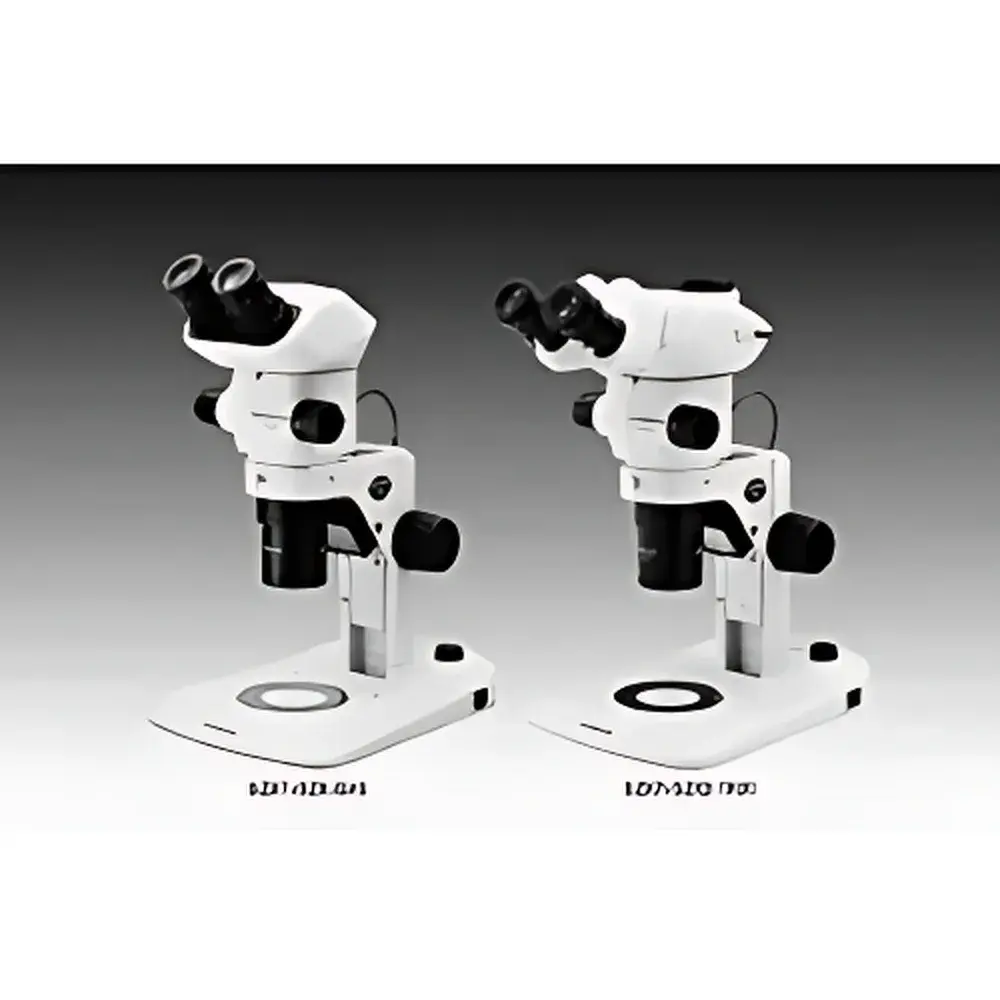
OLYMPUS SZX7 Stereo Microscope
| Brand | OLYMPUS |
|---|---|
| Origin | Japan |
| Model | SZX7 |
| Zoom Ratio | 7:1 (0.8× to 5.6×) |
| Objective Mount | Screw-fixed |
| Observation Tubes | SZX-BI45 (binocular, 45° tilt), SZX-TBI/SZX2-TTR (inclined trinocular, 5–45° tilt), SZX2-TR30 (trinocular, 30° tilt, 2-position beam splitter: 100% eyepiece / 50% eyepiece + 50% camera) |
| Interpupillary Adjustment | 52–76 mm |
| Focusing Travel | 120 mm |
| Illumination | LED transmitted & reflected light (6000 h average lifespan) |
| Power Input | 100–120 V / 200–240 V AC, 50/60 Hz |
| Compliant | RoHS-compliant lead-free optical components throughout system |
| Standard Objectives | DFPL0.5x–4 (NA 0.05, WD 171 mm), DFPL0.75x–4 (NA 0.075, WD 116 mm), DFPLAPO1x–4 (NA 0.10, WD 81 mm), DFPLAPO1.25x–2 (NA 0.125, WD 68 mm), DFPL1.5x–4 (NA 0.15, WD 45.5 mm), DFPL2x–4 (NA 0.20, WD 33.5 mm) |
| Eyepieces | WHSZ-series “ComfortView” wide-field, RoHS-compliant |
Overview
The OLYMPUS SZX7 Stereo Microscope is a high-performance, modular stereomicroscope engineered for routine inspection, quality control, and low-magnification documentation in industrial, academic, and clinical laboratory environments. Built upon an advanced Galilean optical design—free of chromatic aberration and optimized for parallel optical paths—the SZX7 delivers exceptional image fidelity, depth perception, and flat-field sharpness across its full 7:1 zoom range (0.8× to 5.6×). Its optomechanical architecture integrates precision-machined, lead-free optical components compliant with RoHS directives, ensuring long-term stability and environmental responsibility without compromising optical throughput or resolution. Unlike conventional Greenough-style systems, the SZX7’s Galilean configuration enables seamless integration with digital imaging platforms and maintains consistent parfocality during zoom transitions—critical for quantitative measurement, photomicrography, and comparative analysis workflows.
Key Features
- 7:1 Continuous Zoom System: Precision-machined horizontal rotary zoom control (SZX-ZB7 body) provides smooth, backlash-free magnification adjustment from 0.8× to 5.6×, with calibrated index markers at standard intervals (0.8, 1.0, 1.25, 1.6, 2.0, 2.5, 3.2, 4.0, 5.0, 5.6×) for repeatable setup and inter-laboratory reproducibility.
- RoHS-Compliant Optical Pathway: All objectives, eyepieces, prisms, and lens elements are manufactured using lead-free glass formulations—certified to EU Directive 2011/65/EU—ensuring regulatory compliance for export to North America, EU, and APAC markets subject to hazardous substance restrictions.
- Ergonomic Observation Configurations: Selectable observation tubes include binocular (SZX-BI45, fixed 45° inclination), inclined trinocular (SZX-TBI/SZX2-TTR, adjustable 5–45°), and fixed-angle trinocular (SZX2-TR30, 30° tilt) with dual-mode beam splitting (100% visual / 50:50 visual:camera), supporting simultaneous real-time observation and high-fidelity digital capture.
- Extended Focus Travel & Tension Control: Dual coarse/fine focusing mechanism offers 120 mm vertical travel with continuously adjustable knob torque—enabling precise Z-axis positioning for thick specimens or multi-layer assemblies without drift or slippage.
- Dual-Mode LED Illumination: Integrated coaxial and oblique LED illumination modules provide flicker-free, color-stable (CCT ≈ 5700 K) transmitted and reflected lighting. Average rated lifetime exceeds 6,000 hours, eliminating mercury-vapor lamp replacement cycles and thermal drift during extended sessions.
Sample Compatibility & Compliance
The SZX7 accommodates diverse specimen geometries—from printed circuit boards and mechanical assemblies to biological tissues, botanical samples, and forensic evidence—via interchangeable stage inserts (SZ2-SPBW black/white disc, SP-C clear glass plate) and optional fiber-optic illuminators (SZ2-LGB). Its large working distance (up to 171 mm with DFPL0.5x–4 objective) permits unobstructed access for micro-manipulation, soldering, or probe placement. The system meets ISO 10934-1 (optical microscopy terminology), ISO 9022-3 (environmental testing of optical instruments), and conforms to IEC 61000-6-3 (EMC emissions) and IEC 61000-6-2 (immunity) standards. Optional AS aperture stop (SZX-AS) enables Köhler illumination optimization for enhanced contrast in translucent specimens, supporting ASTM E2867-21 (standard guide for stereomicroscopy in materials evaluation).
Software & Data Management
While the SZX7 operates as a standalone optical platform, its trinocular configurations are fully compatible with Olympus cellSens™ Digital Imaging Software (v2.4+), enabling time-lapse acquisition, multi-focus stacking (extended depth of field), annotation, measurement (ISO 10934-2 traceable calibration), and report generation compliant with GLP and FDA 21 CFR Part 11 requirements—including electronic signatures, audit trails, and user-access controls. Image metadata (magnification, objective ID, illumination mode, timestamp) is embedded in TIFF and JPEG outputs for full traceability in regulated QA/QC environments.
Applications
- Electronics manufacturing: SMT component inspection, solder joint evaluation, PCB defect mapping
- Materials science: Coating thickness assessment, fracture surface analysis, powder morphology screening
- Life sciences: Dissection support, embryology staging, histological slide screening
- Forensics: Toolmark comparison, fiber identification, document examination
- Quality assurance: Incoming inspection of machined parts, packaging integrity verification, cosmetic defect grading
FAQ
Is the SZX7 compatible with third-party digital cameras?
Yes—the trinocular tubes feature standardized C-mount (1×) and optional 0.5× reduction adapters, supporting most industrial CMOS/CCD cameras with C-mount interface.
Can the SZX7 be used under ISO/IEC 17025-accredited testing conditions?
Yes—when paired with calibrated stage micrometers and traceable reference standards, and operated per documented SOPs, the SZX7 supports measurement uncertainty budgets required for accredited laboratories.
Does Olympus provide validation documentation for GxP environments?
Olympus offers IQ/OQ documentation templates and supports installation qualification (IQ) protocols; final operational qualification (OQ) and performance qualification (PQ) must be executed by the end user per internal validation policies.
What is the maximum usable field of view at lowest magnification?
With the DFPL0.5x–4 objective and 10× WHSZ eyepieces, the field number is 22 mm, yielding a 44 mm diameter field of view at 0.8× total magnification.
Are replacement parts and service support available globally?
Yes—OLYMPUS maintains authorized service centers across EMEA, North America, and Asia-Pacific, with spare optics, illumination modules, and mechanical subassemblies stocked for ≤72-hour dispatch under standard warranty terms.





