
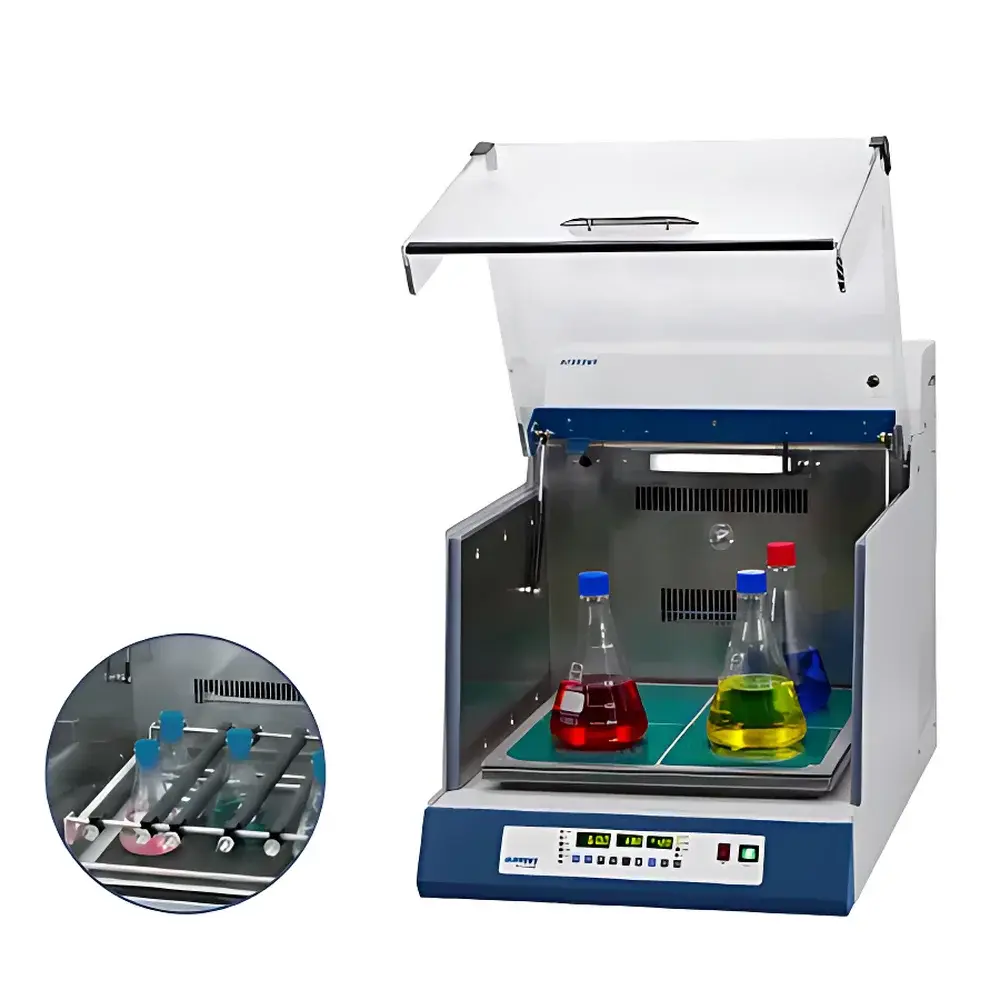
WIGGENS WS-300/WS-300R/WS-600/WS-600R Precision Temperature-Controlled Orbital and Reciprocal Shaking Incubator
| Brand | WIGGENS |
|---|---|
| Origin | Germany |
| Model Series | WS-300, WS-300R, WS-600, WS-600R |
| Oscillation Modes | Orbital & Reciprocal |
| Amplitude Range | 20 mm / 30 mm / 40 mm |
| Speed Range | 10–300 rpm |
| Safety Features | Auto-stop on door opening, overtemperature alarm with heater cutoff, programmable power-resume mode (auto-start or auto-hold) |
| Drive System | Brushless DC motor with PID-controlled speed regulation |
| Compliance | Designed for GLP-compliant laboratories |
Overview
The WIGGENS WS-300/WS-300R/WS-600/WS-600R series represents a class of precision-engineered temperature-controlled shaking incubators designed for demanding applications in life science research, pharmaceutical development, clinical microbiology, and industrial bioprocessing. These units integrate dual-mode orbital and reciprocal shaking mechanisms within a thermally stable, microprocessor-controlled incubation chamber—enabling precise control over both thermal and mechanical stimulation parameters critical to cell culture, enzyme kinetics, solubility studies, immunoassay development, and microbial growth profiling. Unlike basic water baths or static incubators, the WS-series employs a closed-loop PID-regulated heating system coupled with brushless DC motor-driven motion control, ensuring consistent temperature uniformity (±0.3 °C at 37 °C) and rotational speed stability (<±1 rpm deviation under variable load conditions). The chamber design supports passive convection airflow management and optional forced-air circulation (via integrated fan), minimizing thermal stratification while maintaining low acoustic emission (<45 dB(A)) during continuous operation.
Key Features
- Dual oscillation capability: Selectable orbital (circular) or reciprocal (linear back-and-forth) motion modes via intuitive front-panel interface or optional PC software.
- Programmable motion sequencing: Define multi-step protocols including direction (clockwise/counterclockwise), dwell time, pause intervals, and endpoint positioning—ensuring reproducible sample handling across repeated experiments.
- Load-compensated speed control: Real-time torque feedback enables automatic adjustment of motor output to maintain setpoint RPM regardless of flask weight distribution or viscosity changes during incubation.
- Three selectable amplitude settings (20 mm, 30 mm, 40 mm) optimized for compatibility with common vessel formats—from 50 mL centrifuge tubes to 5 L baffled flasks—without requiring mechanical recalibration.
- Integrated safety architecture: Door-interlocked shutoff for both shaker and blower; independent overtemperature cutout circuit with audible alarm; configurable power-fail recovery mode (auto-restart or hold state).
- Robust stainless-steel chamber construction with insulated double-wall housing and silicone-sealed viewing window—resistant to condensation, corrosion, and routine decontamination with ethanol or quaternary ammonium solutions.
Sample Compatibility & Compliance
The WS-series accommodates a broad spectrum of laboratory vessels—including Erlenmeyer flasks (up to 5 L), test tubes, microtiter plates, separatory funnels, and custom bioreactor sleeves—through interchangeable platform accessories. All mounting options (universal spring clamp trays, pre-installed clamp plates, rubber-damped platforms, separatory funnel holders, microplate adapters, and adhesive mounting pads) are engineered to minimize resonance transmission and maximize positional repeatability. Units comply with IEC 61010-1:2010 safety standards for electrical equipment used in laboratory environments and support audit-ready documentation per ISO/IEC 17025 requirements. When operated with validated calibration procedures and traceable NIST-certified thermistors, the system meets criteria for use in GMP-regulated environments where temperature mapping and motion parameter verification are mandated by FDA 21 CFR Part 11 and EU Annex 11.
Software & Data Management
Optional WIGGENS LabControl™ software enables remote configuration, real-time monitoring, and secure data logging of temperature, speed, amplitude, and runtime status. Data export is supported in CSV and XML formats, with timestamped entries linked to user-defined experiment IDs. Audit trail functionality records all parameter modifications, operator logins, and system events—fully compliant with ALCOA+ principles (Attributable, Legible, Contemporaneous, Original, Accurate, Complete, Consistent, Enduring, Available). Firmware updates are delivered via USB interface with cryptographic signature verification to ensure integrity and traceability.
Applications
- Mammalian and microbial suspension culture under controlled shear stress conditions
- Protein expression optimization in shake-flask bioreactors
- Antibiotic susceptibility testing using standardized broth microdilution protocols
- Solid-phase immunoassay incubation with agitation-enhanced antigen-antibody binding kinetics
- Extraction efficiency studies in analytical chemistry (e.g., EPA Method 3510C)
- Enzyme activity assays requiring simultaneous thermal and mechanical activation
- Seed stock propagation and cryopreservation media equilibration
FAQ
What is the difference between the “R” and non-“R” models (e.g., WS-300 vs. WS-300R)?
The “R” suffix denotes units equipped with a reversible drive system enabling programmable clockwise and counterclockwise orbital rotation, whereas standard models operate in fixed-direction orbital mode only.
Can the unit maintain setpoint temperature during extended reciprocal shaking at high amplitudes?
Yes—the chamber’s thermal mass, PID-tuned heating elements, and adaptive fan control collectively ensure ±0.5 °C stability across the full operational range (ambient +5 °C to 80 °C), even under maximal mechanical load.
Is third-party calibration support available?
WIGGENS-certified service partners provide on-site temperature uniformity mapping, speed verification, and amplitude validation in accordance with ASTM E2918 and ISO/IEC 17025 guidelines.
Are replacement parts such as platform clamps or drive belts available separately?
All mechanical and electronic spare components—including motor assemblies, control boards, and accessory mounting hardware—are stocked globally and supplied with full traceability documentation.
Does the system support integration into a centralized laboratory automation network?
Via optional RS-485 or Ethernet module, the incubator can be embedded into BMS or LIMS architectures using Modbus RTU or TCP/IP protocols for centralized monitoring and event-triggered workflows.



