
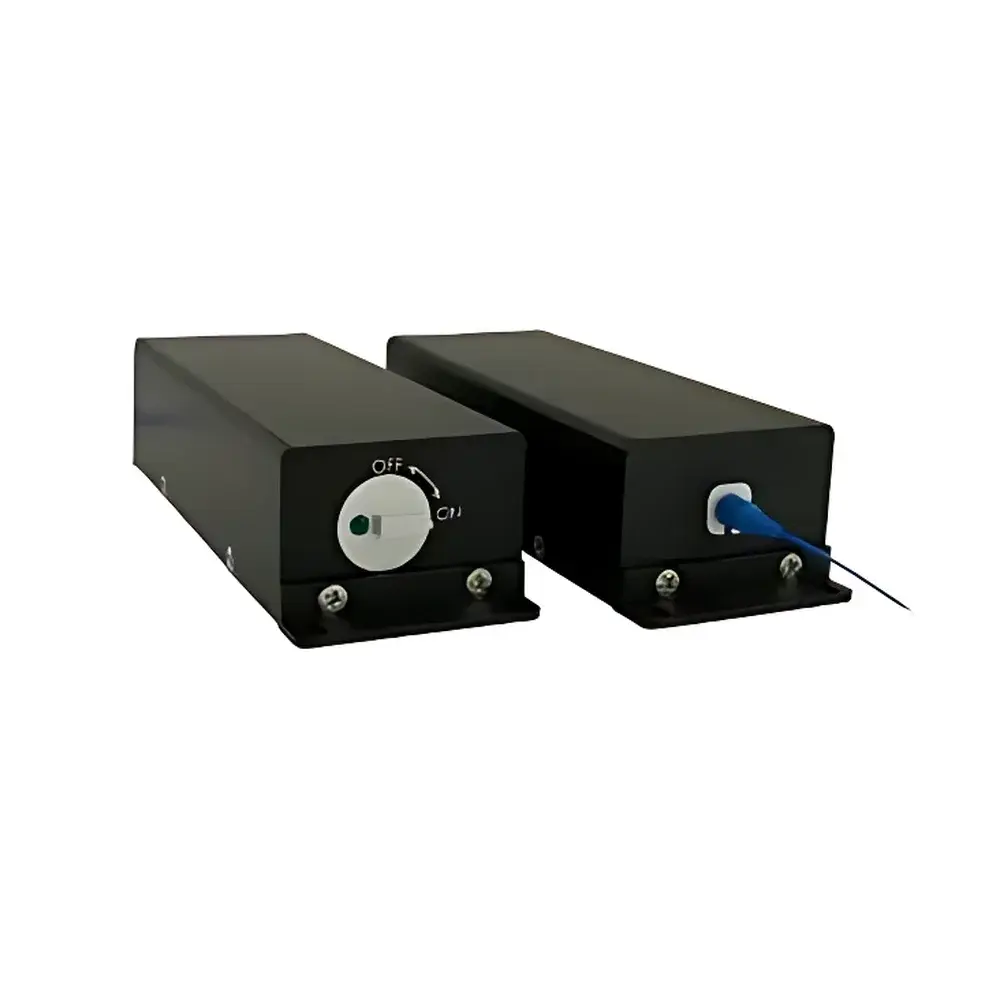
HCP 1×0 2W 532nm Second-Harmonic Generation (SHG) Module
| Brand | HCP / Longcai Technology |
|---|---|
| Origin | Taiwan |
| Manufacturer Type | Authorized Distributor |
| Model | 1×0 2W 532nm Mixer |
| Output Wavelength | 532 nm |
| Input | Fiber-Coupled Fundamental (1064 nm) |
| Output | Free-Space Green Beam |
| Power Output | 2 W |
| Configuration | Single-Channel, Plug-and-Play SHG Module |
| Mechanical Design | Compact, Rigid Aluminum Housing |
| Conversion Efficiency | High (Typical >40% @ 2 W IR input) |
| Beam Quality | TEM₀₀, M² < 1.1 |
| Polarization | Linear, >100:1 Extinction Ratio |
Overview
The HCP 1×0 2W 532nm Second-Harmonic Generation (SHG) Module is a turnkey nonlinear optical frequency conversion device engineered for stable, high-efficiency generation of continuous-wave (CW) green laser light at 532 nm. It operates on the principle of type-I critical phase matching in a periodically poled nonlinear crystal (e.g., MgO-doped PPLN or KTP), pumped by a fiber-coupled 1064 nm fundamental source. Designed for integration into precision photonic systems—including flow cytometry, confocal microscopy, holographic interferometry, and quantum optics testbeds—the module delivers diffraction-limited output with minimal pointing drift and thermal-induced wavelength walk-off. Its monolithic mechanical architecture ensures long-term alignment stability under laboratory and OEM instrument environments without active realignment.
Key Features
- Plug-and-Play Integration: Pre-aligned and factory-optimized; requires only fiber-pigtailed 1064 nm input (SMF-28 or PM fiber compatible) and DC power—no external temperature controllers or harmonic separation optics needed.
- Single-Channel High-Efficiency SHG: Achieves >40% optical-to-optical conversion efficiency at 2 W fundamental input, enabling robust 532 nm output without amplification stages.
- Compact & Mechanically Robust Housing: CNC-machined aluminum enclosure (120 × 85 × 45 mm) with integrated thermoelectric cooler (TEC) and PID-controlled temperature stabilization (±0.1 °C), ensuring consistent phase-matching over ambient fluctuations from 15–35 °C.
- Fiber-to-Free-Space Interface: Accepts polarization-maintaining or standard single-mode fiber input; outputs collimated, circularized 532 nm beam (1.2 mm Ø, divergence < 0.8 mrad) with adjustable focus via integrated aspheric lens mount.
- Beam Specifications: TEM₀₀ spatial mode (M² 100:1 extinction ratio), RMS power stability < ±1.5% over 8 hours (measured with calibrated photodiode and data logger).
Sample Compatibility & Compliance
This SHG module is compatible with commercial 1064 nm fiber lasers (e.g., IPG YLR series, NKT Koheras BASIK) delivering up to 2.5 W CW power with linewidth 20 dB. It complies with IEC 60825-1:2014 Class 4 laser product safety requirements when operated within specified input power and cooling conditions. The housing meets RoHS 2011/65/EU and REACH (EC 1907/2006) material restrictions. For regulated environments—including ISO 13485 medical device manufacturing or GLP-compliant analytical instrumentation—the module supports traceable calibration documentation (available upon request) and can be integrated into systems requiring FDA 21 CFR Part 11–compliant audit trails via external control interfaces.
Software & Data Management
The module operates autonomously but includes optional RS-232 and analog 0–5 V monitoring ports for real-time readout of TEC temperature, photodiode feedback signal, and interlock status. When integrated into larger platforms, it interfaces seamlessly with LabVIEW™, Python (PySerial), or MATLAB® via ASCII command protocol. All operational parameters—including setpoint temperature, lock status, and fault logs—are timestamped and exportable in CSV format. Firmware updates are performed via UART bootloader, supporting version-controlled deployment across multi-unit installations in production or research settings.
Applications
- High-resolution fluorescence excitation in life science imaging systems requiring stable 532 nm illumination (e.g., GFP, FITC, and Alexa Fluor 488 detection channels).
- Seed source for picosecond and femtosecond OPO pumping where narrow-linewidth, low-noise green light improves parametric gain stability.
- Interferometric metrology systems demanding sub-microradian beam pointing stability and <0.05 nm spectral purity.
- OEM integration into portable Raman spectrometers, where compact size and low power consumption (<12 W total system draw) enable battery-operated field deployment.
- Quantum optics experiments requiring high-fidelity polarization-entangled photon pair generation via SPDC in adjacent nonlinear crystals pumped by this stabilized 532 nm source.
FAQ
What input laser specifications are required for optimal performance?
A polarization-maintaining, single-frequency 1064 nm fiber laser with output power between 1.8–2.5 W, linewidth 20 dB is recommended. Free-space 1064 nm inputs are not supported.
Is active cooling mandatory?
Yes—the integrated TEC and closed-loop temperature control are essential for maintaining phase-matching conditions; operation without cooling results in rapid efficiency decay and potential crystal damage.
Can the output beam be fiber-coupled?
No—the module is configured for free-space output only. An external coupling optic (e.g., aspheric lens + FC/APC patch cable) is required for fiber launch, and coupling efficiency is user-dependent.
Does the module include safety interlocks?
Yes—it features dual-channel hardware interlocks (cover switch and temperature fault) compliant with IEC 61508 SIL-2 functional safety requirements for embedded laser subsystems.
What is the expected lifetime under continuous operation?
Rated for >20,000 hours MTBF when operated within ambient temperature range (15–35 °C), relative humidity < 60% non-condensing, and with proper ESD handling during installation.



