
PPLN-SHG Periodically Poled Lithium Niobate Crystal for Second Harmonic Generation
| Brand | HCP (Longcai Technology) |
|---|---|
| Origin | Taiwan |
| Type | Commercial PPLN Crystal Module for SHG |
| Dimensions | Grating Length (X): 0.3–50 mm (customizable) |
| Thickness (Z) | 0.5–1.0 mm |
| Anti-Reflection Coating | Broadband AR (488–1700 nm) |
| Poling Structure | Single-period, Multi-period, and Fan-out Domain Configurations |
Overview
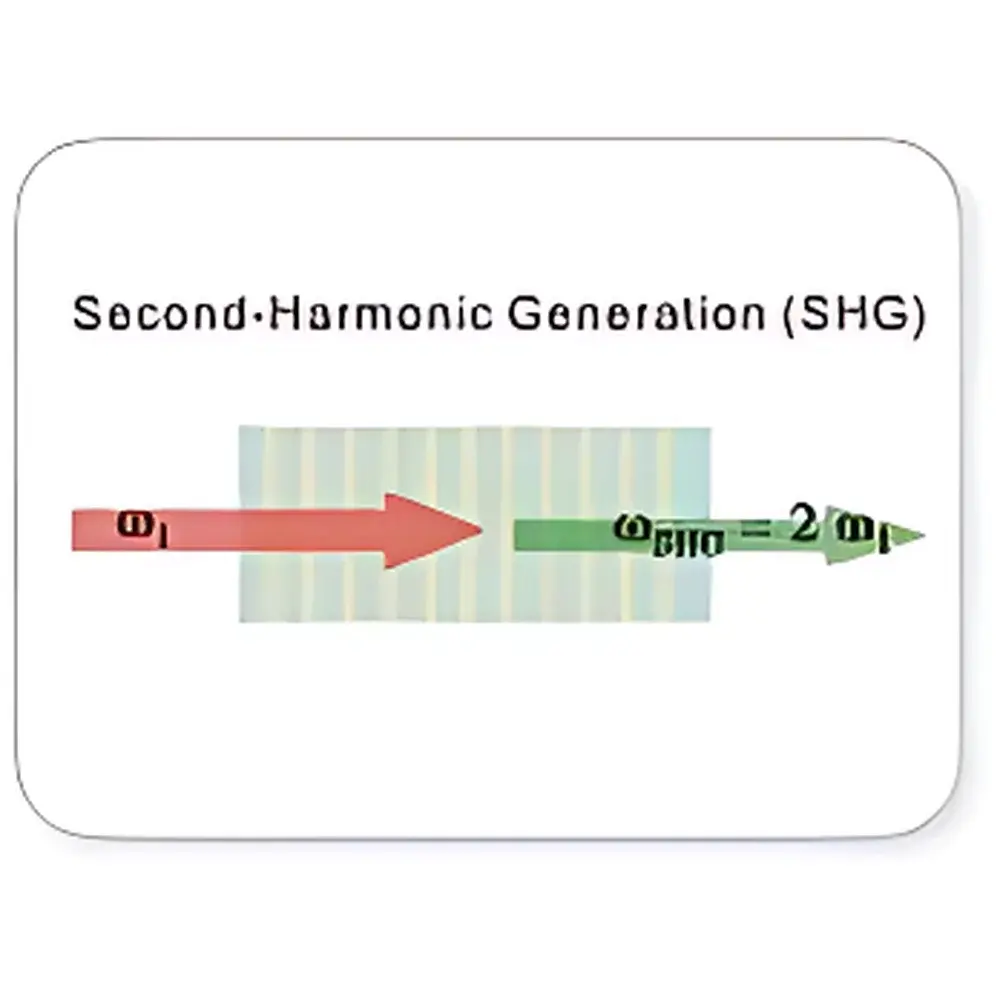
The PPLN-SHG is a high-performance periodically poled lithium niobate (PPLN) crystal module engineered for efficient second harmonic generation (SHG) in continuous-wave (CW) and pulsed laser systems. Based on quasi-phase-matching (QPM) principles, this nonlinear optical crystal enables precise wavelength conversion across the visible to near-infrared spectrum (488–1700 nm fundamental → 244–850 nm second harmonic). Unlike birefringent phase-matching techniques, QPM in PPLN offers superior flexibility in wavelength selection, higher effective nonlinear coefficients (deff ≈ 16 pm/V), and broad temperature-tuning bandwidths—making it ideal for tunable coherent light sources in spectroscopy, quantum optics, and biomedical imaging applications.
Key Features
- Engineered domain inversion: Precisely controlled ferroelectric poling yields single-period, multi-period, or fan-out grating structures—enabling simultaneous or broadband SHG operation without mechanical realignment.
- Broadband anti-reflection coating: Optimized for 488–1700 nm input range with <0.25% surface reflectivity per interface, minimizing insertion loss and parasitic reflections.
- High optical homogeneity: Czochralski-grown, MgO-doped LiNbO3 substrate ensures low photorefractive damage threshold and thermal stability up to 200 °C.
- Customizable geometry: Standard grating lengths of 0.3, 0.5, 1.0, 10, 25, and 50 mm; thickness options of 0.5 mm and 1.0 mm; custom dimensions available upon request for integration into OEM laser cavities or external resonant enhancement setups.
- Robust packaging: Mounted in kinematic aluminum holders with precision-aligned AR-coated windows and optional temperature-controlled mounts (±0.1 °C stability) for long-term phase-matching reproducibility.
Sample Compatibility & Compliance
The PPLN-SHG crystal is compatible with Ti:sapphire, fiber, diode-pumped solid-state (DPSS), and OPO-based pump lasers operating in CW, nanosecond, picosecond, and femtosecond regimes. Its design adheres to ISO 10110-7 (surface quality), ISO 14997 (laser-induced damage threshold testing), and IEC 61228 (nonlinear optical component safety classification). All crystals undergo full spectral transmission verification (200–5000 nm) and wavefront distortion mapping (λ/10 @ 633 nm) prior to shipment. Documentation includes traceable calibration reports compliant with GLP requirements for regulated R&D environments.
Software & Data Management
While the PPLN-SHG is a passive optical component, its integration into automated laser systems benefits from compatibility with industry-standard control interfaces. When paired with temperature-tuned mounts or motorized translation stages, it supports integration via RS-232, USB, or Ethernet protocols using LabVIEW™, Python (PyVISA), or MATLAB® drivers. Optional software tools include HCP’s QPM Calculator Suite—providing phase-matching angle, temperature, and poling period predictions per input wavelength and polarization state—validated against Sellmeier equations for MgO:PPLN (accuracy ±0.2 nm over 488–1700 nm). Audit trails and configuration logs comply with FDA 21 CFR Part 11 when deployed in GMP-aligned optical assembly lines.
Applications
- Visible laser source generation: Efficient 1064 nm → 532 nm (Nd:YAG), 1550 nm → 775 nm (telecom OPO pumping), and 780 nm → 390 nm (ultracold atom trapping) conversion.
- Mid-IR difference frequency generation (DFG) seed stages: Used in tandem with another PPLN crystal for high-brightness 3–12 µm output.
- Quantum photonics: SPDC-based entangled photon pair generation at telecom wavelengths with high spectral purity.
- Confocal and multiphoton microscopy: Compact SHG modules for label-free tissue imaging with sub-µm axial resolution.
- Industrial process monitoring: Integrated into inline laser diagnostics for real-time monitoring of coating thickness, stress-induced birefringence, or gas absorption features.
FAQ
What pump laser specifications are recommended for optimal SHG efficiency?
Typical requirements include M² <1.3, beam diameter 100–500 µm (1/e²), divergence <1 mrad, and power stability 30% conversion efficiency in optimized cavities.
Is temperature tuning required for wavelength agility?
Yes—temperature tuning (typically 25–200 °C) provides ~0.03 nm/°C shift in phase-matched wavelength; fan-out gratings eliminate the need for translation but require uniform temperature distribution across the aperture.
Can this crystal be used for sum-frequency generation (SFG) or optical parametric oscillation (OPO)?
Yes—PPLN-SHG crystals support SFG and OPO when configured with appropriate poling periods and pump/signal/idler wavelength matching per Manley–Rowe relations and energy conservation constraints.
What is the typical laser-induced damage threshold (LIDT) for this module?
Measured LIDT is ≥1 GW/cm² for 1064 nm, 10 ns pulses (10 Hz); ≥5 MW/cm² for CW operation at 1550 nm—values confirmed per ISO 21254-2 test methodology.
Do you provide mounting solutions compatible with standard optomechanics?
Yes—standard SM1 (1.035″-40) and kinematic baseplates with ±2° tip/tilt adjustability are available; custom mounts with integrated thermistors and PID controllers are offered for OEM integration.




