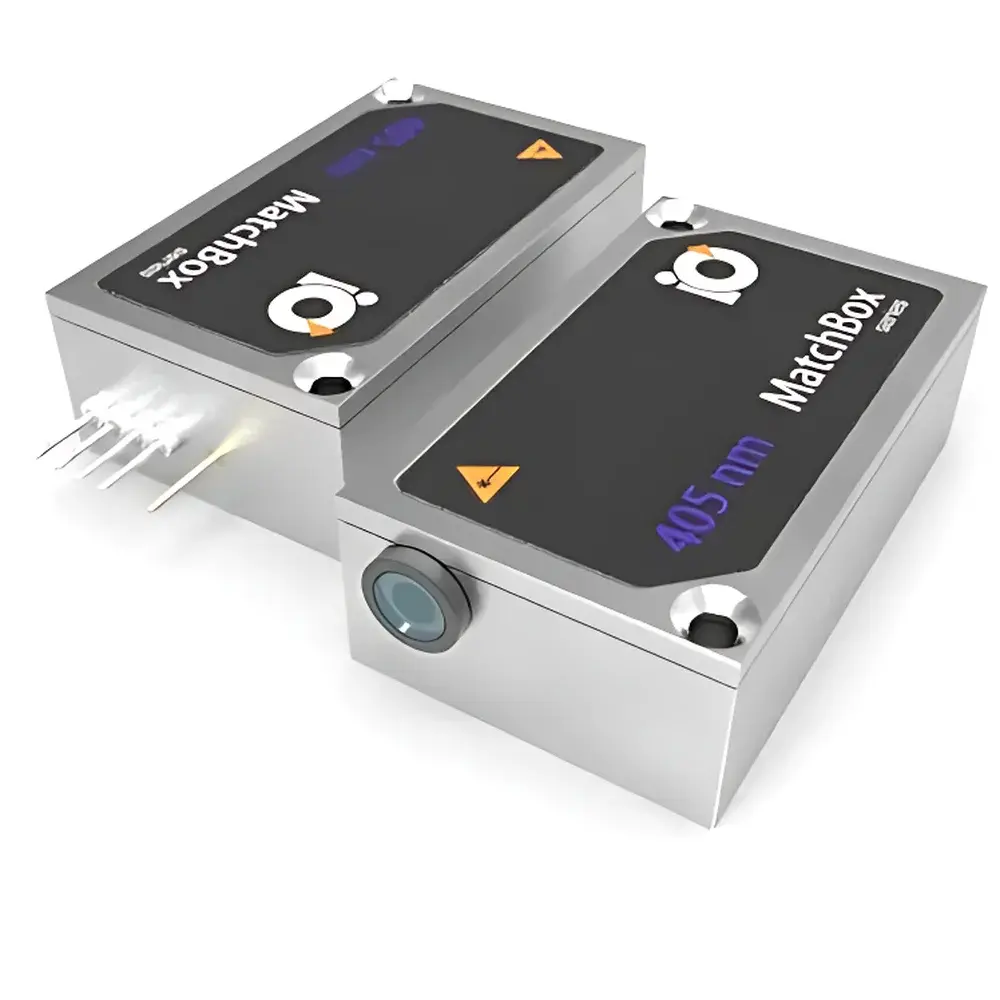
German-Made Compact Semiconductor Laser System – cw-laser Series for Spectroscopy and Precision Optical Applications
| Origin | Germany |
|---|---|
| Supplier Type | Authorized Distributor |
| Import Status | Imported |
| Model | cw-laser |
| Price Range | USD 1,400 – 7,000 (FOB Hamburg) |
| Core Component | Semiconductor Laser Module with Integrated Driver and TEC Control |
Overview
The cw-laser series is a line of compact, continuous-wave (CW) semiconductor laser systems engineered for high-stability optical excitation in analytical and industrial instrumentation. Based on edge-emitting diode laser technology, these modules operate via stimulated emission in III–V semiconductor heterostructures (e.g., AlGaAs, InGaAsP), delivering diffraction-limited output with intrinsic wavelength stability under active thermoelectric cooling (TEC) and precision current regulation. Designed specifically for integration into fluorescence spectrometers, Raman microscopes, and time-resolved optical setups, the cw-laser platform emphasizes low noise (<0.3% RMS intensity noise, 10 Hz–10 MHz), narrow spectral linewidth (<0.1 nm for SLM-configured variants), and rapid TTL/analog modulation capability (up to 500 kHz). Its modular architecture supports OEM integration while maintaining compliance with IEC 60825-1:2014 Class 3B/Class 4 laser safety requirements depending on output power configuration.
Key Features
- Wavelength flexibility: Standard options at 405 nm, 450 nm, 520 nm, 635 nm, 660 nm, 785 nm, and 830 nm — selected to match common fluorophore absorption bands and Raman excitation windows.
- Thermally stabilized operation: Integrated Peltier cooler and high-resolution temperature sensor enable ±0.02 °C thermal regulation, ensuring drift <±5 pm/h over 8-hour continuous operation.
- Software-controllable interface: USB-C and RS-232 connectivity with ASCII command protocol; compatible with LabVIEW™, Python (PySerial), MATLAB®, and EPICS for automated calibration routines and remote power ramping.
- Modular mechanical design: Industry-standard 25.4 mm (1″) cylindrical housing with SM1-threaded collimator mount; optional FC/PC, SMA905, or fiber-pigtailed output configurations.
- Low-power consumption: Typical operating draw <3.5 W at 5 V DC input; suitable for battery-powered portable analyzers and embedded metrology subsystems.
Sample Compatibility & Compliance
The cw-laser series is validated for use with standard optical components including dichroic mirrors (OD4+ blocking at pump wavelength), notch filters (0.5 cm⁻¹ Raman shift resolution), and silicon-based CCD/CMOS detectors. All units undergo individual factory calibration traceable to PTB (Physikalisch-Technische Bundesanstalt) reference standards. Regulatory compliance includes CE marking per Directive 2014/35/EU (Low Voltage Directive) and 2014/30/EU (EMC Directive); laser classification documentation follows EN 60825-1:2014 Annex G. For regulated environments (e.g., pharmaceutical QC labs), optional firmware enables audit-trail logging of all power and temperature setpoints per FDA 21 CFR Part 11 requirements when paired with compliant host software.
Software & Data Management
A cross-platform control application (Windows/macOS/Linux) provides real-time monitoring of diode current, TEC voltage, case temperature, and photodiode feedback signal. Raw telemetry data exports to CSV or HDF5 format with timestamp resolution ≤10 ms. API support includes RESTful endpoints for integration into LIMS or MES platforms. Firmware updates are delivered via signed binary packages with SHA-256 verification. No cloud dependency — all processing occurs locally to preserve data sovereignty and meet ISO/IEC 27001-aligned IT security policies.
Applications
- Fluorescence spectroscopy: Excitation of organic dyes (e.g., FITC, TRITC), quantum dots, and GFP-tagged biomolecules with minimal photobleaching.
- Raman microscopy: 785 nm variant optimized for reduced fluorescence background in biological tissue and polymer analysis (ASTM E1840-22 compliant).
- Confocal and multiphoton scanning systems: Sub-micron beam pointing stability (<2 µrad/°C) enables long-duration z-stack acquisition.
- Optical pumping: Seed source for DPSS lasers and OPOs; CW output serves as master oscillator in MOPA architectures.
- Flow cytometry: Pulse-modulated mode supports gated detection in high-throughput cell sorting (ISO 13845-2:2021 referenced).
- Holographic interferometry: Coherence length >1 m (for narrow-linewidth variants) supports quantitative phase imaging in MEMS and microfluidic characterization.
FAQ
Is this laser system suitable for alignment in cleanroom environments?
Yes — the sealed metal housing and conformal-coated PCB meet ISO Class 5 particulate limits when operated within specified ambient temperature (15–30 °C) and humidity (30–60% RH non-condensing) ranges.
Can multiple cw-laser units be synchronized for multi-wavelength excitation?
Yes — external trigger inputs support master-slave configuration with jitter <5 ns using LVDS-level synchronization signals.
What is the typical lifetime under continuous operation at rated power?
MTTF exceeds 20,000 hours per IEC 62089:2016 accelerated life testing protocols, assuming proper heatsinking and stable drive current.
Do you provide OEM labeling and custom firmware?
Yes — white-label packaging, engraved housings, and firmware customization (e.g., proprietary command sets, boot-time diagnostics) are available under NDA.
Is there a version qualified for aerospace or automotive qualification standards?
Standard units comply with MIL-STD-810G vibration/shock profiles; extended-temperature (-20 to +70 °C) and AEC-Q200 qualified variants are available upon request.