
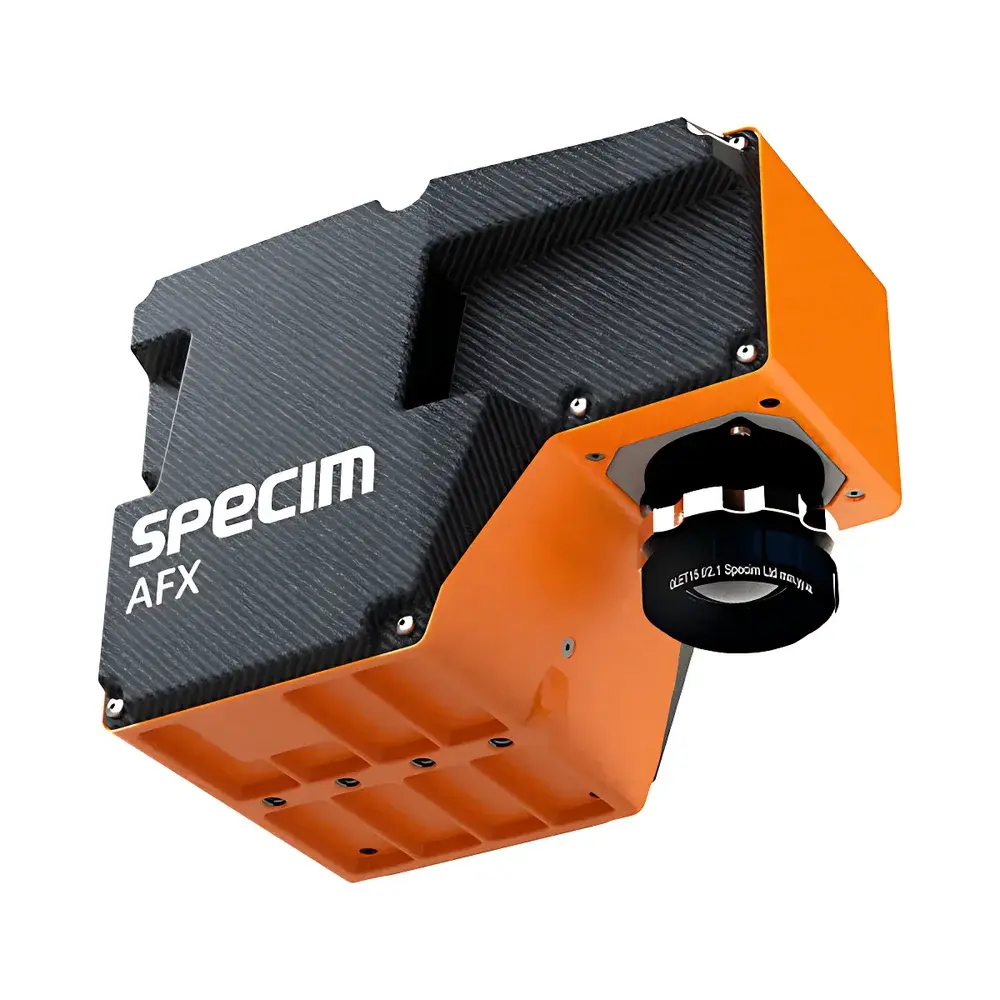
Specim FX120 Hyperspectral Imaging Camera
| Brand | Specim (Konica Minolta Group) |
|---|---|
| Origin | Finland |
| Model | FX120 |
| Imaging Principle | Push-broom |
| Optical Design | Binary Optics |
| Platform Compatibility | Ground-based & Airborne |
| Spectral Range | 400–1100 nm |
| Spectral Resolution | 5 nm |
| Spatial Resolution | 1024 pixels per line |
| Field of View (TFOV) | 10°–90° (interchangeable lenses) |
| Frame Rate | Up to 800 fps |
| Detector Type | CMOS line-scan sensor |
| Interface | Camera Link HS / CoaXPress 2.0 |
| Cooling | Thermoelectric (TE) stabilized |
| Data Format | ENVI-compatible raw binary (.bil) + metadata (.hdr) |
Overview
The Specim FX120 is a high-performance, push-broom hyperspectral imaging camera engineered for quantitative spectral analysis and spatially resolved material characterization across visible and near-infrared (VNIR) wavelengths. Operating on the fundamental principle of line-scan spectroscopy, the FX120 captures full spectral data cubes (x, y, λ) by synchronizing linear motion—whether from a translation stage, conveyor belt, UAV gimbal, or aircraft platform—with high-speed spectral line acquisition. Its core optical architecture employs precision binary optics, enabling diffraction-limited performance, minimal chromatic aberration, and consistent point spread function (PSF) across the entire 400–1100 nm range. Unlike filter-wheel or tunable-filter systems, the FX120 delivers true simultaneous spectral sampling at 5 nm resolution with no moving parts in the optical path—ensuring mechanical robustness, measurement repeatability, and suitability for integration into automated industrial inspection lines or field-deployable remote sensing platforms.
Key Features
- Push-broom acquisition architecture optimized for high-speed, distortion-free spectral imaging at up to 800 fps (full 1024-pixel line)
- VNIR spectral coverage from 400 nm to 1100 nm with native 5 nm spectral resolution (FWHM), calibrated traceably to NIST-traceable standards
- Modular lens interface supporting TFOV selection from 10° to 90°, enabling flexible standoff distance and ground sampling distance (GSD) configuration
- Thermoelectrically cooled CMOS line-scan detector ensuring stable dark current and low temporal noise (<15 e⁻ RMS) over extended acquisitions
- Dual high-bandwidth interfaces: Camera Link HS (for deterministic real-time streaming) and CoaXPress 2.0 (for long-cable, single-cable power+data operation)
- Onboard FPGA-based preprocessing including non-uniformity correction (NUC), bad pixel replacement, and radiometric linearization
- IP65-rated housing option available for outdoor or industrial environments; operating temperature range: −10 °C to +50 °C
Sample Compatibility & Compliance
The FX120 is compatible with solid, semi-solid, and particulate samples under ambient or controlled illumination (e.g., halogen, LED, or solar-simulated sources). It supports reflectance, transmittance, and fluorescence modalities when paired with appropriate light sources and calibration references (e.g., Spectralon® panels, NIST-traceable lamps). The system complies with IEC 61326-1 (EMC for laboratory equipment), CE marking requirements, and RoHS 2011/65/EU directives. For regulated industries—including pharmaceutical QA/QC, food safety testing, and defense-related spectral intelligence—the FX120’s raw data output format adheres to ENVI header conventions and supports audit-ready metadata embedding (wavelength calibration, exposure time, sensor temperature, lens ID), facilitating alignment with GLP and GMP documentation workflows.
Software & Data Management
Specim provides the proprietary SpectralCube software suite for real-time visualization, spectral library matching, and pixel-wise classification (e.g., PCA, MNF, SAM, SID). Raw data streams are saved in industry-standard ENVI BIL format with embedded .hdr files containing full radiometric and geometric metadata. The SDK (C/C++, Python, MATLAB) enables seamless integration into custom automation frameworks (e.g., LabVIEW, Python-based OPC UA clients) and supports FDA 21 CFR Part 11-compliant electronic signatures when deployed with validated third-party LIMS or MES platforms. Batch processing pipelines support automated atmospheric correction (for airborne use), spectral unmixing, and false-color index mapping (e.g., NDVI, PRI, CCI)—all exportable as georeferenced GeoTIFFs or CSV tables for statistical analysis.
Applications
- Industrial sorting and quality control: Real-time identification of polymer types, contaminant detection in recycled plastics, coating thickness verification, and defect mapping on printed electronics
- Agricultural phenotyping: Canopy-level assessment of chlorophyll content, water stress indices, and nitrogen status in field trials or greenhouse monitoring
- Food safety & authenticity: Detection of mycotoxin contamination in grains, adulteration in olive oil, and spoilage indicators in meat and dairy surfaces
- Pharmaceutical manufacturing: Blend uniformity analysis of tablet cores, excipient distribution mapping, and counterfeit drug screening via spectral fingerprinting
- Environmental monitoring: Soil organic carbon estimation, mine tailings characterization, and microplastic identification in aquatic sediments
- Defense & security: Camouflage detection, chemical residue identification, and forensic material differentiation under non-contact conditions
FAQ
What spectral calibration options are available for the FX120?
Factory calibration includes wavelength accuracy ±0.5 nm and radiometric linearity ±2% across the full range. Optional on-site recalibration services include NIST-traceable lamp-based verification and user-defined reference panel characterization.
Can the FX120 be synchronized with external triggers or motion encoders?
Yes—it supports hardware TTL trigger input/output, encoder pulse synchronization (A/B/Z phase), and genlock capability for multi-sensor fusion in UAV or robotic platforms.
Is radiometric calibration included with the system?
Each unit ships with a certified reflectance calibration kit (Spectralon® panel + irradiance standard) and preloaded calibration coefficients in the firmware; full radiometric calibration reports are provided upon request.
Does the FX120 support real-time spectral classification?
SpectralCube software enables GPU-accelerated real-time classification at >200 fps (ROI-limited); full-frame classification requires post-processing but scales linearly with CPU/GPU resources.
What is the minimum integration time and dynamic range?
Minimum exposure is 1 µs; dynamic range exceeds 68 dB (16-bit digitization with dual-gain readout architecture), supporting both low-light fluorescence and high-reflectance metallic surface imaging.




