
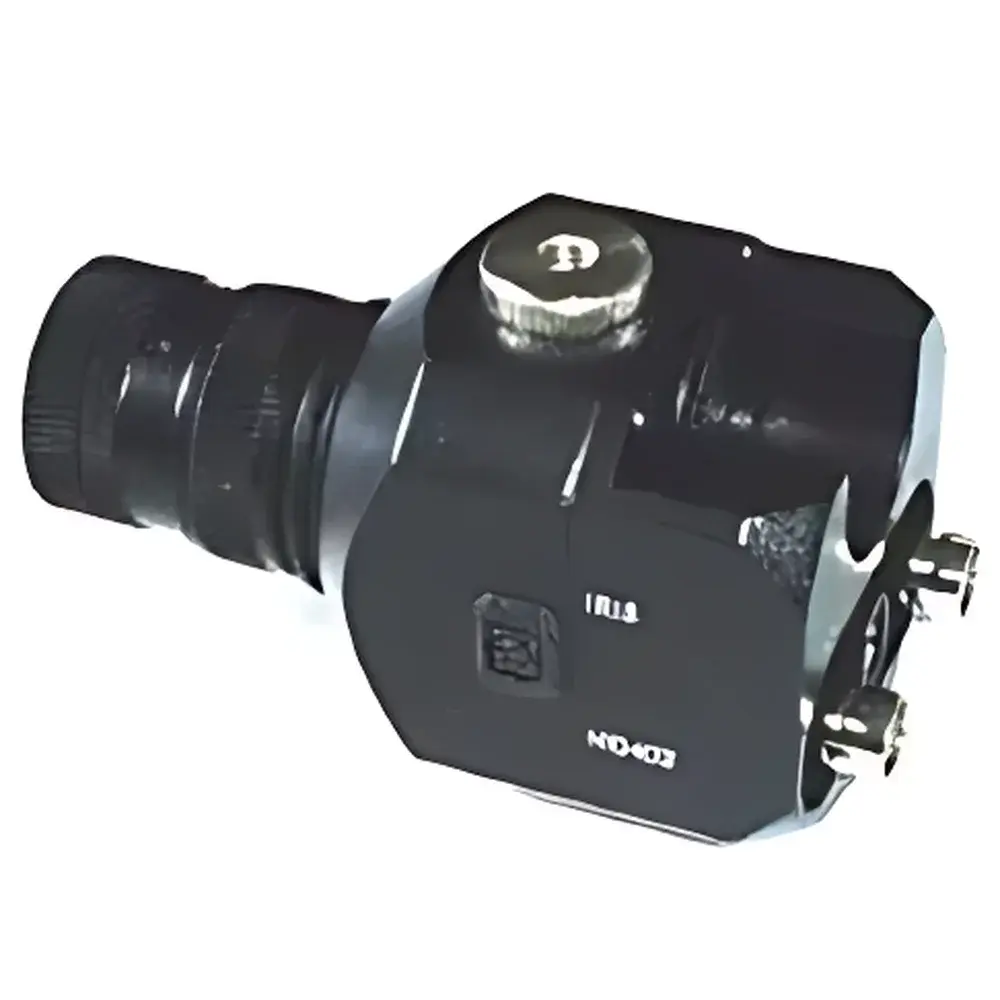
ElectroOptic CONTOUR-IR Near-Infrared Camera
| Brand | ElectroOptic |
|---|---|
| Origin | Belarus |
| Model | CONTOUR-IR |
| Spectral Range | 400–1700 nm |
| Sensor Type | CCD (1/3″, 582 × 752) |
| Lens | F1.4 / 26 mm, C-mount |
| FOV | 20° |
| SNR | 48 dB |
| Frame Rate | 25 fps (CCIR standard) |
| Resolution | 570 TV lines |
| Video Output | Composite video (RCA, 1 Vp-p, 75 Ω) |
| Power Supply | DC 10–14 V, 150 mA |
| Operating Temperature | 5–40 °C |
| Weight | 0.3 kg |
| Dimensions | 56 × 110 mm |
| Sensitivity | ~5 µW/mm² @ 1310 nm |
| Compliance | CE, RoHS |
Overview
The ElectroOptic CONTOUR-IR Near-Infrared Camera is a precision optical imaging instrument engineered for high-fidelity visualization, documentation, and quantitative analysis of near-infrared (NIR) radiation across the 400–1700 nm spectral band. Based on a high-sensitivity silicon CCD sensor with optimized quantum efficiency in the NIR region, the CONTOUR-IR operates on the principle of photon-to-electron conversion under controlled thermal and electronic conditions—enabling stable, low-noise imaging of weak infrared emissions from sources including GaAs LEDs, laser diodes (LDs), DPSS lasers, and free-electron laser (FEL) systems. Its design prioritizes optical fidelity, temporal stability, and compatibility with calibrated NIR optical setups—making it suitable for laboratory-grade alignment, beam profiling, optical system verification, and non-destructive inspection where visible-light cameras fail. Unlike broadband thermal imagers, the CONTOUR-IR delivers diffraction-limited spatial resolution and linear photometric response within its designated spectral window, supporting traceable intensity measurements when used with NIST-traceable calibration filters.
Key Features
- Wide spectral response from 400 nm (visible edge) to 1700 nm (short-wave infrared), covering key telecom wavelengths (1310 nm, 1550 nm) and common laser emission bands
- F1.4 / 26 mm C-mount lens with 20° field of view—optimized for uniform illumination and minimal vignetting in collimated or divergent NIR beams
- High signal-to-noise ratio (48 dB) achieved through low-dark-current CCD architecture and synchronized internal clocking
- CCIR-standard 25 fps progressive-scan video output ensures compatibility with legacy and modern video acquisition systems without frame interpolation artifacts
- Composite analog video output (RCA, 1 Vp-p, 75 Ω) enables direct integration with oscilloscopes, digital storage recorders, and industrial vision monitors
- Compact, lightweight housing (56 × 110 mm, 0.3 kg) with integrated mounting interface supports handheld, tripod-mounted, or OEM integration into optical benches and test stations
- DC-powered operation (10–14 V, 150 mA) ensures stable performance in electrically noisy environments without reliance on USB bus power
Sample Compatibility & Compliance
The CONTOUR-IR is routinely deployed in applications requiring non-invasive NIR observation of semiconductor devices, fiber-optic components, laser safety validation, and infrared microscopy. It maintains compatibility with standard optical elements—including interference filters (e.g., 1064 nm notch, 1310/1550 nm bandpass), C-mount adapters, microscope couplers, and neutral density filters (2–5% T @ 1064 nm). All units conform to CE marking requirements for electromagnetic compatibility (EMC Directive 2014/30/EU) and restriction of hazardous substances (RoHS Directive 2011/65/EU). While not certified for medical device use under IEC 62304 or FDA 21 CFR Part 820, the camera’s analog video output and deterministic timing behavior support integration into GLP-compliant test setups where raw image data is archived with metadata (timestamp, exposure setting, lens ID) per ISO/IEC 17025 documentation practices.
Software & Data Management
The CONTOUR-IR operates as a standalone analog imaging device; no proprietary driver or software is required for basic video capture. When paired with external frame grabbers (e.g., National Instruments PCIe-1433, Epiphan DVI2USB 3.0), it supports time-stamped acquisition in LabVIEW, MATLAB Image Acquisition Toolbox, or Python (OpenCV + DirectShow). For quantitative analysis, users apply radiometric calibration curves—supplied as tabulated responsivity values (µW/mm² per digital unit) at 1310 nm, 1550 nm, and 1700 nm—to convert pixel intensity into irradiance. Audit trails for exposure settings, filter configurations, and environmental conditions (recorded manually or via external sensors) satisfy traceability requirements under ISO/IEC 17025 Clause 7.7. The absence of embedded firmware or network interfaces eliminates cybersecurity concerns associated with IoT-enabled instruments, aligning with ITAR- and EAR-controlled lab infrastructure policies.
Applications
- Laser beam profiling and alignment verification for NIR sources (e.g., 1064 nm Nd:YAG, 1310/1550 nm telecom lasers, 1700 nm supercontinuum)
- Optical system characterization—including M² measurement, wavefront distortion assessment, and focal spot analysis
- Infrared microscopy of semiconductor wafers, photonic integrated circuits (PICs), and transparent polymer substrates
- Non-destructive evaluation (NDE) of coatings, laminates, and composite materials using NIR transmittance contrast
- Quality control of IR-emitting components (LEDs, VCSELs, LD modules) during production testing
- Educational demonstrations of NIR optics, spectral filtering, and photon detection physics
FAQ
Does the CONTOUR-IR provide radiometric calibration out of the box?
No—radiometric calibration requires user-applied correction factors based on supplied responsivity curves and validated reference sources (e.g., NIST-traceable tungsten halogen lamps with calibrated NIR filters).
Can the camera be used with a microscope objective?
Yes—via optional C-mount microscope adapter kits; effective magnification and working distance depend on selected objective and relay lens configuration.
Is the 1700 nm upper limit an absolute cutoff or a sensitivity threshold?
It reflects the 10% relative quantum efficiency point; measurable signal persists beyond 1700 nm but with rapidly diminishing SNR and increased thermal noise contribution.
What is the maximum permissible irradiance before sensor saturation or damage?
Continuous exposure to >10 mW/mm² at 1550 nm may induce localized heating and temporary responsivity drift; pulsed operation up to 100 MW/cm² (10 ns pulses) is permissible with appropriate attenuation.
How does the CONTOUR-IR differ from the CONTOUR-M and CONTOUR-IR CMOS variants?
The CONTOUR-IR uses a global-shutter CCD optimized for analog video stability and low read noise; the CONTOUR-M integrates an LCD display and battery-ready power management; the CMOS variant prioritizes USB 2.0 digital streaming and software-controllable parameters over analog robustness.





