
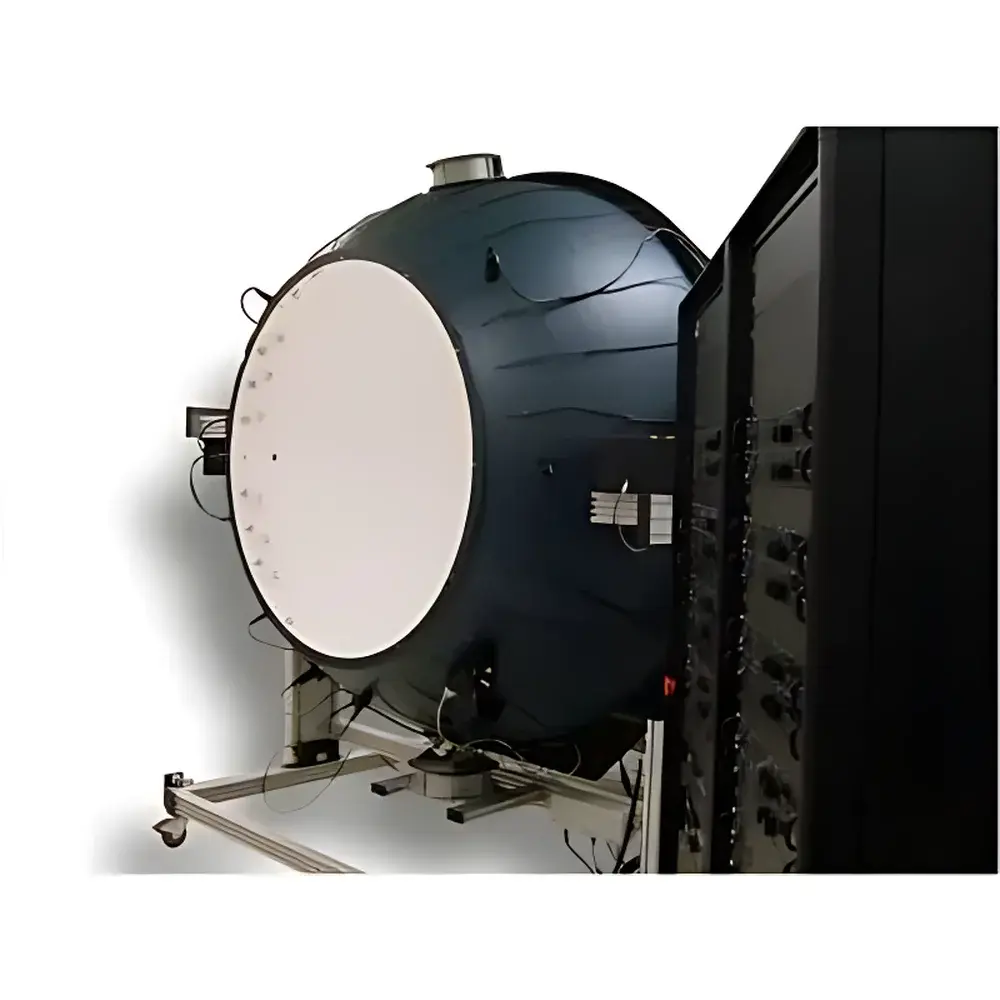
Large Uniform Source System Custom – Labsphere USS
| Brand | Labsphere |
|---|---|
| Origin | USA |
| Manufacturer Type | Authorized Distributor |
| Product Category | Imported |
| Model | USS |
| Component Type | Fiber Collimator |
| Light Source Options | Xenon + Tungsten-Halogen (UV–NIR), LED, or Laser |
| Spectral Range | 250 nm to 2500 nm |
| Color Temperature Range | 2800 K to 6500 K (continuously variable) |
| Radiance Adjustment | Fully continuous, 0–100% output |
| Calibration | NIST-traceable radiometric and photometric reports available |
| Software Control | LabVIEW- and Python-compatible GUI with automated ramping, logging, and audit trail support |
| Compliance | Designed to support ISO/IEC 17025-compliant calibration workflows |
Overview
The Labsphere USS (Uniform Source System) is a fully customizable large-area uniform light source engineered for high-fidelity radiometric and photometric calibration of optical imaging and detection systems. Based on Labsphere’s proprietary integrating sphere technology and precision baffle design, the USS delivers spatially uniform radiance (±0.2% center-to-edge uniformity over >95% of active aperture) across apertures ranging from 300 mm to 2000 mm in diameter. It operates on the principle of multiple diffuse reflections within a spectrally neutral, barium sulfate–coated integrating sphere cavity, ensuring Lambertian emission characteristics essential for traceable sensor characterization. The system is purpose-built for end-to-end validation of remote sensing instruments, spaceborne imagers, aerial surveillance platforms, industrial machine vision sensors, and laboratory-grade radiometers—where spatial uniformity, spectral stability, and radiometric repeatability are non-negotiable.
Key Features
- Modular architecture supporting scalable aperture sizes (standard configurations: 300 mm, 500 mm, 1000 mm, and custom up to 2000 mm)
- Dual-source capability: synchronized xenon arc lamp (250–1100 nm) and tungsten-halogen lamp (350–2500 nm) enabling seamless UV–NIR spectral coverage and continuously tunable correlated color temperature (2800 K–6500 K)
- Optional monochromatic configurations using narrowband LED arrays or tunable laser sources for spectral responsivity mapping of single-pixel detectors, CCD/CMOS arrays, and photodiode-based radiometers
- Integrated real-time radiance monitoring via calibrated reference detector mounted on sphere wall, enabling closed-loop intensity stabilization and drift compensation
- Fiber-coupled collimator interface (standard SMA905 or FC/PC) for integration with external monochromators, spectroradiometers, or beam delivery optics
- Thermally stabilized sphere housing with active airflow control to maintain < ±0.1°C cavity temperature stability during extended operation
Sample Compatibility & Compliance
The USS accommodates full-frame and mosaic-format imaging sensors—including scientific CMOS, EMCCD, InGaAs, and cooled MCT detectors—as well as non-imaging devices such as cosine receptors, goniophotometers, and integrating sphere-based reference standards. All optical interfaces comply with ANSI Z80.10 and ISO 15774 for luminous intensity measurement geometry. Radiometric calibrations are performed in Labsphere’s A2LA-accredited (ISO/IEC 17025:2017) calibration laboratory, with uncertainty budgets documented per NIST SP 250-98 and traceable to NIST Standard Reference Materials (SRMs) 2201 (radiance), 2202 (irradiance), and 1930 (luminance). Optional GLP/GMP-compliant documentation packages include full audit trails, calibration certificate versioning, and instrument-specific SOPs.
Software & Data Management
The USS is controlled via Labsphere’s Unified Source Control Suite (USCS), a Windows-based application built on LabVIEW Real-Time and offering Python API support (PyLabsphere SDK). Functions include programmable intensity ramps (linear, exponential, stepwise), time-synchronized data capture from integrated and external detectors, multi-channel logging (radiance, temperature, lamp voltage/current), and export to CSV, HDF5, or MATLAB .mat formats. For regulated environments, optional 21 CFR Part 11 compliance modules provide electronic signatures, role-based access control, and immutable audit logs—all validated per IQ/OQ protocols. All software binaries and configuration files are version-controlled and archived with SHA-256 checksum verification.
Applications
- Radiometric calibration of Earth observation payloads (e.g., VIIRS, OLI, MSI) prior to launch
- Photometric validation of automotive ADAS cameras under varying daylight spectra
- Spectral responsivity characterization of hyperspectral push-broom sensors using monochromatic USS variants
- Uniformity testing of medical endoscope imaging channels per IEC 62303
- Reference source for ISO 15774-compliant luminance meter verification
- Development and verification of BRDF/BTDF measurement systems requiring spatially uniform illumination
FAQ
What is the maximum achievable radiance uniformity across the output port?
Typical spatial uniformity is ±0.15% (center-to-edge) over 95% of the defined aperture area, verified by scanning photometer mapping per ISO 13665.
Can the USS be integrated into an existing cleanroom or vacuum chamber environment?
Yes—custom flange mounts (CF, KF, or ISO-K), feedthrough-compatible power/control cabling, and low-outgassing materials (per ASTM E595) are available upon request.
Is NIST-traceable calibration included with shipment?
A baseline NIST-traceable radiance calibration report is provided standard; additional spectral irradiance or photopic luminance calibrations are available as optional add-ons.
How is thermal drift managed during long-duration exposure tests?
The system employs dual-zone thermal regulation: active air cooling of lamp housings and PID-controlled sphere wall temperature stabilization, limiting radiance drift to < 0.05% per hour at steady-state output.
Do you support third-party automation integration (e.g., with National Instruments PXI or Keysight PathWave)?
Yes—USCS exposes full SCPI command set and TCP/IP socket interface; drivers for NI-DAQmx, Keysight IO Libraries, and MATLAB Instrument Control Toolbox are provided.





