
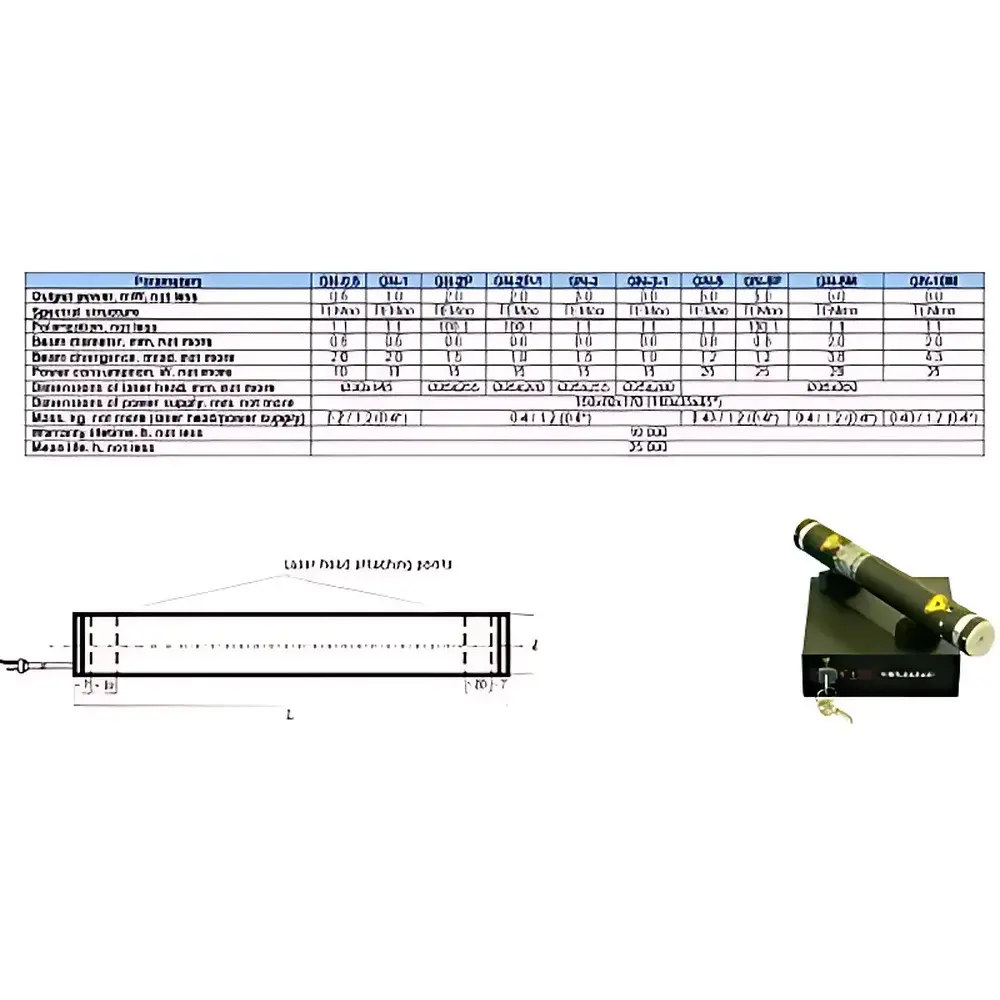
GN-5 Helium-Neon Laser, 632.8 nm Visible Wavelength
| Origin | Russia |
|---|---|
| Manufacturer Type | Authorized Distributor |
| Origin Category | Imported |
| Model | GN-5 |
| Pricing | Available Upon Request |
Overview
The GN-5 Helium-Neon (HeNe) laser is a continuous-wave (CW), gas-discharge laser engineered for high spectral purity and long-term amplitude stability in the visible spectrum. Operating at the fundamental transition wavelength of 632.8 nm (red), it leverages the well-characterized atomic emission line of neon atoms excited by electron collision in a helium–neon gas mixture. This laser adheres to standard cavity design principles—using a stable plano-concave resonator with dielectric mirrors optimized for >99.9% reflectivity at 632.8 nm and high-transmission output coupling—ensuring excellent temporal coherence (coherence length typically exceeding 20 cm) and low relative intensity noise (<0.1% RMS, 10 Hz–10 MHz). Its inherent mode stability (TEM00 output), narrow linewidth (<1.5 GHz), and minimal pointing drift (<5 µrad/°C) make it suitable for precision optical alignment, interferometry, holography, and calibration of spectrometers and photodetectors.
Key Features
- Stable single-longitudinal-mode (SLM) or multi-longitudinal-mode (MLM) operation depending on cavity length configuration—standard units deliver MLM output with typical power stability of ±1.5% over 8 hours at constant ambient temperature.
- Hermetically sealed glass plasma tube with integrated Brewster-angle windows and internal mirror coatings, eliminating external optical realignment requirements during service life.
- Low-noise power supply with regulated current drive (±0.01% ripple) and soft-start circuitry to suppress cathode sputtering and extend tube lifetime beyond 20,000 operating hours.
- Integrated thermal management via passive conduction cooling; no forced-air or water cooling required for nominal operation up to 40 °C ambient.
- Compliant with IEC 60825-1:2014 Class 3R safety classification when equipped with standard beam aperture and key-controlled interlock (optional).
Sample Compatibility & Compliance
The GN-5 laser is compatible with standard optomechanical mounts (e.g., Ø25 mm kinematic posts, SM1-threaded lens tubes) and interfaces directly with common optical tables, breadboards, and modular alignment platforms. It meets essential electromagnetic compatibility (EMC) requirements per EN 61326-1:2013 for laboratory instrumentation. While not certified to FDA 21 CFR Part 1040.10/1040.11 for medical device integration, its output characteristics align with ANSI Z136.1–2022 safety guidelines for non-medical laser use. For GLP/GMP environments, optional factory-installed beam shutter and TTL-compatible modulation input (0–5 V, rise time <100 ns) support audit-trail–capable process control integration.
Software & Data Management
The GN-5 operates as a standalone analog source and does not include embedded firmware or digital communication interfaces (e.g., USB, RS-232). However, its analog modulation input enables synchronization with external data acquisition systems (e.g., National Instruments DAQ, Thorlabs Kinesis) for time-resolved intensity monitoring or closed-loop stabilization. Users may log operational parameters—including runtime hours (via external hour meter), supply voltage, and ambient temperature—using standard SCADA or LabVIEW-based logging architectures. No proprietary software is required; all calibration and performance verification follow traceable NIST-traceable photometric protocols using calibrated silicon photodiodes (e.g., Hamamatsu S120VC) and power meters compliant with ISO/IEC 17025.
Applications
- Wavelength reference standard in metrology labs performing calibrations of CCD/CMOS array detectors and monochromator slit functions.
- Alignment source for large-aperture optical systems including astronomical telescope collimation and synchrotron beamline steering.
- Coherent illumination in undergraduate and graduate optics laboratories for Michelson, Mach–Zehnder, and Fabry–Pérot interferometer experiments.
- Seed source for frequency-doubling experiments using nonlinear crystals (e.g., BBO, LBO) targeting 316.4 nm UV generation.
- Reference beam in digital holographic microscopy (DHM) setups requiring sub-nanometer phase stability over acquisition windows ≥1 s.
FAQ
What is the typical warm-up time to achieve rated power stability?
The GN-5 reaches 95% of nominal output power within 15 minutes of cold start; full amplitude and pointing stability are achieved after 30 minutes under ambient conditions of 20–25 °C.
Is the laser polarization state specified and maintained?
Yes—the standard GN-5 delivers linear polarization with an extinction ratio ≥500:1, oriented parallel to the base mounting surface, and maintains this orientation across its specified operating temperature range (15–35 °C).
Can the GN-5 be operated in pulsed mode?
No—it is designed exclusively for CW operation; pulse modulation must be implemented externally using electro-optic or acousto-optic modulators.
Are replacement tubes available, and what is their expected lifetime?
Genuine replacement plasma tubes are available through authorized distribution channels and carry a minimum guaranteed lifetime of 20,000 hours under recommended operating conditions (≤25 mA discharge current, ≤35 °C ambient).
Does the unit include beam expansion or collimation optics?
No—beam delivery is provided as a raw Gaussian output (M² < 1.1, divergence ≈ 1.2 mrad); collimating lenses or beam expanders must be selected and mounted separately based on application-specific working distance and spot size requirements.




