
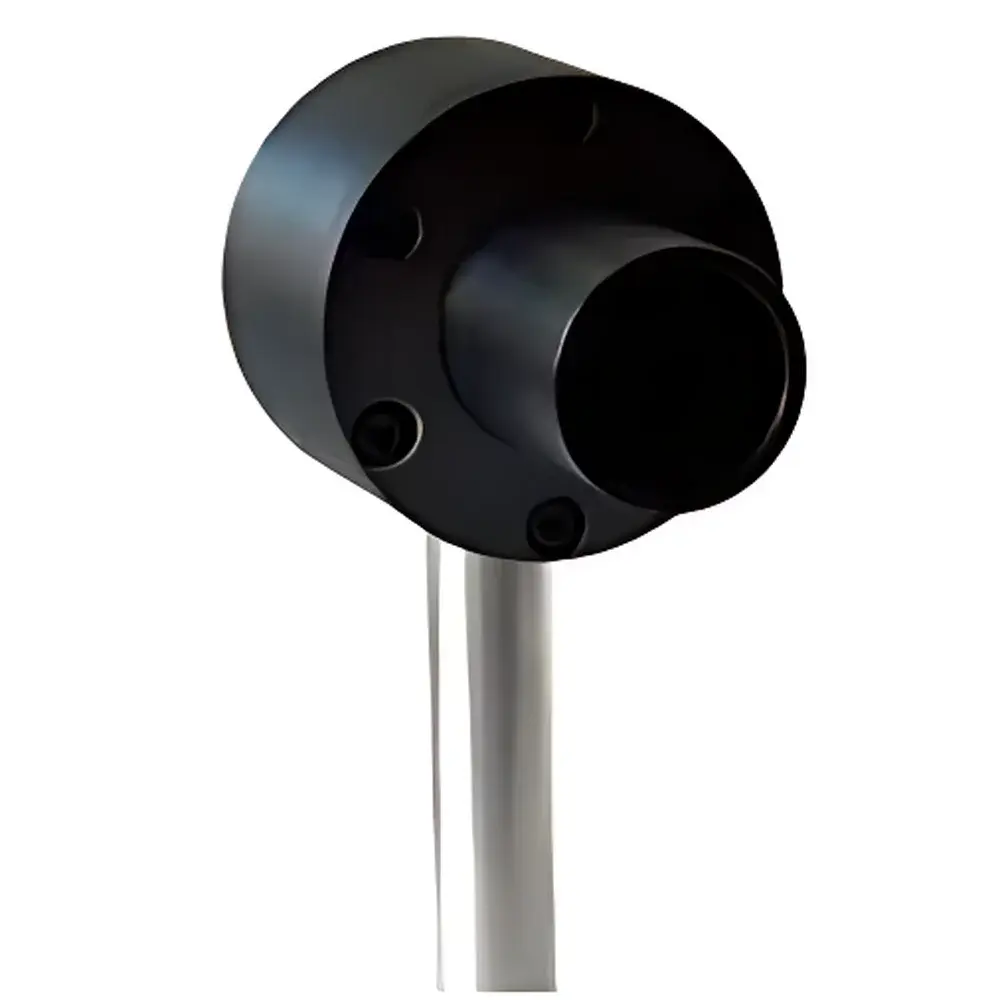
PyroScience Series HP High-Power Thermopile Power Meter
| Brand | PyroScience |
|---|---|
| Origin | Germany |
| Model | Series HP |
| Detector Type | Thermopile-based Optical Power Meter |
| Application | High-power & VUV Laser Measurement |
| Max. Average Power | Up to 150 W |
| Max. Power Density | Up to 200 W/cm² |
| Active Aperture | 25–50 mm Ø |
| Sensitivity Range | 70–150 mV/W (standard), 80–120 mV/W (VUV variant) |
| Output Interface | BNC |
| Vacuum Compatibility | KF-40 flange (VUV version) |
| Operating Environment | Ambient air or high-vacuum (VUV models) |
| Compliance | CE, RoHS, ISO/IEC 17025 traceable calibration available |
Overview
The PyroScience Series HP is a thermopile-based optical power meter engineered for precise, stable, and damage-resistant measurement of continuous-wave (CW) and quasi-CW laser radiation at high average power levels and extreme power densities. Unlike photodiode-based sensors, the Series HP employs a robust ceramic absorber layer optimized for thermal equilibrium and minimal reflectivity across UV–NIR spectral ranges—including deep vacuum ultraviolet (VUV) at 157 nm—making it suitable for excimer lasers, CO₂ systems, fiber lasers, and high-brightness diode stacks. Its core operating principle relies on the Seebeck effect: incident optical energy is absorbed by a blackened, thermally isolated ceramic surface; the resulting temperature gradient across a thermopile junction generates a proportional millivolt output signal linearly correlated to incident power. This architecture eliminates saturation effects common in semiconductor detectors and ensures long-term stability without active cooling under rated conditions.
Key Features
- Multiple head configurations: BB-25HP (25 mm Ø, 10 W), SHP-25 (25 mm Ø, 10 W), 25/50HP (25 mm Ø, 50 W), 50HP (50 mm Ø, 30 W), and 25/150 (25 mm Ø, 150 W) — each with calibrated sensitivity between 70–150 mV/W
- VUV-optimized variant (30 mm Ø aperture, KF-40 vacuum flange, BNC output) with 80–120 mV/W sensitivity and 30 W max. average power handling at 157 nm
- Ceramic absorber technology enabling uniform absorption >96% from 190 nm to 20 µm, low thermal drift (<0.1 %/°C), and resistance to laser-induced damage at up to 200 W/cm²
- Integrated thermal mass design ensuring time constants <2 seconds for standard heads and <5 seconds for high-power variants — compatible with both steady-state and pulsed (≥10 Hz rep rate) measurements
- Electromechanical isolation options (e.g., VST1N/VST2N preamplifiers with selectable gain ×10/×100/×1000 and 1 MΩ input impedance) for signal conditioning and noise reduction in EMI-prone environments
- Optional vibration isolation kit (PEM-30K) for ultra-stable mounting in optical tables or vacuum chambers
Sample Compatibility & Compliance
The Series HP supports direct measurement of collimated or focused beams within its specified aperture and power density limits. It is compatible with Class 4 laser systems operating in ambient air, nitrogen-purged enclosures, or high-vacuum environments (≤10⁻⁶ mbar) when equipped with KF-40 flanged versions. All detector heads are supplied with NIST-traceable calibration certificates (wavelength-specific: 193 nm, 248 nm, 308 nm, 1064 nm, etc.), conforming to ISO 11554 and DIN EN 60825-1 for laser product safety testing. For regulated laboratory environments, optional GLP-compliant audit trails and 21 CFR Part 11–enabled firmware upgrades are available via LEM 2420 and LM-100 readout units.
Software & Data Management
Readout is supported by three dedicated electronics modules: the LEM 2420 (USB-powered, dual-channel pulse energy + average power meter with PyroBox software), the PM-200 (standalone laser energy meter with 12-bit ADC and 10⁶ dynamic range), and the LM-100 (compact handheld unit with LCD display and auto-ranging). All units provide analog BNC output and digital USB/RS-232 interfaces. PyroSoft Professional software enables real-time data logging, statistical analysis (min/max/avg/std dev), pass/fail thresholding, and export to CSV, MATLAB (.mat), or HDF5 formats. Firmware supports configurable averaging windows (1–1000 samples), zero-offset compensation, and temperature-compensated linearity correction per calibration certificate.
Applications
- Industrial laser processing: monitoring output stability of kW-class fiber lasers used in welding, cladding, and additive manufacturing
- VUV lithography R&D: beam characterization of F₂ excimer lasers (157 nm) in cleanroom vacuum chambers
- Scientific laser labs: power verification of Ti:sapphire oscillators, OPOs, and quantum cascade lasers where photodiode saturation or thermal lensing compromises accuracy
- Medical device validation: QA/QC of dermatological and ophthalmic lasers requiring compliance with IEC 60601-2-22
- Optical component testing: damage threshold assessment of mirrors, windows, and coatings under high-fluence irradiation
FAQ
What is the minimum measurable power for the Series HP heads?
The detection threshold is application-dependent: standard heads resolve ≥10 mW; VUV-optimized variants achieve ≥5 mW under optimal signal conditioning with VST2N preamplifier.
Can the Series HP measure pulsed lasers?
Yes — provided pulse repetition rates exceed 10 Hz and duty cycle remains below 5%. For single-shot or low-rep-rate pulses, use the PM-200 readout with integrated energy integration mode.
Is recalibration required after exposure to vacuum?
No — KF-flanged VUV heads are designed for repeated vacuum cycling; however, annual recalibration is recommended per ISO/IEC 17025 guidelines to maintain metrological traceability.
How does the ceramic absorber compare to metal-coated thermopiles?
Ceramic layers offer superior spectral flatness, lower thermal inertia, and higher damage thresholds than traditional black nickel or gold-black coatings — particularly critical above 10 W/cm².
Which readout unit supports analog voltage logging at 1 kHz sampling?
The LEM 2420, when operated in analog streaming mode via USB, delivers synchronized 16-bit voltage data at up to 2 kHz sample rate with hardware timestamping.




