
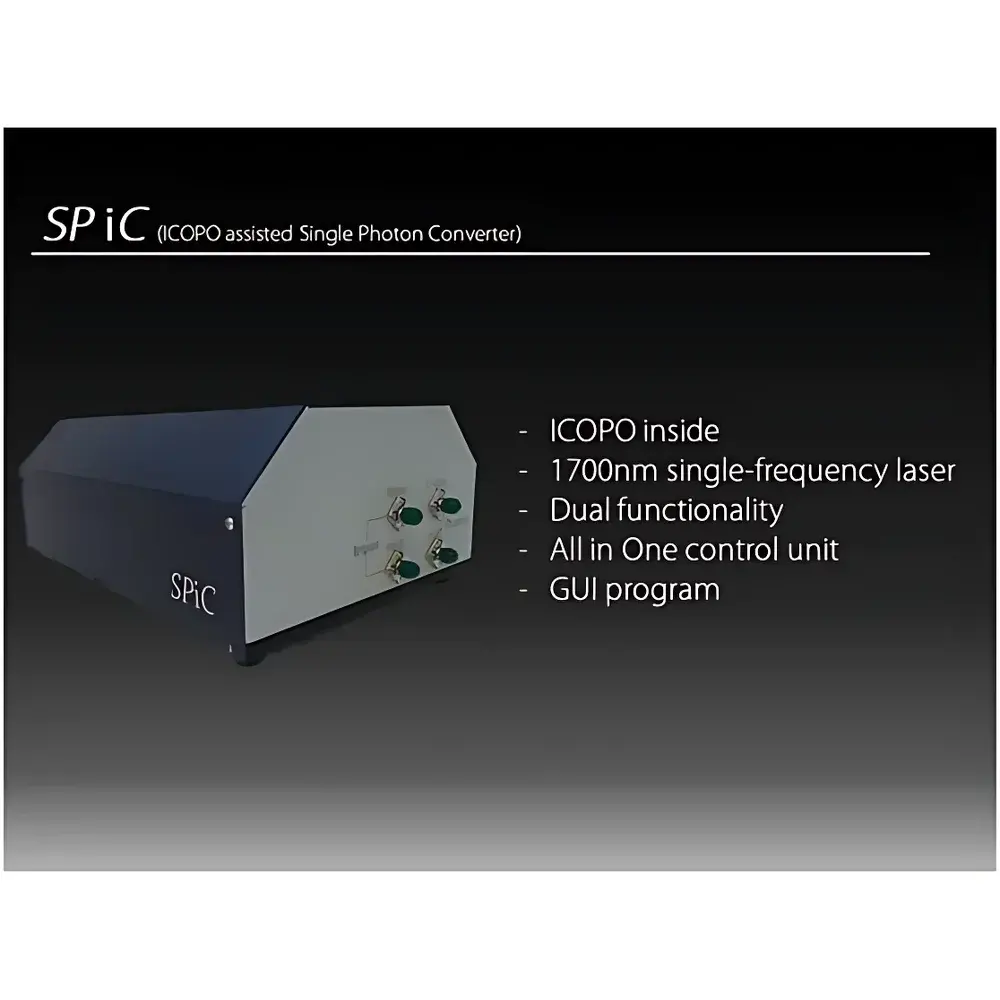
HCP SPIC Single-Photon Upconverter
| Brand | HCP |
|---|---|
| Model | SPIC |
| Origin | Taiwan |
| Type | OPO-Assisted Single-Photon Wavelength Converter |
| Input Wavelength | 1550 nm (single-photon level) |
| Output Wavelength | ~810 nm |
| Pump Source | Integrated 1700 nm single-frequency OPO |
| Waveguide | PPMgO:CLN |
| Input/Output Fiber | PMF (FC/APC) |
| Upconversion Efficiency | ~250 %/W (normalized, non-depleting regime) |
| Phase-Matching Tunability | ~0.25 nm/°C @ 1550 nm (20–60 °C) |
| OPO Linewidth | <100 MHz |
| OPO Power | ≤100 mW avg. |
| Polarization Extinction Ratio (PER) | >18 dB |
| Frequency Stability | <100 MHz / 5 min, <400 MHz / hr |
| TEC Max Current | 3 A |
| TEC Max Voltage | 3.2 V |
| ΔT<sub>max</sub> | 72 °C |
| Thermistor | 10 kΩ ±1% @ 25 °C, β = 3935 K |
| Total Power Consumption | <60 W |
| Operating Temp | 15–30 °C |
| Storage Temp | −10–70 °C |
| Humidity | 5–85% RH (non-condensing) |
Overview
The HCP SPIC Single-Photon Upconverter is an engineered quantum optical instrument designed for high-fidelity wavelength translation of telecom-band (1550 nm) single-photon signals into the visible–near-infrared detection window (~810 nm), where silicon-based single-photon avalanche diodes (SPADs) and intensified CCDs achieve peak quantum efficiency and timing resolution. This device implements sum-frequency generation (SFG) in a periodically poled magnesium oxide-doped congruent lithium niobate (PPMgO:CLN) waveguide, pumped by a co-integrated, thermally stabilized 1700 nm single-frequency optical parametric oscillator (OPO). The architecture eliminates external alignment dependencies and ensures deterministic photon–photon interaction under low-noise, phase-matched conditions. Unlike broadband upconversion schemes, the SPIC operates in a narrow-linewidth, polarization-maintaining configuration—critical for time-bin, polarization-encoded, and frequency-multiplexed quantum communication protocols.
Key Features
- Integrated 1700 nm single-frequency OPO with <100 MHz linewidth and active frequency stabilization (<100 MHz drift over 5 minutes)
- PPMgO:CLN waveguide with polarization-maintaining (PM) fiber pigtails: PM1150 input (1550 nm signal), PM780 output (810 nm upconverted light), FC/APC connectors at both ports
- Four-channel thermal management system: two independently controlled TECs for phase-matching tuning (via waveguide temperature), two for OPO frequency stabilization
- Onboard digital controller with USB interface and vendor-provided software for real-time temperature setpoint adjustment, lock-in monitoring, and log export
- Normalized upconversion efficiency of ~250 %/W measured under non-depleting pump conditions—enabling high signal-to-noise ratio without saturation artifacts
- Ruggedized benchtop enclosure with EMI-shielded electronics, passive vibration isolation mounts, and internal thermal buffering to maintain ambient stability (15–30 °C operational range)
Sample Compatibility & Compliance
The SPIC accepts standard 1550 nm single-photon pulses delivered via polarization-maintaining fiber, including those from attenuated laser diodes, quantum dot emitters, or spontaneous parametric down-conversion (SPDC) sources. Its PMF-coupled design preserves input polarization state—essential for polarization-sensitive quantum measurements. The device complies with IEC 61326-1 (electromagnetic compatibility for laboratory equipment) and meets RoHS 2015/863/EU material restrictions. While not certified for clinical or industrial safety standards (e.g., IEC 61010-1), its Class 1 laser product classification (per IEC 60825-1:2014) confirms safe operation under normal use conditions. Full traceability of thermal sensor calibration (10 kΩ NTC thermistors, β = 3935 K) supports GLP-aligned lab documentation requirements.
Software & Data Management
HCP provides a Windows-compatible control suite supporting both manual and script-driven operation via Python API (pySerial + JSON-RPC interface). The software enables synchronized logging of four TEC temperatures, OPO current/voltage, photodiode monitor readings, and timestamped status flags. All parameters are stored in human-readable CSV files with ISO 8601 timestamps and metadata headers—including firmware version, calibration date, and user-defined experiment ID. Audit trails are preserved locally; no cloud upload or telemetry occurs by default. For regulated environments, the software architecture permits integration with third-party electronic lab notebooks (ELNs) compliant with 21 CFR Part 11 when deployed on validated Windows workstations with role-based access controls.
Applications
- Quantum key distribution (QKD) systems requiring detection of 1550 nm photons using high-efficiency Si-SPADs at 810 nm
- Time-of-flight quantum LiDAR with sub-nanosecond jitter preservation across wavelength conversion
- Hybrid quantum networks interfacing fiber-based telecom infrastructure with atomic memory platforms (e.g., Rb vapor cells, trapped ions)
- Low-light fluorescence correlation spectroscopy (FCS) where upconverted emission avoids detector dark-count limitations
- Fundamental tests of quantum nonlocality using energy-time entangled photon pairs generated at 1550 nm
- Calibration transfer between NIST-traceable 1550 nm photonic standards and visible-wavelength radiometric references
FAQ
What is the maximum input power the SPIC can accept without damage or nonlinear distortion?
The device is optimized for single-photon-level inputs (typically <100 fW average power). Sustained input above −20 dBm may induce thermal lensing in the PPMgO:CLN waveguide or saturate the OPO gain medium. Operation beyond datasheet limits voids warranty and compromises phase-matching stability.
Is the upconversion process polarization-dependent?
Yes—the SPIC requires linearly polarized input aligned to the slow axis of the PM1150 input fiber. Misalignment exceeding 5° reduces efficiency by >30%. A polarization controller is recommended upstream for dynamic compensation.
Can the output wavelength be tuned across the 800–820 nm range?
No. Output wavelength is fixed by the SFG condition: λout−1 = λsignal−1 + λpump−1. With λsignal = 1550 nm and λpump ≈ 1700 nm, λout ≈ 810 nm. Minor shifts (<±0.5 nm) occur only via thermal tuning of the OPO center wavelength.
Does the SPIC support gated detection mode?
Not natively. The upconversion process is continuous-wave (CW) and non-gated. For time-gated applications, external electro-optic modulators or synchronized pump pulsing must be implemented externally.
What maintenance is required for long-term performance stability?
Annual verification of TEC thermal contact resistance and recalibration of thermistor lookup tables against NIST-traceable reference baths is recommended. No consumables or periodic alignment are required under stable environmental conditions.



