
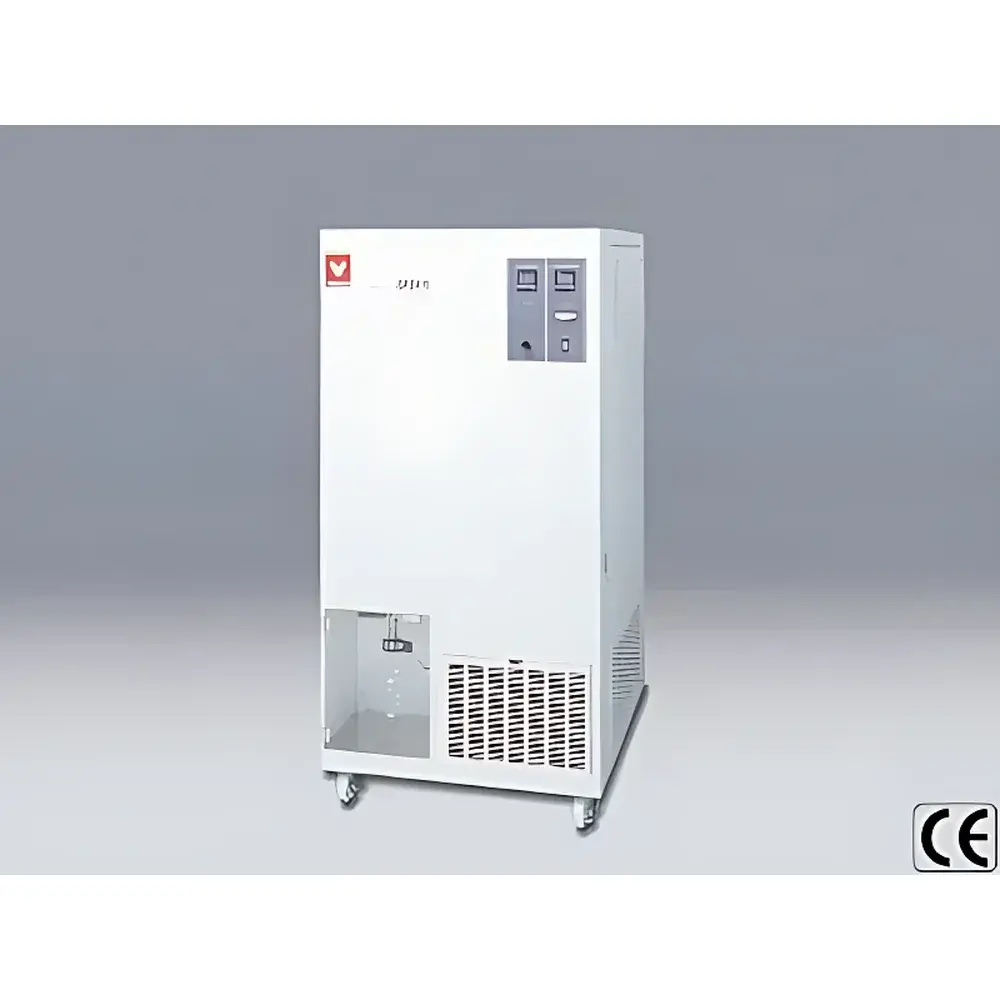
YAMATO GAS410 Organic Solvent Recovery System for Spray Dryers
| Brand | YAMATO |
|---|---|
| Origin | Japan |
| Model | GAS410 |
| Solvent Recovery Method | Condenser + Refrigerated Chiller |
| Carrier Gas | Nitrogen (N₂) |
| Circulating Airflow | 0.12–0.65 m³/min |
| Compressor Type | Linear Reciprocating (for atomization) |
| Blower Type | Roots-type Circulation Blower |
| Solvent Collection Vessel | 2 L Round-Bottom Flask |
| Chiller | Air-Cooled, Hermetic, 400 W, R404A Refrigerant |
| Condenser Cooling | Integrated Refrigerated Condensation |
| Filter Type | Cartridge Filter |
| Condenser Temperature Display | Digital Monitor |
| Filter Differential Pressure Gauge | Real-time Clogging Indicator |
| O₂ Concentration Monitor | Fuel-Cell-Based Sensor |
| Safety Interlocks | O₂ Analyzer, Combustible Gas Alarm, Overcurrent & Earth Leakage Protection, Automatic N₂ Purge on Nozzle Disconnection |
| N₂ Supply Requirement | 30 L/h at 0.2 MPa |
| Dimensions (W×D×H) | 710 × 950 × 1450 mm |
| Weight | Approx. 130 kg |
| Power Supply | AC 200–240 V, 5 A, 50/60 Hz |
| Accessories Included | Full Set of Interconnection Fittings, 2 L Collection Flask |
Overview
The YAMATO GAS410 Organic Solvent Recovery System is an engineered safety and sustainability solution designed exclusively for integration with YAMATO spray dryers—including the ADL311S-A, GB210-A, and DL410 models—operating with flammable or toxic organic solvents. It establishes a fully closed-loop nitrogen (N₂) inert atmosphere system, eliminating solvent vapor discharge to ambient laboratory environments. The core recovery principle relies on refrigerated condensation: process gas laden with solvent vapor is cooled below its dew point via a hermetically sealed R404A chiller (400 W) and a high-efficiency condenser, causing phase transition and liquid-phase collection in a standardized 2 L round-bottom flask. This thermodynamic approach enables safe handling of acetone, ethanol, methanol, ethyl acetate, chloroform, and other volatile organics while maintaining oxygen concentration below 8% v/v—well within the ASHRAE and NFPA 45 recommended inerting thresholds for Class I flammable liquids.
Key Features
- Hermetically sealed N₂ recirculation loop with real-time O₂ monitoring (fuel-cell sensor) and automatic purge activation upon nozzle disconnection
- Integrated air-cooled refrigeration unit (R404A, 400 W) delivering stable condenser surface temperatures down to –25 °C, optimized for high-boiling-point solvents
- Roots-type circulation blower ensures consistent volumetric flow (0.12–0.65 m³/min) across variable load conditions without pulsation
- Cartridge-type particulate filter with differential pressure monitoring provides continuous visual and digital indication of filter loading state
- Dedicated linear reciprocating compressor for precise, oil-free atomization air supply—eliminating contamination risk in sensitive pharmaceutical or fine chemical applications
- Comprehensive safety architecture compliant with IEC 61000-6-2 (EMC immunity) and IEC 61000-6-4 (EMC emissions), featuring dual-redundant overcurrent protection and earth leakage circuit interruption
Sample Compatibility & Compliance
The GAS410 supports thermolabile, oxidation-sensitive, and low-melting-point materials—including APIs, polymers, nanocellulose dispersions, and bioactive peptides—by enabling spray drying at inlet temperatures as low as 40 °C under nitrogen. Its design adheres to ISO 14001 environmental management principles through near-quantitative solvent recovery (>92% typical for ethanol, >88% for acetone per ASTM D5236 standard test conditions). All electrical components meet UL 61010-1 and EN 61010-1 safety requirements for laboratory equipment. Oxygen monitoring and combustible gas detection subsystems satisfy NFPA 86 (2023) Class A oven safety mandates for inert-atmosphere processing. Data logging capabilities support GLP-compliant audit trails when interfaced with validated third-party SCADA systems.
Software & Data Management
While the GAS410 operates via analog-digital hybrid controls (rotary airflow adjustment, LED-based parameter displays), it features RS-485 Modbus RTU output for integration into centralized lab automation platforms. All critical parameters—including condenser temperature, O₂ concentration (% v/v), filter ΔP (kPa), and blower current—are time-stamped and exportable as CSV files via optional USB data logger module (sold separately). The oxygen sensor calibration protocol follows ISO 17025 traceable procedures, with certificate-of-calibration available upon request. For FDA-regulated environments, the system can be configured with 21 CFR Part 11-compliant electronic signatures and audit trail modules through YAMATO’s certified LabLink software suite (requires separate validation package).
Applications
- Pharmaceutical formulation: Lyophilization-grade nanoparticle synthesis using dichloromethane or tert-butanol without solvent loss or explosion hazard
- Functional food ingredient encapsulation: β-carotene, omega-3 oils, or anthocyanins dried under O₂ < 5% to prevent oxidative degradation
- Advanced battery material processing: Cathode precursors (e.g., NMC, LFP) dried from NMP slurries with >90% solvent recovery and zero atmospheric release
- Specialty polymer production: Poly(lactic acid) microspheres prepared from ethyl acetate solutions with minimal thermal history
- Academic research labs: Reproducible solvent-based particle engineering under controlled inert atmospheres per ASTM E2913 guidelines
FAQ
What nitrogen purity is required for optimal GAS410 operation?
Industrial-grade N₂ (≥99.5% purity, dew point ≤ –40 °C) is sufficient; higher purity is not necessary but will not impair performance.
Can the GAS410 be retrofitted to non-YAMATO spray dryers?
Yes—with engineering review of interface dimensions, gas coupling specifications, and control signal compatibility; custom manifold kits are available upon request.
Is the 2 L collection flask autoclavable?
The standard borosilicate glass flask is autoclavable at 121 °C; alternative PTFE-lined or quartz variants are offered for aggressive solvents.
How often must the cartridge filter be replaced?
Under continuous operation with particulate-laden feeds, replacement is recommended every 200–300 hours; the ΔP gauge alerts at ≥15 kPa differential.
Does the system include validation documentation for GMP use?
Factory-installed IQ/OQ protocols are provided; PQ execution requires site-specific testing per user-defined process parameters and must be performed by qualified personnel.



