
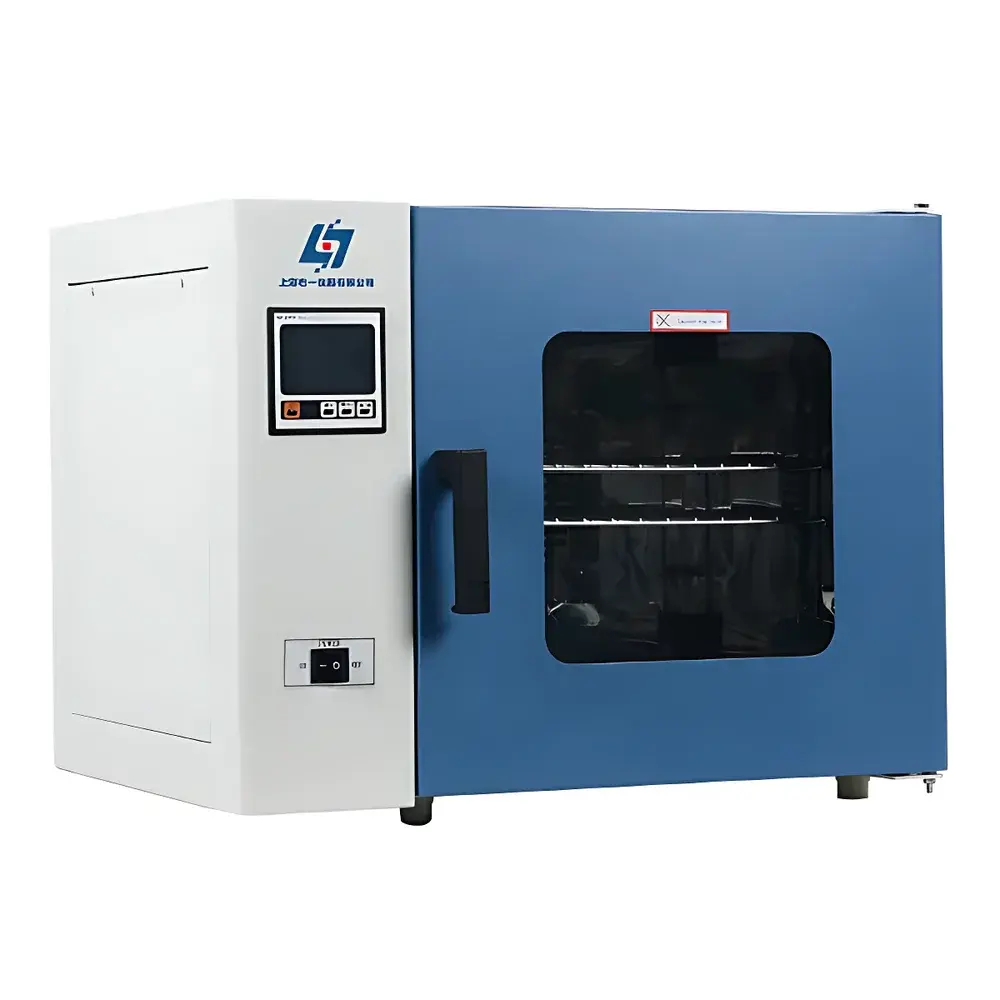
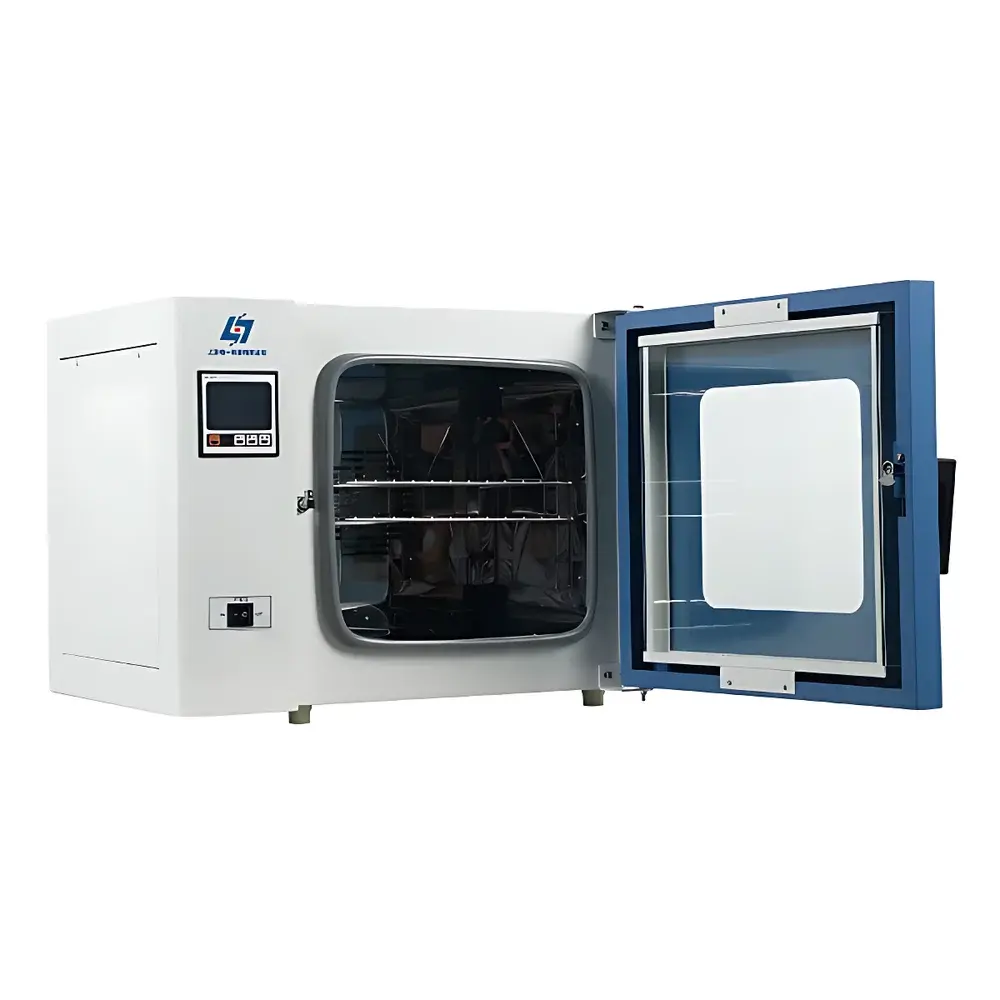
Yoyi DHG-9070A Forced-Air Constant-Temperature Drying Oven
| Brand | Yoyi |
|---|---|
| Origin | Shanghai, China |
| Manufacturer Type | Direct Manufacturer |
| Product Category | Domestic |
| Model | DHG-9070A |
| Instrument Type | General-Purpose Drying Oven |
| Temperature Range | RT+10°C to 250°C |
| Temperature Uniformity | ±2.5% (at 100°C) |
| Temperature Fluctuation | ±1.0°C |
| Temperature Resolution | 0.1°C |
| External Dimensions (W×D×H) | 735×615×630 mm |
| Internal Chamber Dimensions (W×D×H) | 450×400×450 mm |
| Internal Chamber Material | Mirror-Finish Stainless Steel (SUS304) |
| Heating Method | Electric Resistance Heating |
| Power Consumption | 1550 W |
| Rated Voltage/Frequency | AC 220 V / 50 Hz |
| Operating Ambient Temperature | +5°C to +40°C |
| Load Capacity | 80 L |
| Standard Shelf Quantity | 2 adjustable stainless steel shelves |
| Timer Range | 1–9999 minutes |
| Compliance | GB/T 30435–2013 |
Overview
The Yoyi DHG-9070A is a precision-engineered forced-air constant-temperature drying oven designed for reproducible thermal processing in research laboratories, quality control environments, and industrial R&D settings. Based on convective heat transfer principles, the unit employs a rear-mounted centrifugal blower and optimized air duct architecture to ensure uniform airflow distribution across the entire chamber volume. This design enables stable thermal equilibrium with minimal spatial deviation—validated per GB/T 30435–2013 under no-load conditions at 100°C (±2.5% uniformity). The oven operates within a calibrated temperature range of RT+10°C to 250°C, supporting applications including moisture removal, polymer curing, pre-weighing sample conditioning, sterilization of glassware, and thermal stability testing of pharmaceutical excipients and electronic components.
Key Features
- Microprocessor-based PID temperature controller with intuitive LCD menu interface—displays setpoint, real-time chamber temperature, elapsed time, and remaining hold duration simultaneously
- Dual-layer tempered glass observation window with anti-fog coating, enabling non-intrusive visual monitoring without thermal disturbance
- Mirror-finish SUS304 stainless steel interior chamber and adjustable stainless steel shelving—resistant to corrosion, easy to clean, and compliant with GLP cleaning validation protocols
- High-efficiency hot-air circulation system featuring rear-mounted axial fan and symmetrically arranged inlet/outlet vents—minimizes thermal stratification and accelerates equilibration
- Robust cold-rolled steel outer casing with electrostatic epoxy-polyester powder coating—provides mechanical durability and resistance to laboratory chemical exposure
- High-temperature silicone door gasket ensures tight sealing up to 250°C, reducing energy loss and enhancing safety during extended operation
- Independent over-temperature cut-off circuit (optional)—meets IEC 61000-4-2 ESD immunity requirements and provides fail-safe interruption if primary control fails
- Auto-recovery function retains user-defined parameters after power interruption—eliminates manual reconfiguration and supports unattended overnight runs
Sample Compatibility & Compliance
The DHG-9070A accommodates a broad spectrum of sample types—including Petri dishes, weighing bottles, crucibles, glass vials, ceramic substrates, and PCB assemblies—without risk of cross-contamination or material degradation. Its stainless steel chamber complies with ISO 8573-1 (compressed air purity) for inert-gas purged configurations (optional), and its thermal performance aligns with ASTM E145–22 (Standard Specification for Gravity-Convection and Forced-Ventilation Ovens). When equipped with RS485 communication and optional data logging software, the system supports 21 CFR Part 11-compliant audit trails for regulated environments. All electrical components conform to CE marking directives (2014/30/EU EMC, 2014/35/EU LVD), and the unit is certified to GB/T 30435–2013 for safety, metrological accuracy, and operational reliability.
Software & Data Management
While the base configuration includes standalone microcontroller operation, optional digital interfaces enable integration into centralized lab informatics infrastructure. The RS485 port (optional) supports Modbus RTU protocol for bidirectional communication with SCADA systems or LIMS platforms. An embedded thermal printer (optional) generates timestamped hardcopy records of temperature profiles, start/stop events, and alarm logs—critical for ISO/IEC 17025 accreditation. For advanced process control, the programmable temperature controller (optional) allows up to 30 segments with ramp-soak-hold functionality, facilitating complex thermal cycles such as desiccation followed by controlled cooling. All firmware updates are performed via secure USB interface, and parameter changes are logged with operator ID and timestamp when audit mode is enabled.
Applications
- Pharmaceutical: Residual solvent removal from APIs, moisture content determination per USP <921>, stability-indicating assay preconditioning
- Materials Science: Curing of epoxy resins, aging studies of elastomers, outgassing characterization of composites
- Food & Agriculture: Moisture analysis of grains and dairy powders per AOAC 950.46, shelf-life acceleration testing
- Electronics: Pre-bake of PCBs prior to solder paste application, desiccation of hygroscopic components before packaging
- Academic Research: Sample preparation for SEM/TEM, ashing of biological tissues, calibration standard conditioning
- Environmental Testing: Drying of filter membranes post-particulate collection (EPA Method 201A), soil moisture gravimetry
FAQ
What is the maximum operating temperature and how is it verified?
The DHG-9070A is rated for continuous operation up to 250°C. Temperature calibration is traceable to NIM (National Institute of Metrology, China) standards, with factory verification conducted using Class A Pt100 probes per JJG 205–2005.
Can this oven be used for sterilization of surgical instruments?
No. While the unit achieves temperatures sufficient for dry-heat sterilization (160–180°C for 2 hours), it lacks validated bioburden reduction certification (e.g., ISO 17665) and does not meet EN 285 requirements for medical device sterilizers.
Is the internal chamber volume truly 80 liters?
Yes—the nominal capacity is calculated geometrically from internal dimensions (450 × 400 × 450 mm) and confirmed by water displacement test per GB/T 30435 Annex B.
Does the oven support inert atmosphere operation?
Yes—when fitted with the optional inert gas inlet kit (including needle valve and rotameter), users can maintain nitrogen or argon atmospheres to prevent oxidation during thermal treatment of sensitive materials.
How often should temperature uniformity be re-verified in routine use?
Per ISO/IEC 17025 Clause 6.4.8, uniformity mapping should be performed at installation, after major maintenance, and at least annually—using nine-point thermocouple mapping per ASTM E145 Annex A3.



