
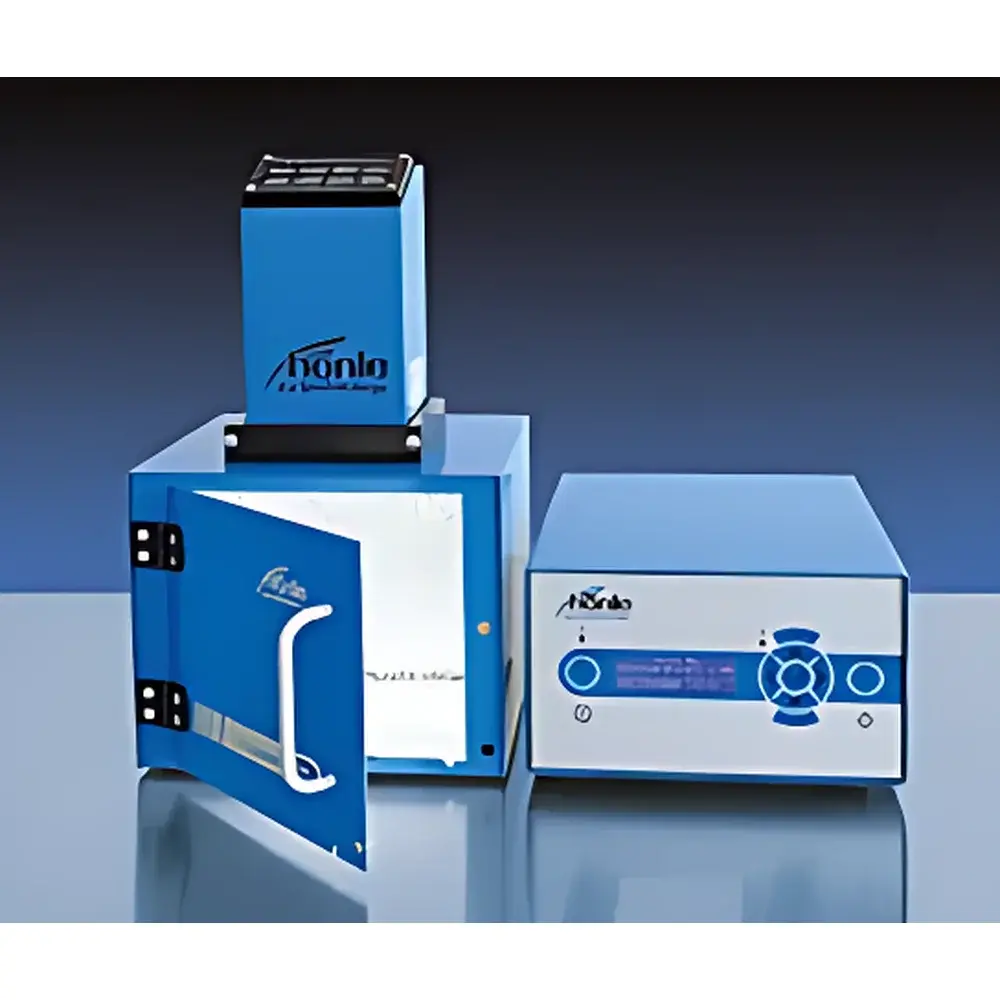
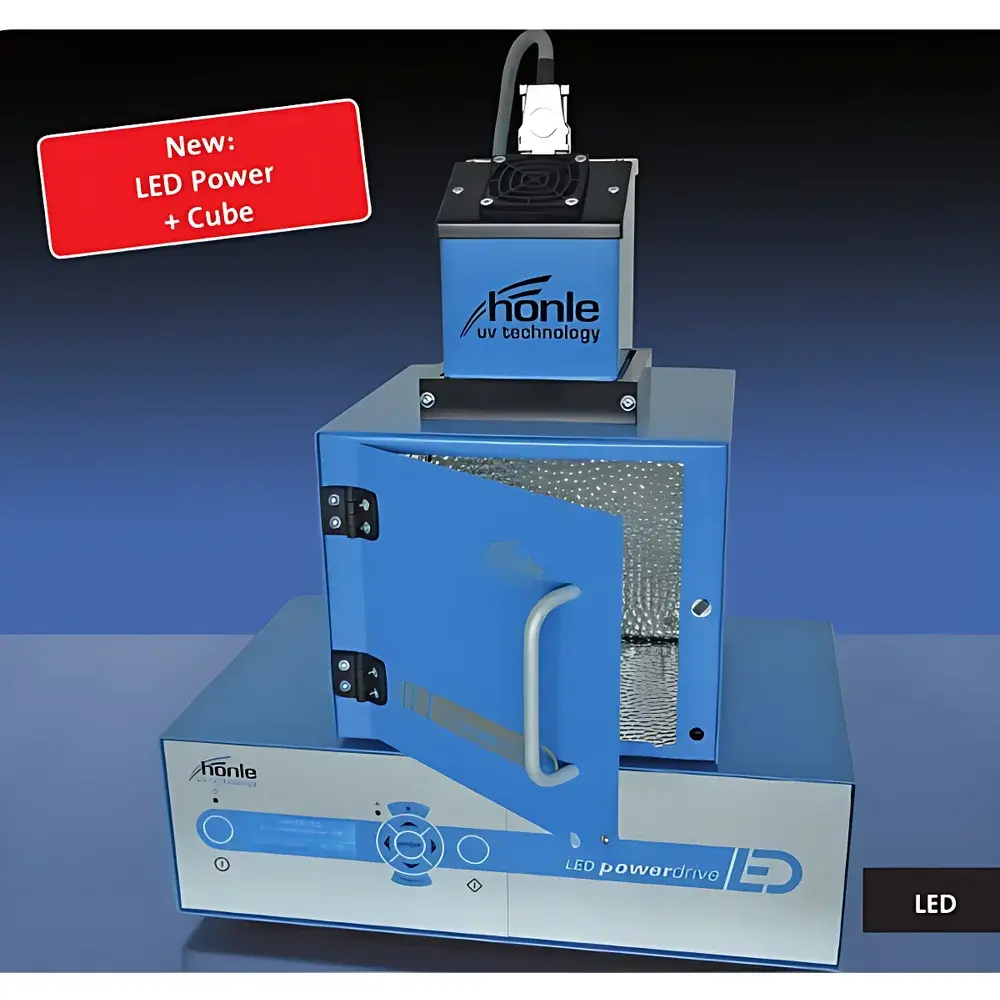
Honle LED CUBE 100 IC UV Aging Test Chamber
| Brand | Honle |
|---|---|
| Origin | Germany |
| Model | LED CUBE 100 IC |
| Irradiation Time Range | 0.01–9999 s |
| Effective Irradiation Area | 180 × 180 mm |
| Maximum Irradiance | 3000 mW/cm² |
| Humidity Range | up to 95% RH |
| Illumination Temperature | 25 °C |
| Black Panel Temperature | 25 °C |
| UV Wavelength Options | 365 nm, 385 nm, 395 nm, 405 nm, 460 nm (±10 nm) |
| Chamber Internal Dimensions (L×W×H) | 180 × 180 × 180 mm |
Overview
The Honle LED CUBE 100 IC is a compact, high-precision UV aging test chamber engineered for controlled photochemical exposure in R&D laboratories and low-volume production environments. Unlike conventional mercury-vapor or fluorescent UV sources, this system employs solid-state LED technology operating across five discrete, user-selectable wavelengths—365 nm, 385 nm, 395 nm, 405 nm, and 460 nm—with spectral tolerance of ±10 nm. Its core principle relies on narrowband, cold-source irradiation, eliminating infrared (IR) emission and enabling stable, non-thermal UV exposure critical for temperature-sensitive substrates such as polymers, optical adhesives, biofilms, and microelectronics. The chamber’s 180 × 180 × 180 mm internal volume supports small-format samples or carrier plates, while its reflective interior geometry and optimized emitter array ensure spatial irradiance uniformity ≥90% across the full 180 × 180 mm active area (per ISO 4892-3 Annex B verification methodology). With no warm-up or cooldown delay, the system delivers immediate, repeatable irradiation onset—essential for time-resolved photostability studies and accelerated aging protocols aligned with ASTM G154, ISO 11341, and IEC 61215 standards.
Key Features
- Five independently selectable UV/visible LED wavelengths (365, 385, 395, 405, 460 nm), each with dedicated driver and thermal management
- Precise irradiance control from 1% to 100% of maximum output (up to 3000 mW/cm² with LED Spot 100 HP IC module)
- Three programmable irradiation time modes: 0.01–99.99 s (10-ms resolution), 0.1–999.9 s (100-ms resolution), and 1–9999 s (1-s resolution), plus continuous operation
- Integrated safety interlock: UV emission ceases instantly upon door opening, complying with IEC 60825-1 Class 1 laser product safety requirements
- Real-time monitoring of LED operational hours, elapsed exposure time, and chamber surface temperature (black panel sensor)
- No IR emission—enables testing of thermally labile materials without thermal degradation artifacts
- Modular lamp design: field-replaceable LED Spot 100 IC (low-intensity) or LED Spot 100 HP IC (high-intensity) modules, rated for >20,000 hours at nominal drive current
Sample Compatibility & Compliance
The LED CUBE 100 IC accommodates flat, rigid, or mounted specimens up to 180 mm × 180 mm × 180 mm—including PCBs, optical lenses, medical device components, adhesive-coated films, and coated solar cell substrates. Its absence of convective heating eliminates forced-air artifacts, supporting evaluation under isothermal conditions per ISO 4892-3 Clause 7.2. The system meets functional requirements for UV stability assessment referenced in USP , ISO 10993-12 (biocompatibility), and ASTM D4329 (plastic degradation). While not a certified environmental chamber per IEC 60068-2-5, its humidity capability (≤95% RH) allows combined light/humidity stress testing when integrated with external climate control units. All firmware logs—including irradiance setpoints, exposure duration, LED channel activation, and thermal readings—are timestamped and exportable for GLP/GMP audit trails.
Software & Data Management
Operation is managed via an integrated front-panel keypad with LCD status display; no PC dependency is required for basic function execution. Optional RS-485 or USB-C interface enables remote command via SCPI-compatible protocol for integration into automated test sequences. System firmware records cumulative LED operating hours per wavelength channel and stores the last 100 exposure events with parameters and timestamps. Data export is supported in CSV format for post-processing in MATLAB, Python, or LIMS platforms. Firmware adheres to traceability principles outlined in FDA 21 CFR Part 11 for electronic records—user access levels, audit logs, and parameter change history are retained for ≥36 months.
Applications
- UV-curable adhesive curing validation and shelf-life prediction in optoelectronics assembly
- Photostability screening of pharmaceutical packaging films per ICH Q1B guidelines
- Accelerated yellowing and gloss loss testing of automotive interior polymers
- Photo-oxidative degradation kinetics of organic photovoltaic (OPV) layers
- UV resistance qualification of medical-grade silicone tubing and hydrogel coatings
- Calibration and verification of UV radiometers and spectroradiometers (NIST-traceable reference source)
FAQ
Does the LED CUBE 100 IC comply with ASTM G154 Cycle 1 or Cycle 4?
Yes—the system supports irradiance profiles matching ASTM G154-22 Annex A2 for UVA-340 simulation (via 365 nm + 385 nm combination) and can be programmed to replicate timed UV/dark cycles when synchronized with external controllers.
Can irradiance uniformity be verified in-house?
Yes—Honle provides a NIST-traceable calibration certificate for each LED module, and users may validate spatial uniformity using a calibrated UV radiometer (e.g., International Light ILT2400) following ISO 4892-3 Annex B procedures.
Is the chamber suitable for humidity-controlled UV aging?
The internal humidity range reaches 95% RH, but precise dynamic humidity control requires integration with an external humidification system; the CUBE 100 IC serves as the irradiation subsystem in such hybrid configurations.
What is the warranty coverage for LED modules?
Honle offers a 24-month limited warranty on LED emitters against luminous flux decay exceeding 20% under specified drive conditions and ambient temperature ≤25°C.
How is traceability maintained for regulatory submissions?
All exposure events generate immutable log entries including operator ID, timestamp, wavelength selection, irradiance %, exposure duration, and black panel temperature—exportable as CSV for inclusion in 510(k), CE Technical File, or PMDA dossiers.



