
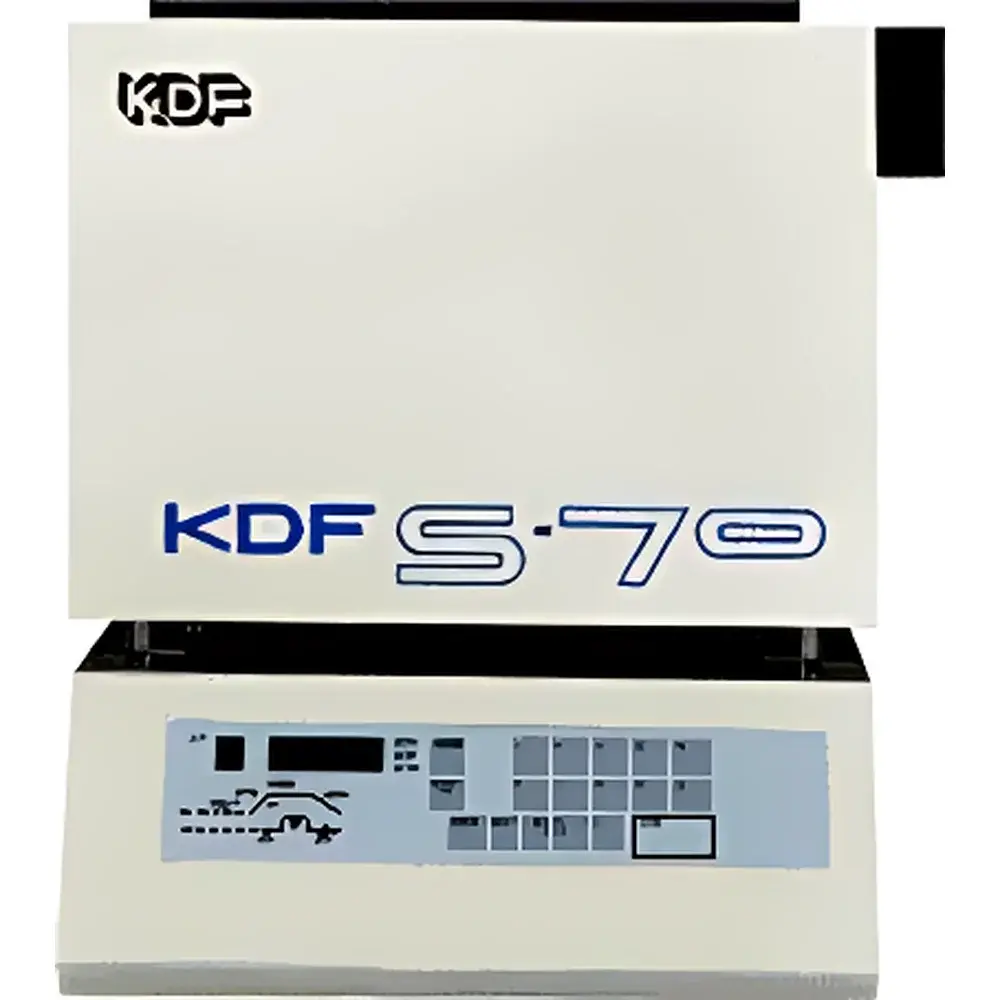
KDF S100G Desktop Muffle Furnace
| Brand | KDF |
|---|---|
| Origin | Japan |
| Instrument Type | Box-Type Muffle Furnace |
| Maximum Temperature | 1100 °C |
| Temperature Control Accuracy | ±3 °C at 1000 °C |
| Rated Power | 8.0 kW |
| Heating Rate to Max Temp | 49 min |
| Heating Method | Resistance Wire Heating |
| Internal Chamber Dimensions (W×H×D) | 350 mm × 300 mm × 500 mm |
| Chamber Volume | 52.5 L |
| Temperature Control | PID with Auto-Tuning |
| Programmable Steps | 9 Presets (up to 4 combinable as “Casting Ring” sequences) |
| Gas Inlet Option | Standard N₂ flow (20 L/min for S100G model) |
| Safety Systems | Dual Thermocouple Monitoring, Over-Temperature Cut-off, Fan-Activated Cooling, Current Overload Protection, Microcontroller Self-Diagnostic |
Overview
The KDF S100G Desktop Muffle Furnace is a high-performance, benchtop-compatible box-type furnace engineered for precise thermal processing in research laboratories, quality control environments, and advanced materials development facilities. Designed according to JIS and IEC 61000-4 electromagnetic compatibility standards, it employs resistive heating via Kanthal AF alloy heating elements (Al ~6%, Cr ~23%, Fe ~71%) embedded in dual-sided chamber walls, ensuring uniform thermal distribution and long service life. The furnace operates under ambient atmosphere by default (S-series), while the G-series variant integrates a factory-calibrated gas inlet module—standard-equipped with 20 L/min nitrogen supply—for controlled inert or reducing atmospheres during sintering, debinding, annealing, or ashing. Its core temperature regulation architecture utilizes digital PID control with real-time auto-tuning, dynamically adjusting proportional-integral-derivative constants to maintain stability across load variations, chamber fill volume changes, and extended dwell cycles. This enables reproducible thermal profiles critical for ISO 17025-accredited testing labs and GLP-compliant material qualification workflows.
Key Features
- Robust ceramic fiber insulation (JIS-compliant composition) providing thermal efficiency and low external surface temperature (<60 °C at 1100 °C operation)
- Dual JIS K-type thermocouples—one for control, one for independent safety monitoring—ensuring redundancy and traceability
- Microprocessor-based controller with 9 programmable thermal profiles; up to four profiles can be chained into a single multi-segment “Casting Ring” sequence for complex ramp-hold-cool-gas-purge cycles
- Gas inlet system pre-configured for nitrogen (20 L/min standard on S100G), compatible with optional mass flow controllers and exhaust scrubbers (e.g., ES72S/VF72S)
- Comprehensive safety suite: over-temperature cut-off, current overload breaker, rear-panel thermal sensor, fan-triggered cooling activation, and microcontroller self-diagnostics covering heater open-circuit, thermocouple failure, memory corruption, and ramp deviation alerts
- Front-panel interface with large LED display, intuitive parameter navigation, and dedicated terminals for external recorder output, gas unit power, and odor removal system integration
Sample Compatibility & Compliance
The S100G accommodates diverse sample geometries and compositions—including ceramic green bodies, metal powders, polymer-matrix composites, catalyst precursors, and biological ashing crucibles—within its 52.5 L chamber (350 × 300 × 500 mm internal dimensions). Its ±3 °C uniformity at 1000 °C meets ASTM E220 calibration requirements for furnace qualification, while the 0.5 °C temperature resolution supports USP thermal validation protocols. The furnace complies with IEC 61010-1 for laboratory electrical safety and supports audit-ready operation under FDA 21 CFR Part 11 when paired with validated data logging software (via optional analog/digital output modules). Optional accessories—including KDW-200 reinforced workbenches, KDG-100 gas distribution manifolds, and ES72S catalytic odor abatement units—extend operational compliance for ISO 14001 environmental management systems.
Software & Data Management
While the S100G operates autonomously via its embedded controller, it provides analog (mV) and digital (RS-485 Modbus RTU) interfaces for integration into centralized lab automation platforms. The built-in thermocouple output terminal allows direct connection to third-party chart recorders or LIMS-compatible DAQ systems. All program parameters—including ramp rates (°C/min), hold durations (0–99 h 59 min), setpoint temperatures (100–1100 °C), gas injection triggers, and soak stabilization criteria—are stored non-volatilely and support version-controlled backup via USB export (optional adapter). Audit trails—including start/stop timestamps, operator ID input fields, deviation alarms, and manual override logs—are retained for 30 days and align with GLP documentation requirements for thermal process validation.
Applications
- Ceramic sintering and crystallization (e.g., alumina, zirconia, SiC)
- Superconducting oxide phase formation (YBCO, BSCCO)
- Thermal debinding of metal injection molded (MIM) and ceramic injection molded (CIM) parts
- Controlled ashing of organic matrices per AOAC 942.05 and EPA Method 3050B
- Heat treatment of tool steels, stainless alloys, and nickel-based superalloys (annealing, stress relieving)
- Glass fusing, devitrification studies, and borosilicate annealing
- Pre-oxidation of titanium alloys and nitridation of silicon wafers under N₂ atmosphere
FAQ
What is the maximum recommended continuous operating temperature?
The S100G is rated for continuous use up to 1000 °C; 1100 °C is specified as short-term maximum (≤2 hours per cycle) to preserve heating element longevity.
Can the furnace be used under vacuum or hydrogen atmosphere?
No—the S/SG series is designed exclusively for ambient or inert gas (N₂, Ar) environments; vacuum or reactive gas operation requires specialized furnace models with sealed flanges and explosion-proof construction.
Is the temperature uniformity validated across the entire chamber volume?
Yes—uniformity is certified per ASTM E220 Annex A3 using nine-point mapping at 1000 °C; full validation reports are available upon request.
How does the auto-tuning function adapt to changing thermal loads?
The controller executes a step-response analysis during initial ramp-up, then continuously updates PID coefficients based on real-time error integral and derivative terms, maintaining stability even with variable crucible mass or density.
Are firmware updates supported remotely?
Firmware upgrades require local USB connection and KDF-certified engineering tools; remote update capability is not implemented to ensure regulatory compliance and system integrity.



