
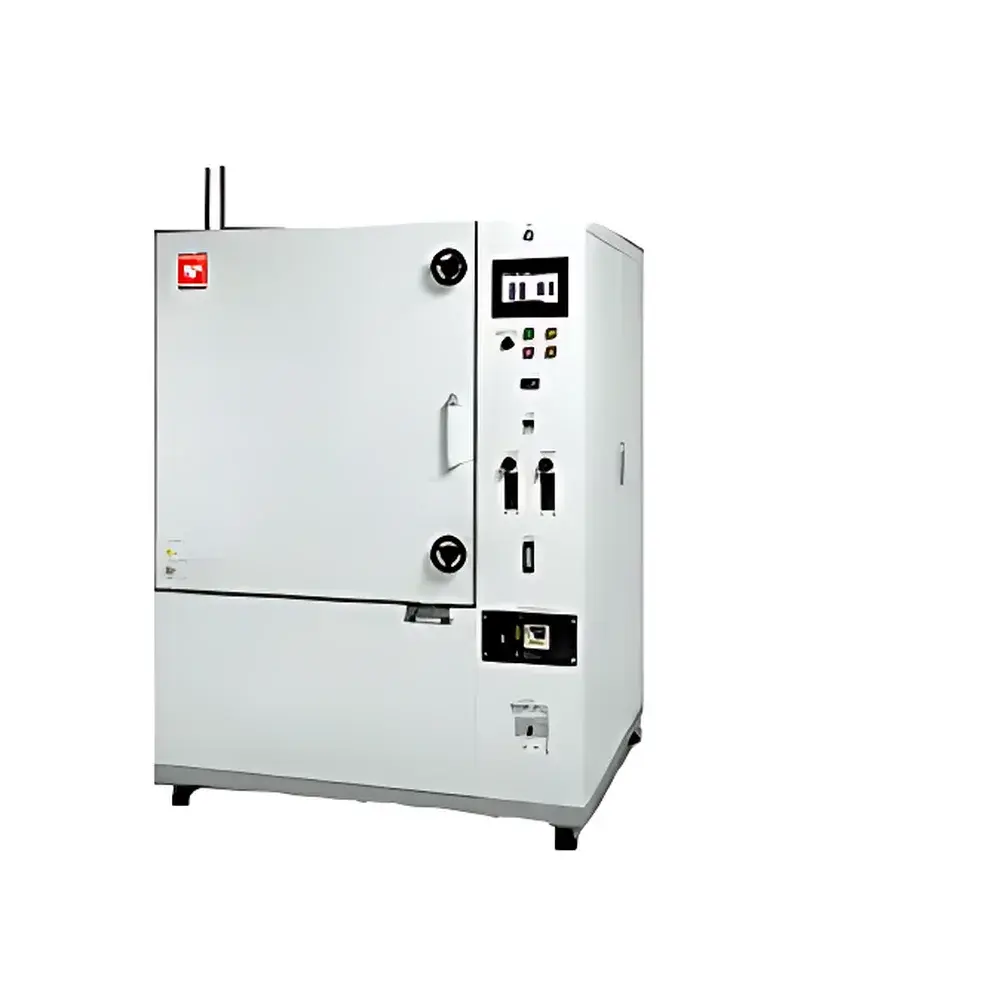
YAMATO DNN430C Anaerobic High-Temperature Atmosphere Furnace
| Brand | YAMATO |
|---|---|
| Origin | Japan |
| Model | DNN430C |
| Instrument Type | High-Temperature Atmosphere Furnace |
| Temperature Range | Ambient + 50 °C to 360 °C |
| Temperature Uniformity | ±0.5 °C |
| External Dimensions | 1090 × 950 × 1540 mm |
| Internal Chamber Dimensions | 450 × 450 × 450 mm |
| Chamber Material | Stainless Steel (SUS304) |
| Heating Method | Forced Convection with Recirculating Hot Air |
| Atmosphere Control | N₂-purged, O₂ < 20 ppm |
| Sealing Mechanism | Magnetic Door Seal with Water-Cooled Flange |
| Cooling System | Integrated Water-Cooled Jacket & Exhaust Gas Condensation Trap |
| Control Interface | 7-inch TFT LCD Touchscreen |
| Operating Modes | Auto Program / Manual Setpoint |
| Safety Systems | Dual-Stage Door Interlock, Overtemperature Cut-off (Independent PID), O₂ Sensor Alarm, N₂ Pressure/Flow Monitoring, Coolant Flow Detection, Leak Sensor, Earth Leakage Circuit Breaker (ELCB) |
Overview
The YAMATO DNN430C is a precision-engineered anaerobic high-temperature atmosphere furnace designed for controlled thermal processing under ultra-low oxygen conditions. It operates on the principle of inert gas displacement and dynamic pressure-balanced sealing to maintain an oxygen concentration below 20 ppm throughout the entire thermal cycle — from ambient soak to maximum operating temperature of 360 °C. Unlike standard drying ovens or muffle furnaces, the DNN430C integrates a closed-loop nitrogen purge architecture with real-time O₂ monitoring, water-cooled magnetic door sealing, and forced convection heating to ensure both atmospheric integrity and thermal homogeneity. Its chamber geometry (450 × 450 × 450 mm) and stainless-steel construction (SUS304) support repeatable, contamination-free processing of sensitive materials in R&D and pilot-scale manufacturing environments.
Key Features
- Ultra-low oxygen environment: Achieves and sustains ≤20 ppm O₂ via programmable N₂ flow control, integrated electrochemical O₂ sensor, and leak-tight magnetic door seal with water-cooled flange.
- Thermal performance: Forced convection heating system ensures ±0.5 °C temperature uniformity across the full working volume; ramp rates are fully adjustable from 0.1 to 10 °C/min.
- Dual-mode operation: Intuitive 7-inch TFT touchscreen interface supports both automated multi-step thermal profiles and manual setpoint control with real-time parameter logging.
- Integrated safety architecture: Includes redundant overtemperature protection (independent mechanical and electronic cut-offs), door interlock switches, N₂ supply pressure and flow verification, coolant flow monitoring, liquid leak detection, and ELCB-compliant electrical isolation.
- Process sustainability: Standard condensate recovery unit cools and collects volatile byproducts from thermal decomposition (e.g., organics in LTCC binder burnout), minimizing exhaust emissions and supporting lab compliance with local VOC handling guidelines.
Sample Compatibility & Compliance
The DNN430C accommodates substrates and components up to 400 × 400 × 400 mm, including ceramic green tapes, LTCC laminates, glass wafers, semiconductor packaging carriers, and metal oxide precursors. Its stainless-steel chamber and inert atmosphere prevent oxidation, carbon deposition, or intermetallic diffusion during annealing, debinding, and sintering steps. The system conforms to fundamental requirements of ISO 17025-accredited laboratories for thermal process validation and supports traceable calibration per ASTM E220 and IEC 60584-2. While not certified for Class I Div 1 hazardous locations, its safety subsystems align with EN 61000-6-2 (EMC immunity) and EN 61000-6-4 (EMC emission) standards. Full audit trails — including temperature, O₂ concentration, N₂ flow, and alarm events — are timestamped and exportable for GLP/GMP documentation.
Software & Data Management
The embedded controller logs all critical process variables at user-selectable intervals (1–60 seconds) and stores ≥10,000 hours of data internally. CSV export via USB port enables post-run analysis in Excel or MATLAB. Optional RS-485 Modbus RTU or Ethernet TCP/IP interface allows integration into centralized SCADA or MES platforms for batch record linkage and remote supervision. All parameter changes, alarm triggers, and mode transitions are time-stamped with operator ID (if network-authenticated), satisfying basic FDA 21 CFR Part 11 requirements for electronic records when deployed with institutional IT governance policies.
Applications
- Low-Temperature Co-fired Ceramic (LTCC) processing: Controlled organic binder removal without blistering or warpage.
- Electronic component annealing: Stress relief and metallization stabilization for thick-film resistors, hybrid IC substrates, and MEMS packaging.
- Glass substrate heat treatment: Edge-strengthening, stress-relief annealing, and low-temperature crystallization without surface oxidation.
- Ceramic powder debinding: Solvent-free thermal extraction of PVB, PMMA, or wax-based binders from injection-molded green bodies.
- Research-scale catalyst activation: Pre-reduction of transition metal oxides under reproducible reducing atmospheres prior to catalytic testing.
FAQ
What is the typical time required to reach <20 ppm O₂ from ambient air?
Typically 15–25 minutes depending on initial chamber load and N₂ supply pressure (recommended ≥0.4 MPa); faster achievement is possible with optional pre-purge module.
Can the DNN430C be operated continuously at 360 °C?
Yes — rated for indefinite operation at maximum temperature, provided cooling water flow meets specification (≥3 L/min at 15–25 °C inlet) and ambient room temperature remains ≤30 °C.
Is third-party calibration certification available?
YAMATO provides factory calibration certificates (NIST-traceable thermocouples and O₂ sensor); accredited third-party calibration services (e.g., A2LA-certified labs) can be arranged through authorized distributors.
Does the system support custom gas mixtures beyond nitrogen?
The base configuration is optimized for N₂; H₂/N₂ or forming gas (5% H₂/95% N₂) operation requires optional explosion-proof modifications, dedicated gas train, and safety interlock upgrades — consult technical sales for feasibility assessment.
How is maintenance access structured for the heating elements and circulation fan?
Front-access service panels allow full replacement of heating banks and impeller assemblies without chamber disassembly; preventive maintenance intervals are defined in the Operation Manual (Section 7.2) and aligned with ISO 13374 condition monitoring guidelines.



