
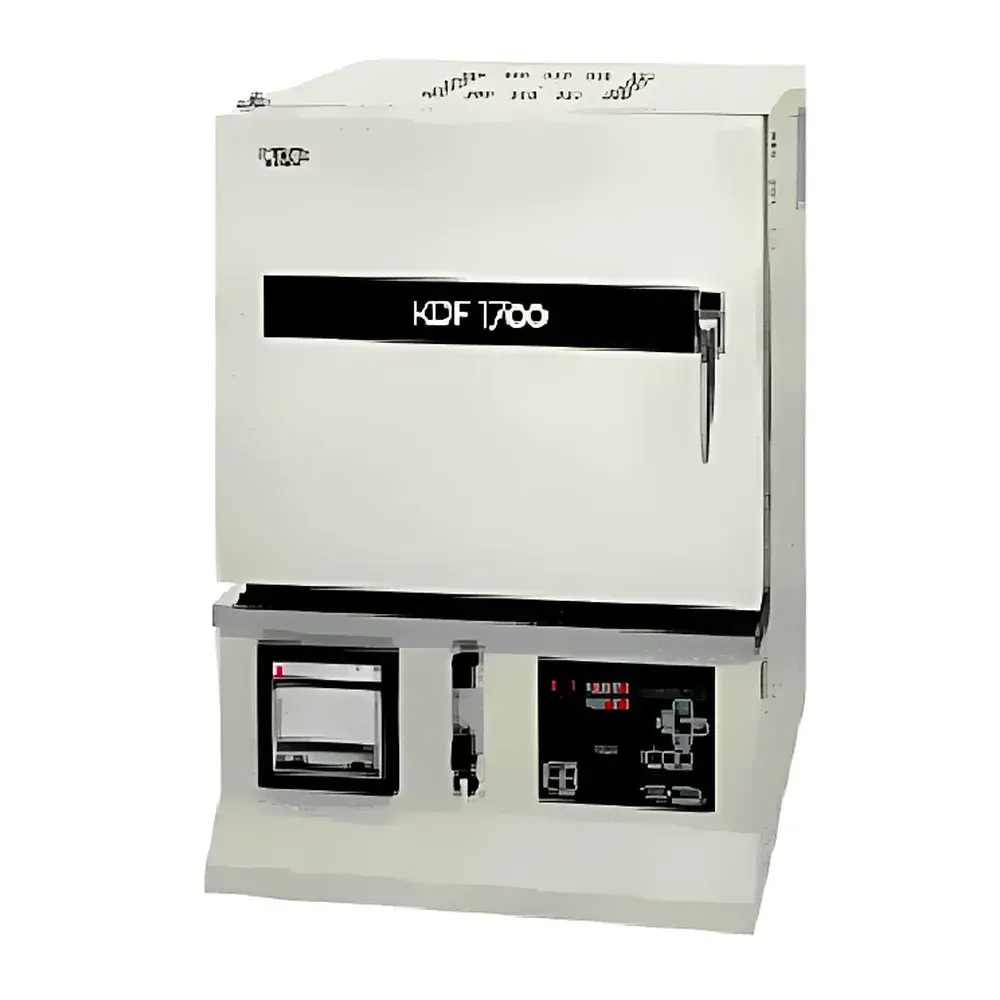
KDF KDF-1700 Desktop High-Temperature Muffle Furnace
| Brand | KDF |
|---|---|
| Origin | Japan |
| Model | KDF-1700 |
| Instrument Type | Box-Type Muffle Furnace |
| Maximum Temperature | 1700 °C |
| Usable Temperature Range | 600–1700 °C |
| Typical Operating Temperature | 1600 °C |
| Heating Rate (RT → 1700 °C) | 65 min (no casting ring, 50 Hz) |
| Rated Power | 6 kW |
| Chamber Dimensions | 200 (W) × 230 (H) × 260 (D) mm |
| External Dimensions | 560 (W) × 830 (H) × 630 (D) mm |
| Heating Element | 10 rods of Molybdenum Disilicide (MoSi₂), rated to 1800 °C |
| Insulation | Ceramic Fiber |
| Temperature Control | PID with 3 preset PID parameter sets |
| Thermocouple Type | JIS Class B (B-type, 400–1800 °C) |
| Programmable Steps | 19 programs, up to 30 segments per program |
| Safety Systems | Door interlock, leakage current breaker, over-temperature protection, thermal fuse, auto-cooling fan shutdown, thermocouple/open-heater fault detection, abnormal temperature rise monitoring |
| Output Options | 5-channel programmable event outputs, alarm contact outputs, start/stop control terminals, momentary power-loss recovery, relay contact outputs |
| Optional Accessories | Temperature recorder (100-mm chart width), gas introduction unit with programmable electromagnetic flowmeter (gas type & flow rate customizable), 20-mm socket holder (KDW-200) |
Overview
The KDF KDF-1700 Desktop High-Temperature Muffle Furnace is a precision-engineered laboratory box furnace designed for demanding thermal processing applications in advanced materials research. Operating on the principle of resistive heating via high-stability molybdenum disilicide (MoSi₂) elements, it delivers stable, uniform, and contamination-free heating environments up to 1700 °C — suitable for sintering, annealing, calcination, and heat treatment of ceramics, refractory metals, oxide-based composites, and next-generation functional materials. Its compact external footprint (560 × 830 × 630 mm) houses an unusually spacious chamber (200 × 230 × 260 mm), enabling efficient batch processing of crucibles, substrates, and custom fixtures without compromising thermal homogeneity. The furnace is engineered for continuous operation at 1600 °C — its recommended maximum sustained temperature — ensuring long-term element integrity and repeatable thermal profiles across extended experimental campaigns.
Key Features
- High-reliability MoSi₂ heating system: 10 parallel rods rated to 1800 °C, providing rapid thermal response and exceptional longevity under cyclic high-temperature loads.
- Ceramic fiber insulation architecture: Low thermal mass and low heat loss, contributing to energy efficiency and precise thermal ramp control.
- Advanced PID temperature regulation: Three independent PID parameter sets allow optimization for distinct heating phases (e.g., slow ramp through phase transitions, dwell stabilization, controlled cooling).
- Comprehensive programmability: 19 stored programs, each supporting up to 30 time-temperature segments — sufficient to replicate complex thermal cycles required by ASTM C1171 (ceramic sintering), ISO 17885 (refractory testing), or proprietary material development protocols.
- Multi-layer safety architecture: Integrated door interlock prevents operation when unsealed; thermal fuses and over-temperature cut-offs operate independently of the main controller; real-time diagnostics monitor thermocouple continuity, heater integrity, and abnormal thermal drift.
- Fail-safe operational logic: Automatic power cutoff upon fan failure, thermocouple break, or uncontrolled temperature excursion; momentary power interruption recovery preserves program state and resumes from last valid segment.
Sample Compatibility & Compliance
The KDF-1700 accommodates standard alumina, zirconia, and graphite crucibles (up to Φ80 mm × 100 mm height), as well as custom sample holders mounted on ceramic supports. Its muffle design ensures atmospheric isolation — compatible with inert (Ar, N₂), reducing (H₂/N₂ mix), or vacuum-compatible configurations when paired with optional gas introduction modules. While not certified to UL/CSA as a standalone appliance, the furnace meets IEC 61000-6-3 (EMC emission) and IEC 61000-6-2 (immunity) standards. Its control architecture supports audit-ready operation under GLP and GMP frameworks when used with optional chart recorders or validated data logging systems compliant with FDA 21 CFR Part 11 requirements.
Software & Data Management
The front-panel interface provides real-time visualization of setpoint, measured temperature, program step number, elapsed time, and active safety status — eliminating ambiguity during unattended runs. All alarms and fault conditions are logged with timestamps and displayed as plain-text codes (e.g., “TC_OPEN”, “HEATER_BREAK”). Optional analog/digital outputs enable integration into centralized lab automation platforms (e.g., LabVIEW, DeltaV, or Siemens Desigo). The 100-mm strip-chart recorder option provides permanent, tamper-evident thermal history documentation — essential for regulatory submissions and inter-laboratory method transfer. Event-triggered relay outputs can initiate auxiliary actions: gas valve sequencing, exhaust activation, or camera triggering for in-situ thermal imaging correlation.
Applications
- Sintering of advanced ceramics (Al₂O₃, SiC, ZrO₂, BaTiO₃) and ultra-high-temperature ceramics (UHTCs) such as HfC and TaC.
- Thermal stability assessment of battery cathode materials (e.g., NMC, LFP) and solid electrolytes under controlled atmospheres.
- Heat treatment of metal-organic framework (MOF) derivatives and carbonized precursors for catalyst support development.
- Crystallization studies of glass-ceramics and phase-separation behavior in multicomponent oxide systems.
- Calibration and verification of high-temperature reference materials (e.g., melting points of Pt, Pd, Ni) per ISO/IEC 17025 guidelines.
- Pre-oxidation of silicon carbide fibers and thermal aging of aerospace-grade composites.
FAQ
What is the recommended maintenance interval for the MoSi₂ heating elements?
Under continuous operation at ≤1600 °C with proper atmosphere control, MoSi₂ elements typically maintain calibration stability for 1,500–2,000 hours. Visual inspection for surface pitting or localized thinning is advised every 500 operating hours.
Can the KDF-1700 be operated under vacuum or reduced pressure?
The standard configuration is not vacuum-rated. For sub-atmospheric applications, a dedicated vacuum-muffle variant with flanged ports and reinforced sealing is required — contact technical support for KDF-V series compatibility.
Is the B-type thermocouple included with the furnace?
Yes — a JIS Class B thermocouple is factory-installed and calibrated. Replacement sensors must conform to JIS C 1602:2020 specifications for B-type (Pt–30%Rh / Pt–6%Rh) construction.
Does the furnace support remote monitoring via Ethernet or USB?
No native digital communication port is provided. Integration requires third-party analog-to-digital signal conditioning or use of the programmable contact outputs with external PLC or DAQ systems.
What is the typical temperature uniformity across the chamber at 1600 °C?
Measured per ASTM E220, radial uniformity is ±8 °C and axial uniformity is ±12 °C within the central 70% volume (140 × 161 × 182 mm) under steady-state conditions.
Related Products



