
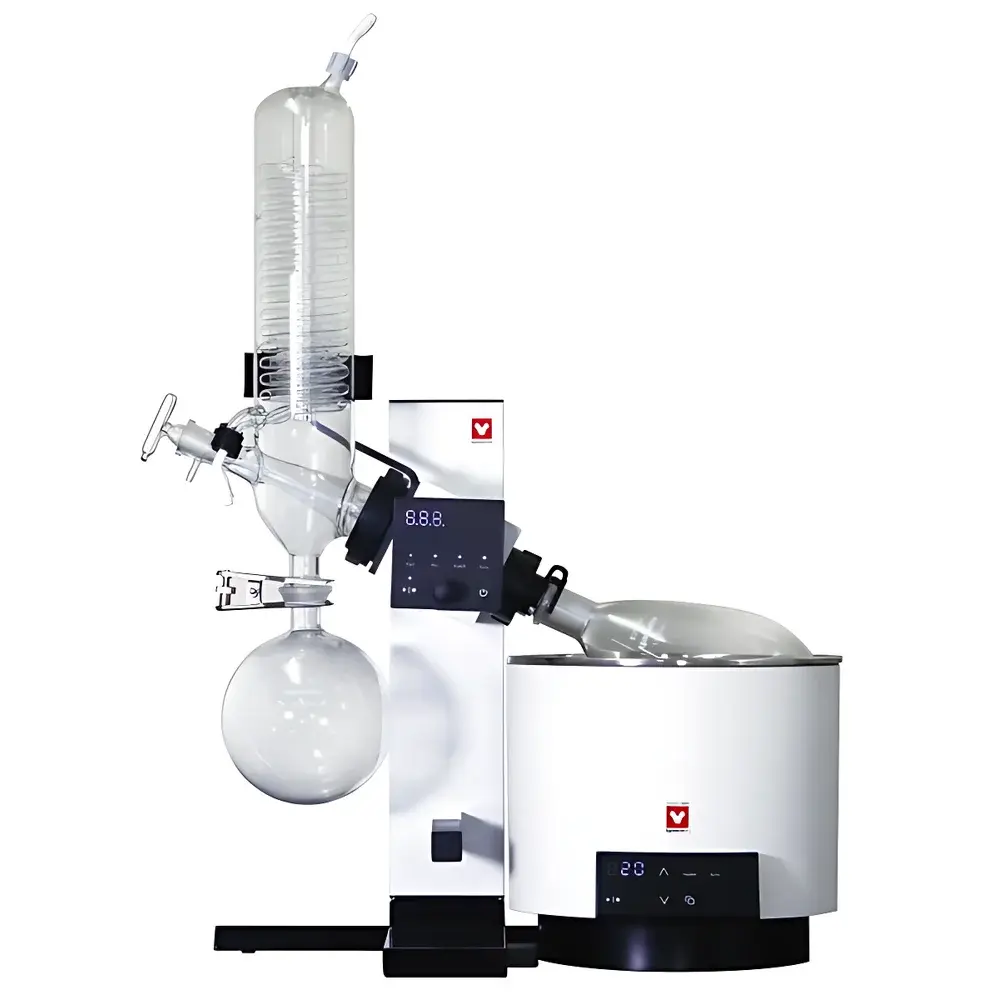
YAMATO RE212 Rotary Evaporator
| Brand | YAMATO |
|---|---|
| Origin | Japan |
| Model | RE212 |
| Capacity | 1 L |
| Ultimate Vacuum | < 399.9 Pa |
| Rotation Speed | 5–315 rpm |
| Bath Temperature Range | Ambient to 180 °C |
| Temperature Control Accuracy | ±1 °C |
| Condenser Cooling Area | 0.11 m² |
| Motor Type | DC Servo Motor |
| Lift Stroke | 200 mm |
| Rotation Direction Modes | Forward / Reverse / Auto-Alternating |
| Power Supply | 100–240 V AC, 50/60 Hz |
| Condenser Design | Dual Helical Coil (Type A/B/E) |
| Insulation | Standard Thermal Barrier on All Condensers |
| Safety Features | Condenser Locking Bracket (B/E), Inlet Tube Protective Sleeve (B) |
Overview
The YAMATO RE212 Rotary Evaporator is an entry-level, space-optimized benchtop system engineered for reliable solvent removal and concentration of heat-sensitive samples under reduced pressure. It operates on the fundamental principle of rotary evaporation—simultaneous application of vacuum, controlled bath heating, and sample rotation—to increase surface area and accelerate evaporation while minimizing thermal degradation. Designed specifically for laboratories with limited fume hood depth or footprint constraints, the RE212 integrates a low-profile condenser assembly (mounting height optimized for standard 750 mm-deep hoods), manual vertical lift mechanism, and modular glassware compatibility. Its core architecture emphasizes mechanical robustness, electrical safety across global voltage standards, and operational flexibility—making it suitable for routine purification in academic teaching labs, QC environments, and small-scale R&D settings where reproducibility, ease of maintenance, and regulatory traceability are prioritized over automated workflow integration.
Key Features
- Compact footprint and low condenser mounting height (≤350 mm from base) enabling seamless installation within standard laboratory fume hoods.
- DC servo motor drive delivering precise, stepless speed control from 5 to 315 rpm with high torque stability at low speeds and minimal vibration at elevated rotation rates.
- Manual lift system with 200 mm vertical travel range, facilitating intuitive flask positioning and rapid glassware exchange without actuator calibration or pneumatic dependency.
- Tri-mode rotation logic: forward-only, reverse-only, and programmable auto-alternating direction—enhancing mixing efficiency for viscous or heterogeneous solutions and reducing bumping risk during distillation onset.
- 360° rotatable control panel with high-contrast white LED display, ensuring optimal visibility under varied lighting conditions and ergonomic access regardless of bench orientation.
- Universal power input (100–240 V AC, 50/60 Hz) compliant with IEC 61000-4 electromagnetic compatibility standards, eliminating need for external transformers in multi-country deployments.
- Dual-helical condenser design (standard on all A/B/E configurations) providing extended vapor path length and uniform cooling distribution across boiling point ranges from low-boiling solvents (e.g., diethyl ether, bp 34.6 °C) to higher-boiling media (e.g., ethylene glycol, bp 197 °C).
Sample Compatibility & Compliance
The RE212 accommodates standard ISO-K 29/32 and ISO-K 24/29 ground-glass joints, supporting interchangeable 1 L round-bottom flasks and matching condensers. Its bath temperature range (ambient to 180 °C) permits use with both water and silicone oil media, with ±1 °C thermal regulation accuracy verified per ASTM E220 calibration protocol. The system meets IEC 61010-1:2010 safety requirements for laboratory electrical equipment and incorporates passive thermal insulation on all condenser surfaces to suppress ambient condensation—a critical factor in humidity-controlled cleanrooms or GLP-compliant facilities. While the RE212 itself does not include digital audit trail or electronic signature capabilities, its analog control architecture ensures full mechanical transparency, supporting manual logbook-based documentation aligned with FDA 21 CFR Part 11 Annex A expectations for non-automated systems.
Software & Data Management
The RE212 operates via a dedicated analog control interface with no embedded microprocessor or network connectivity. All operational parameters—including rotation speed, bath temperature setpoint, and direction mode—are adjusted manually and displayed locally on the LED screen. This design eliminates firmware dependencies, cybersecurity vulnerabilities, and software validation overhead. Users maintain full traceability through handwritten or spreadsheet-based batch records referencing time-stamped parameter entries, consistent with ISO/IEC 17025 Clause 7.7 (control of technical records) and USP analytical instrument qualification frameworks for Class A equipment. Optional external data loggers (e.g., certified thermocouple-based bath temperature monitors) may be integrated for enhanced process verification in GMP environments.
Applications
- Solvent recovery and sample concentration in organic synthesis workflows (e.g., post-reaction workup of Grignard or Suzuki coupling products).
- Removal of volatile extraction solvents (hexane, chloroform, acetone) from natural product isolates prior to HPLC analysis.
- Preparative-scale dehydration of heat-labile biomolecules—including peptides and labile glycosides—under mild vacuum and controlled thermal input.
- Concentration of aqueous polymer dispersions and colloidal suspensions where shear-induced aggregation must be minimized via low-rpm operation.
- Teaching laboratory demonstrations of phase equilibria, Raoult’s law deviations, and vacuum-driven boiling point depression principles.
FAQ
Does the RE212 support automatic vacuum control or pressure ramping?
No. Vacuum level must be regulated externally using a compatible vacuum controller or two-stage diaphragm pump with manual throttle valve.
Can the RE212 be used with corrosive solvents such as concentrated HCl or bromine-containing compounds?
Only with chemically resistant glassware (e.g., borosilicate 3.3) and appropriate PTFE-coated seals; standard rubber gaskets are incompatible. Consult YAMATO Chemical Resistance Guide prior to deployment.
Is the 1 L flask capacity rated for full-volume operation at maximum bath temperature?
Yes, provided the flask is no more than 50% filled to prevent foaming over and ensure adequate headspace for vapor expansion under vacuum.
What maintenance intervals are recommended for the DC servo motor and bath heater?
Motor requires no scheduled lubrication; annual visual inspection of carbon brushes is advised. Bath heater calibration should be verified semiannually using a NIST-traceable thermometer.
Are replacement parts—such as condenser gaskets or lift mechanism bushings—available through authorized distributors?
Yes. YAMATO maintains a global spare parts catalog with ≥5-year component availability for RE212 hardware, including OEM-specified Viton® and PTFE sealing kits.



