
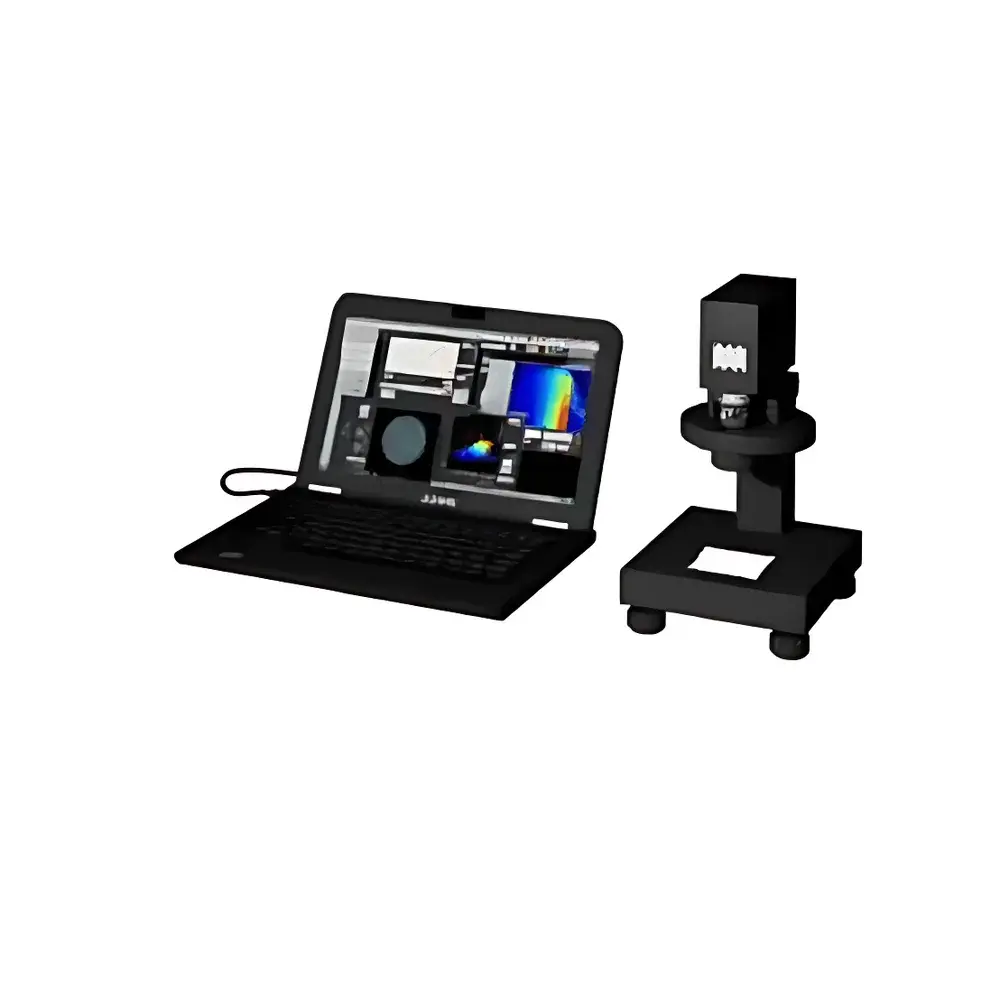
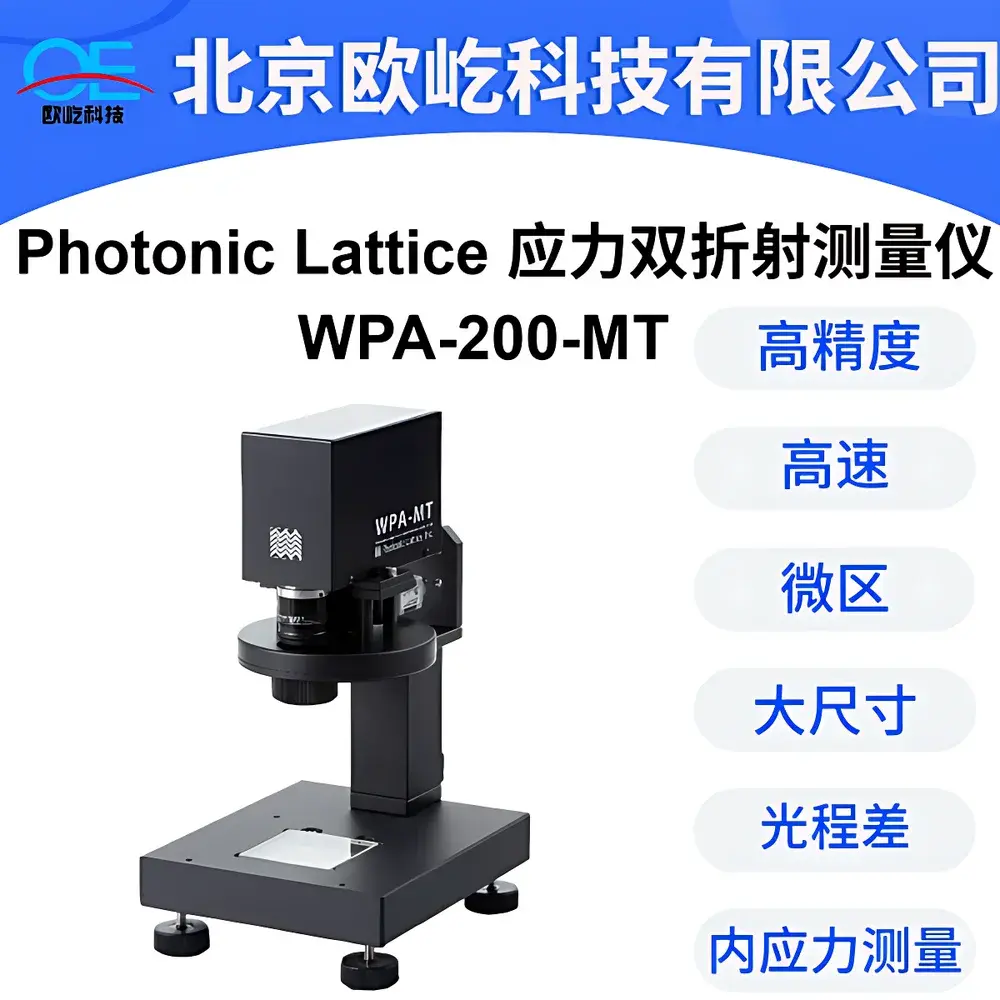
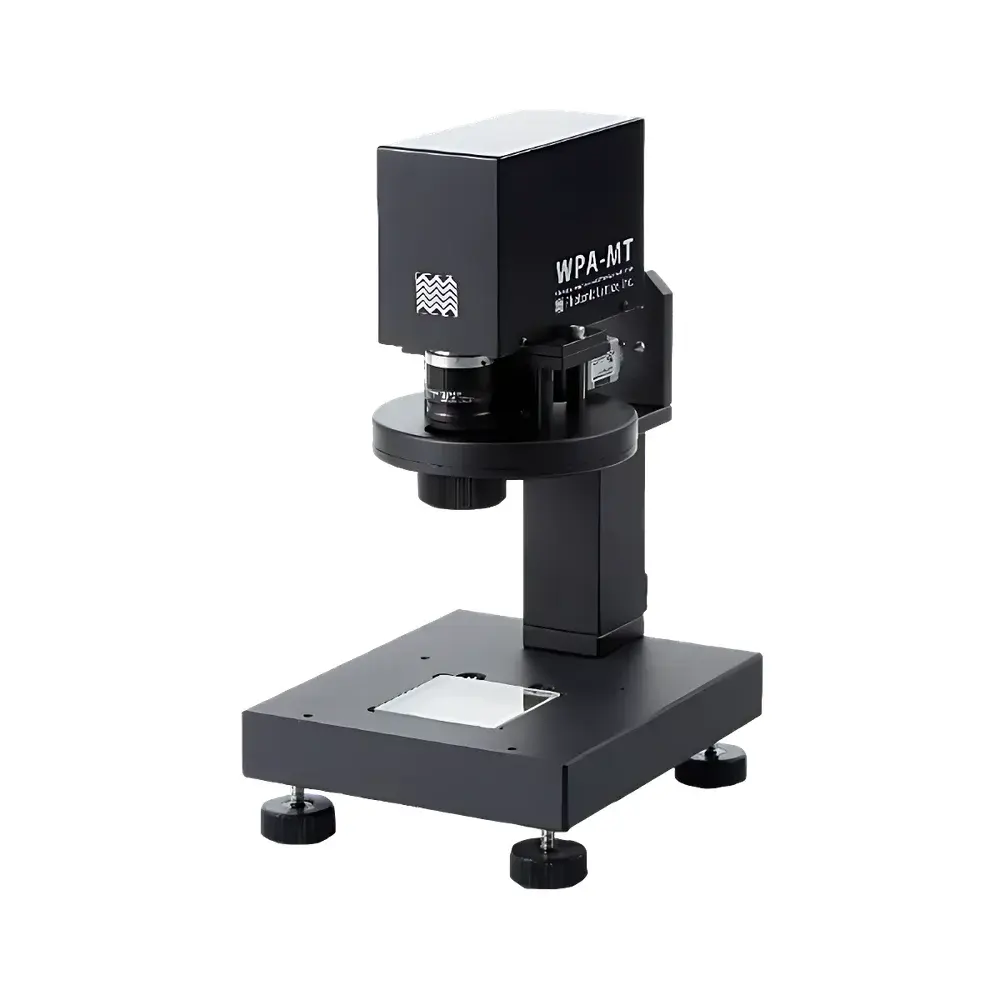
Photonic Lattice WPA-200-MT Polarizing Stress Meter
| Brand | Photonic Lattice |
|---|---|
| Origin | Japan |
| Model | WPA-200-MT |
| Output Parameters | Retardation [nm], Fast Axis Angle [°], Stress-Converted Retardation (optional) [MPa] |
| Measurement Wavelengths | 523 nm, 543 nm, 575 nm |
| Birefringence Range | 0–3500 nm |
| Minimum Resolution | 0.001 nm |
| Repeatability | <0.1 nm (σ) |
| Standard Field of View | 34 × 40 mm |
| Optional Lenses | FOV range 6.3 × 7.5 mm to 17.5 × 21 mm |
| Optional Functions | Real-time Analysis Software, Lens Evaluation Software, Data Processing Software, External Control Interface, CD Mode |
Overview
The Photonic Lattice WPA-200-MT Polarizing Stress Meter is a high-precision, automated optical metrology system engineered for quantitative evaluation of birefringence in transparent optical components—particularly precision molded lenses used in smartphone cameras, AR/VR optics, and advanced imaging modules. It operates on the principle of polarimetric phase retardation measurement using monochromatic LED illumination at three precisely stabilized wavelengths (523 nm, 543 nm, and 575 nm), enabling wavelength-dependent birefringence characterization and improved discrimination between intrinsic material stress and form-induced anisotropy. The instrument employs a calibrated photoelastic imaging configuration with rotating polarizer-analyzer optics and high-dynamic-range CMOS detection, delivering nanometer-level resolution in retardation quantification. Its design prioritizes integration into high-throughput manufacturing environments where rapid, objective, and traceable assessment of residual stress is critical to maintaining modulation transfer function (MTF) performance and minimizing image distortion.
Key Features
- Automated pass/fail classification: Integrated decision logic engine executes real-time comparison of measured retardation and fast-axis orientation against user-defined acceptance thresholds, outputting binary results with timestamped logging.
- Region-of-interest (ROI) auto-selection: Algorithm-driven segmentation identifies lens apertures or functional zones based on edge contrast and geometric templates—eliminating manual ROI definition and reducing operator dependency.
- Multi-wavelength capability: Simultaneous or sequential acquisition at 523 nm (green), 543 nm (yellow-green), and 575 nm (orange) supports spectral birefringence profiling and empirical correction for dispersion effects in polymer and glass substrates.
- Sub-nanometer resolution and repeatability: Achieves 0.001 nm minimum resolution and <0.1 nm (σ) measurement repeatability under controlled thermal and vibration conditions—meeting requirements for Class I optical component qualification per ISO 10110-5.
- Modular optical path: Interchangeable lens adapters support FOVs from 6.3 × 7.5 mm (high-magnification micro-lens inspection) to 17.5 × 21 mm (full-size camera module screening), ensuring adaptability across product families.
Sample Compatibility & Compliance
The WPA-200-MT accommodates plano-convex, biconvex, aspheric, and freeform polymer (e.g., COC, COP, PC) and optical glass (e.g., BK7, SF6) lenses with thicknesses ranging from 0.3 mm to 8 mm and diameters up to 35 mm. Sample mounting utilizes non-contact vacuum chucks or low-pressure pneumatic holders to prevent mechanical stress induction during measurement. All hardware and firmware comply with IEC 61000-6-2 (immunity) and IEC 61000-6-4 (emission) standards. Data integrity features—including audit-trail-enabled software logs, electronic signatures (per FDA 21 CFR Part 11 Annex 11 guidelines), and GLP/GMP-aligned reporting templates—are available via optional validation packages.
Software & Data Management
The system runs on Windows-based Photonic Lattice Analysis Suite v4.x, supporting both standalone operation and factory automation integration via TCP/IP, RS-232, or digital I/O triggers. Core modules include Real-Time Analysis Engine (for live retardation mapping), Lens Evaluation Module (with MTF-correlation presets and Zernike decomposition), and Data Processing Studio (enabling batch statistical analysis, SPC charting, and CSV/Excel export). The Data Log function records full-frame retardation maps, axis orientation fields, and metadata (operator ID, timestamp, environmental sensor readings) for each measurement—facilitating root-cause analysis and process capability studies (Cp/Cpk). Raw data files are stored in vendor-neutral HDF5 format with embedded calibration metadata.
Applications
- Smartphone camera lens production: In-line verification of injection-molded polymer lenses to ensure retardation ≤15 nm across active aperture—directly correlating with MTF >90% at 100 lp/mm.
- AR waveguide substrate screening: Detection of localized stress gradients in laminated glass/polymer stacks that induce polarization-dependent coupling loss.
- Optical adhesive bondline inspection: Quantification of interfacial birefringence arising from cure shrinkage or thermal mismatch in bonded assemblies.
- R&D stress mapping: Correlation of molding parameters (hold pressure, cooling rate) with spatial retardation distribution using the CD Mode (Cross-Diagnostic) for process optimization.
- Quality gate validation: Integration into AQL sampling plans per ISO 2859-1, with automated report generation compliant with AS9100D clause 8.6 requirements.
FAQ
What standards does the WPA-200-MT support for calibration traceability?
Calibration is performed using NIST-traceable quarter-wave and half-wave reference plates; certificate includes uncertainty budget per ISO/IEC 17025 requirements.
Can the system measure curved surfaces without correction artifacts?
Yes—the optical design incorporates telecentric illumination and pupil-conjugate imaging to minimize angle-dependent retardation errors on surfaces with sag up to ±1.2 mm.
Is stress conversion (nm → MPa) applicable to all materials?
Stress calibration coefficients are pre-loaded for common optical polymers and glasses; custom coefficients can be imported via CSV for proprietary materials.
How is thermal drift managed during extended production runs?
An internal temperature-stabilized LED driver and dual-point thermal compensation algorithm maintain wavelength accuracy within ±0.05 nm over 0–40 °C ambient range.
Does the system support MES or SCADA integration?
Yes—OPC UA server option enables seamless connectivity to Siemens SIMATIC, Rockwell FactoryTalk, and Mitsubishi iQ Platform environments.





