
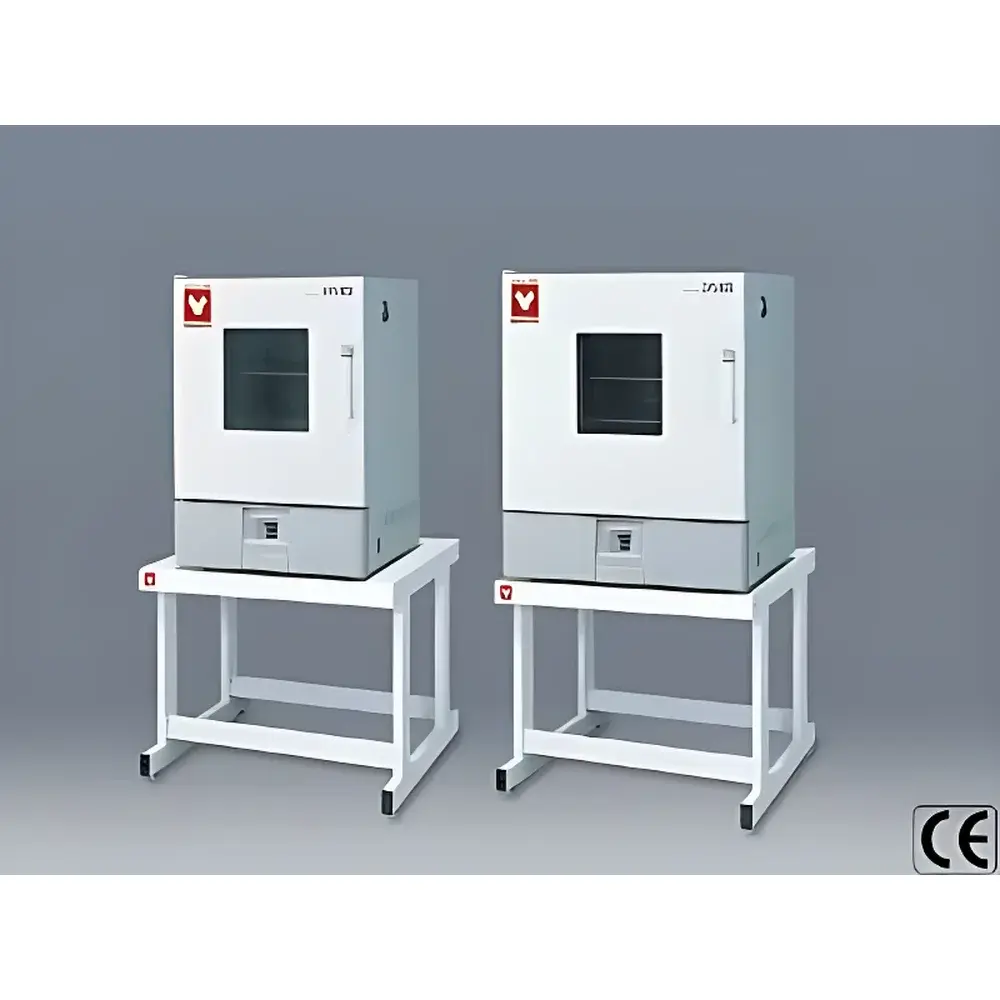
Yamato DVS412C & DVS612C Natural Convection Programmable Drying Ovens
| Brand | Yamato |
|---|---|
| Origin | Japan |
| Model | DVS412C / DVS612C |
| Heating Method | Natural Convection |
| Temperature Range | Ambient +10°C to 260°C |
| Temperature Control Accuracy | ±1°C (at 260°C) |
| Temperature Uniformity | ±5°C (at 260°C) |
| Chamber Volume | 99 L / 162 L |
| Interior Dimensions (W×D×H mm) | 450×490×450 / 600×540×500 |
| Power Rating | 1.2 kW / 1.36 kW |
| Controller | 3-Stage PID with 3-Program × 30-Step Programmability |
| Safety Features | Dual Independent Over-Temperature Protection, Self-Diagnostic Circuitry (Sensor Fault, Heater Open, SSR Short), Earth Leakage Circuit Breaker, Keypad Lock |
| Compliance | Designed for GLP-compliant laboratories |
Overview
The Yamato DVS412C and DVS612C are precision-engineered natural convection drying ovens designed for reproducible thermal processing in analytical, quality control, and research laboratories. Unlike forced-air systems, these ovens rely on buoyancy-driven airflow—eliminating fan-induced turbulence and minimizing sample disturbance—making them ideal for moisture loss assays, gravimetric analysis, powder drying, polymer conditioning, and stability testing where uniform, gentle heat exposure is critical. Each unit features a dual-sensor architecture: a primary K-type thermocouple for process temperature regulation and a physically independent over-temperature safety sensor that triggers hard cutoff at user-defined thresholds. The chamber’s stainless steel interior, glass fiber insulation, and corrosion-resistant cold-rolled steel exterior ensure long-term dimensional stability and chemical resistance under repeated thermal cycling.
Key Features
- Natural convection heating system optimized for minimal thermal gradients and high repeatability across the working volume.
- Three-stage PID temperature controller with digital 4-digit LED display: green for measured temperature, red for setpoint—enabling real-time verification of thermal performance.
- Programmable operation supporting up to three independent programs, each configurable with up to 30 steps (e.g., 30×1, 15×2, or 10×3 step configurations) for complex thermal profiles including ramp-hold-cool sequences.
- Integrated self-diagnostic circuitry continuously monitors heater integrity, thermocouple functionality, SSR output status, and sensor continuity—logging fault codes for traceable troubleshooting.
- Dual-layer safety architecture: primary temperature regulation via PID loop, backed by an isolated over-temperature prevention circuit with adjustable trip point and automatic power cutoff.
- Comprehensive operator safeguards including keypad lock, power-failure recovery with resume-on-restoration logic, and earth leakage protection compliant with IEC 61000-4-5 surge immunity standards.
Sample Compatibility & Compliance
These ovens accommodate standard laboratory ware—including porcelain crucibles, aluminum weighing dishes, glass Petri dishes, and polymer trays—within their spacious, uniformly heated chambers. The 30 mm inter-shelf spacing and reinforced stainless steel wire mesh shelves (rated to 15 kg per level) support stacked configurations without compromising airflow or thermal homogeneity. All models conform to JIS Z 8806 (Testing methods for drying ovens), meet electromagnetic compatibility requirements per CISPR 11 Group 1 Class B, and are constructed to facilitate compliance with ISO/IEC 17025 accreditation criteria for equipment qualification. Optional RS485 interface enables integration into centralized lab monitoring systems with timestamped event logging suitable for 21 CFR Part 11–aligned environments when paired with validated software.
Software & Data Management
While the DVS series operates via embedded firmware without external PC dependency, optional accessories extend data governance capabilities. The RS485 communication port supports Modbus RTU protocol for remote parameter readout, real-time temperature streaming, and alarm state polling. When connected to compatible data loggers or SCADA platforms, users can generate electronic records with time-stamped temperature traces, program execution logs, and safety event timestamps—essential for audit trails in regulated pharmaceutical, food, and materials testing labs. The built-in timer (1 min to 999 h 50 min) includes “wait until start” functionality, enabling delayed initiation synchronized with shift schedules or upstream process triggers.
Applications
- Moisture content determination per ASTM D2231, ISO 787-2, and USP <731>.
- Pre-drying of filter papers, silica gel, and desiccants prior to gravimetric analysis.
- Thermal conditioning of ceramic powders, metal oxides, and battery electrode materials before sintering or characterization.
- Residual solvent removal from coated substrates and thin-film samples without mechanical stress.
- Stability studies of hygroscopic compounds under controlled thermal exposure per ICH Q1A(R3) guidelines.
- Calibration of humidity sensors and reference material conditioning in metrology labs.
FAQ
What distinguishes natural convection from forced-air drying in this model?
Natural convection eliminates fan-induced air movement, reducing particle displacement and surface abrasion—critical for fragile or fine particulate samples. It also avoids localized cooling effects common with forced-air nozzles, yielding more consistent thermal exposure across shelf surfaces.
Can the oven retain program settings during a power outage?
Yes—the integrated power-loss compensation function preserves active program steps and elapsed time, resuming operation automatically upon power restoration without manual reinitialization.
Is calibration certificate included with shipment?
Factory calibration documentation is provided; however, field calibration using NIST-traceable reference thermometers is recommended prior to first use and at defined intervals per internal SOPs or ISO/IEC 17025 requirements.
Are custom shelving configurations available?
Standard units ship with two stainless steel mesh shelves and four shelf supports. Additional shelves, heavy-duty reinforced trays, and height-adjustable rack systems (e.g., ON61C, OD40C) are available as catalogued accessories.
Does the DVS series support validation protocols such as IQ/OQ/PQ?
Yes—the deterministic control architecture, diagnostic logging, and repeatable thermal performance enable straightforward installation qualification (IQ), operational qualification (OQ), and performance qualification (PQ) execution using standard test methodologies outlined in ASTM E2500 and EU GMP Annex 15.



