
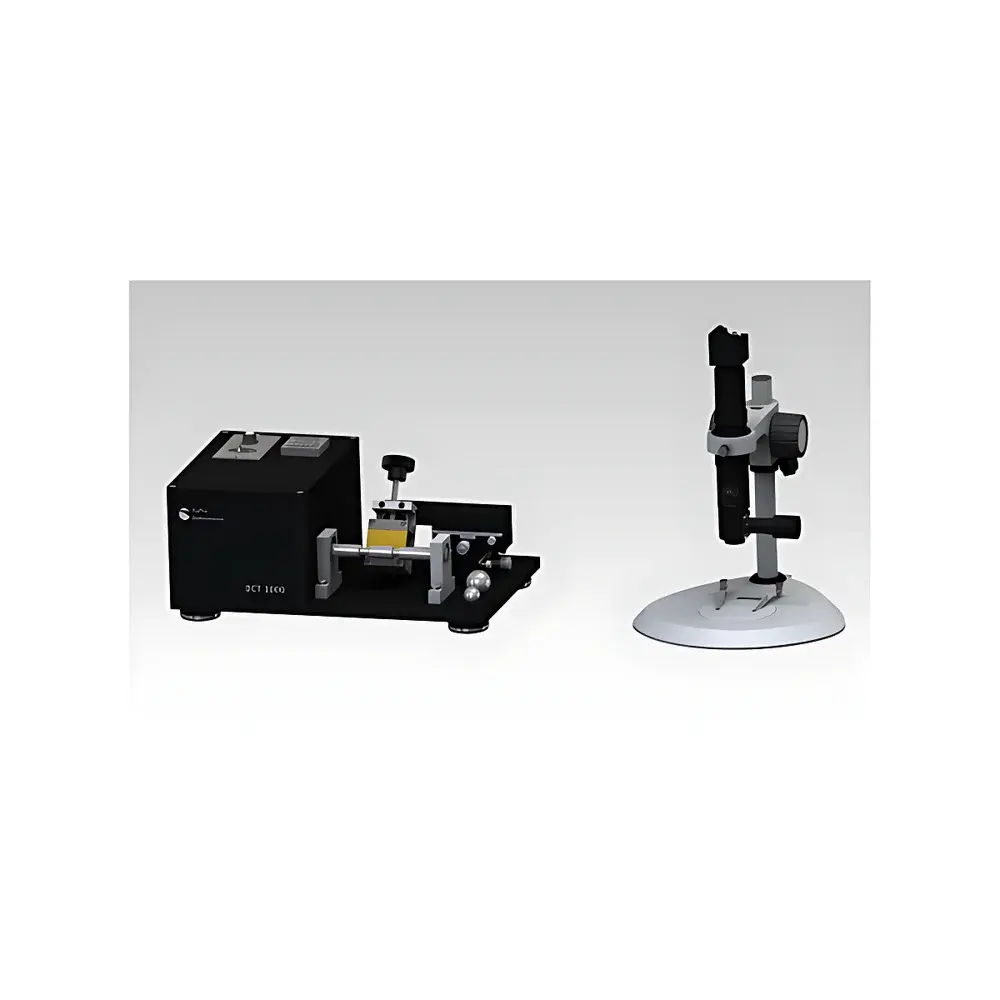
BCT1000 Ball-Cratering Thickness Analyzer
| Origin | Beijing, China |
|---|---|
| Manufacturer Type | Authorized Distributor |
| Origin Classification | Domestic (China) |
| Model | BCT1000 |
| Price Range | USD 1,400 – 7,000 |
Overview
The BCT1000 Ball-Cratering Thickness Analyzer is a precision mechanical–optical instrument engineered for non-destructive, high-reproducibility measurement of hard, brittle thin films and coatings with thicknesses exceeding 1 µm. It operates on the established ball-cratering principle—a standardized mechanical profiling technique in which a rotating spherical indenter (typically tungsten carbide or diamond-coated steel) grinds a controlled, hemispherical crater into the coated surface while simultaneously removing the top layer. The resulting crater geometry—comprising the exposed substrate and the intact coating rim—is imaged via integrated digital CCD microscopy. Film thickness is calculated from the measured crater diameter and depth using geometric calibration derived from known material removal rates and spherical indentation kinematics. This method is particularly suited for ceramic coatings (e.g., Al₂O₃, TiN), hard metal overlays (Cr, Ni-P, WC-Co), solid lubricants (MoS₂, DLC), and wear-resistant PVD/CVD layers where conventional eddy-current or XRF techniques lack resolution or suffer from substrate interference.
Key Features
- Robust mechanical architecture with CNC-machined aluminum alloy frame and precision-ground spindle assembly ensuring long-term dimensional stability and minimal thermal drift.
- Motorized, programmable rotation speed control (50–300 rpm) and adjustable vertical feed rate (0.1–5 µm/s) for consistent crater formation across diverse coating hardnesses (HV 800–3000).
- Integrated 10×–50× zoom digital CCD microscope with LED ring illumination, real-time image capture, and sub-pixel edge detection algorithm for accurate crater rim localization.
- Self-calibrating crater depth estimation based on pre-characterized ball diameter (3.175 mm standard), rotational time, and empirically validated material-specific ablation coefficients.
- Compact benchtop footprint (W × D × H: 320 × 360 × 410 mm) designed for integration into QC labs, coating production lines, and R&D cleanrooms without requiring vacuum or inert gas environments.
Sample Compatibility & Compliance
The BCT1000 accommodates flat or gently curved substrates up to Ø100 mm and 30 mm thickness, including metallic (steel, aluminum, titanium alloys), ceramic (SiC, alumina), and silicon wafers. Samples require no conductive coating or metallization—unlike SEM-based cross-sectioning—and are compatible with ISO 2063-1:2019 (thermal spray coating thickness measurement) and ASTM B568–98 (X-ray fluorescence standard, referenced for validation correlation). While not a regulatory-certified device per se, its measurement protocol aligns with GLP documentation requirements: all acquisition parameters (rotation time, feed rate, magnification, timestamp) are embedded in image metadata and exportable as CSV/Excel. Optional audit-trail logging supports internal 21 CFR Part 11 readiness when paired with validated LIMS software.
Software & Data Management
The proprietary CraterVision™ analysis suite (v3.2, Windows 10/11 compatible) provides automated crater recognition, dynamic scaling calibration, and thickness calculation using the formula t = d² / (8R), where t = film thickness, d = crater diameter, and R = indenter radius. Software features include batch processing of up to 99 images, statistical reporting (mean, SD, CV%), pass/fail threshold alerts, and PDF report generation with embedded raw images and measurement coordinates. All data files are stored in open HDF5 format for third-party scripting (Python/MATLAB) and traceable revision control. No cloud dependency—full local data sovereignty maintained.
Applications
- Quality assurance of PVD/CVD tooling coatings (TiAlN, CrN) in cutting tool manufacturers.
- Process validation of electroless nickel-phosphorus (ENP) plating thickness uniformity on aerospace hydraulic components.
- R&D quantification of DLC (diamond-like carbon) layer growth kinetics during plasma-enhanced CVD development.
- Failure analysis of delaminated thermal barrier coatings (YSZ) by correlating local thickness loss with EDS elemental mapping.
- ISO/TS 16949-compliant thickness release testing for automotive piston ring coatings prior to engine assembly.
FAQ
What coating hardness range is suitable for ball-cratering measurement with the BCT1000?
Coatings with Vickers hardness between 800 HV and 3000 HV are optimal; softer coatings (4000 HV) require extended grinding time and specialized indenter options.
Can the BCT1000 measure multilayer stacks?
Yes—when interlayer contrast is sufficient under optical microscopy (e.g., TiN/TiCN bilayers), the software allows manual rim delineation for each interface; however, quantitative sub-layer resolution is limited to ≥2 µm per layer.
Is sample preparation required before analysis?
No polishing or sectioning is needed; however, surfaces must be free of oils, oxides, or loose particulates. A light ethanol wipe and air-dry is sufficient for most industrial samples.
How is measurement uncertainty determined?
Typical expanded uncertainty (k=2) is ±5% for coatings >3 µm thick, dominated by crater edge detection repeatability and indenter sphericity tolerance (±0.5 µm); certified reference standards (NIST-traceable step height wafers) are recommended for lab-specific uncertainty budgets.
Does the system support automated stage positioning?
Not natively—the BCT1000 uses manual XYZ translation; however, third-party motorized stages with RS-232 or USB TTL interfaces can be integrated via custom API scripting in CraterVision™.



