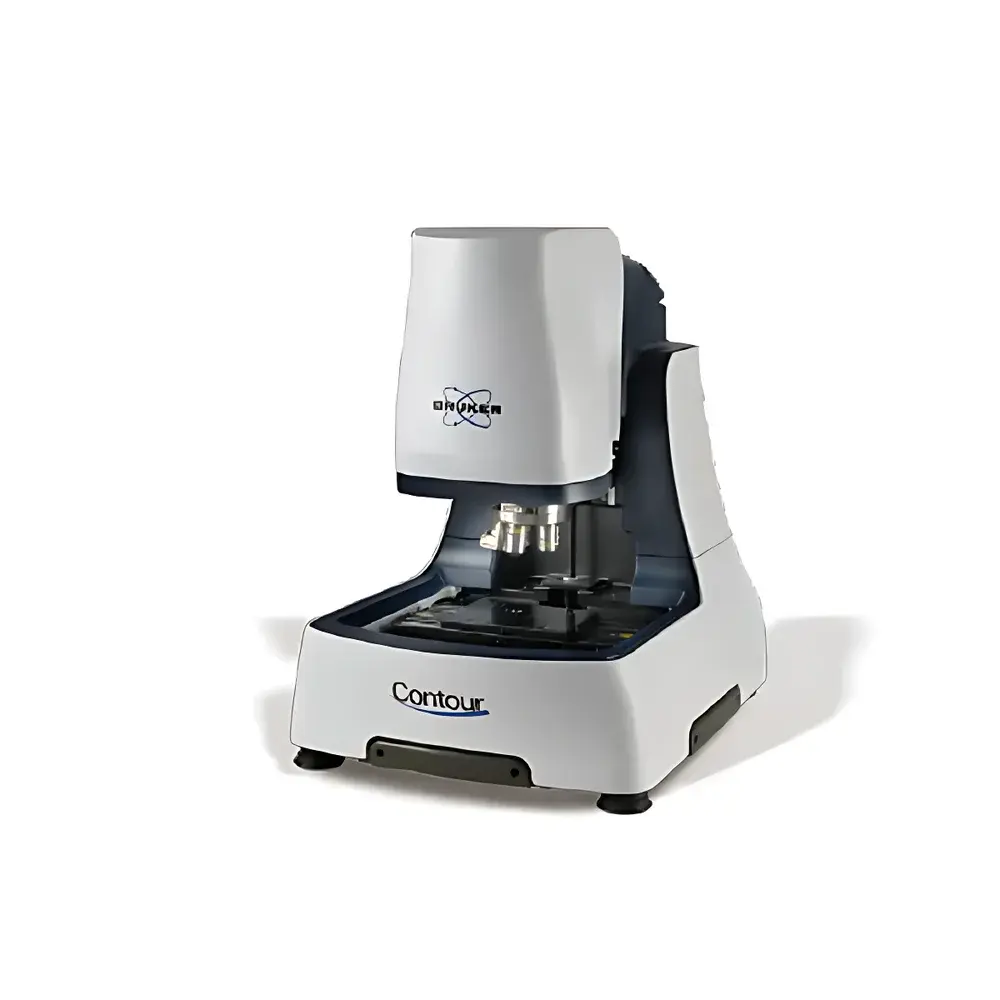
Bruker ContourX-200 White Light Interferometric Optical Profilometer
| Brand | Bruker |
|---|---|
| Origin | Germany |
| Manufacturer Type | Authorized Distributor |
| Product Category | Imported Instrument |
| Model | ContourX-200 |
| Pricing | Upon Request |
| Instrument Type | Non-contact Profilometer / Surface Roughness Analyzer |
| Operating Principle | White Light Interferometry (WLI) |
| Vertical Resolution | Sub-nanometer |
| Surface Reflectivity Range | 0.05% – 100% |
| Field of View | Standard Large FOV |
| Vibration Isolation | Integrated Passive Damping System |
| Compliance Standards | ISO 25178, ISO 4287, ASME B46.1 |
Overview
The Bruker ContourX-200 is a high-performance, non-contact optical profilometer engineered for quantitative 3D surface metrology in research, development, and production environments. Based on proprietary white light interferometry (WLI), the system captures full-field topographic data with sub-nanometer vertical resolution—regardless of magnification—enabling precise characterization of surface form, roughness, step height, curvature, and critical dimensions. Unlike stylus-based or confocal approaches, WLI delivers simultaneous lateral and vertical measurement integrity without surface contact, eliminating risk of sample damage or tip wear. The ContourX-200 integrates over four decades of Bruker’s WLI innovation into a robust architecture optimized for stability, repeatability, and traceable measurement uncertainty. Its optical design accommodates surfaces across an exceptionally broad reflectivity range—from highly absorbing (0.05%) to fully specular (100%)—without requiring manual gain adjustment or hardware reconfiguration.
Key Features
- Sub-nanometer vertical resolution maintained across all objective magnifications—ensuring consistent Z-axis metrological fidelity independent of lateral scale.
- Large standard field-of-view optics enabling rapid acquisition of macro-scale surface features while preserving micro-scale detail.
- Integrated passive vibration isolation platform, factory-tuned to suppress environmental mechanical noise common in shared lab or production-floor settings.
- Automated feature recognition and multi-objective lens support for seamless transition between low-magnification survey imaging and high-resolution localized analysis.
- Real-time interference fringe processing with advanced phase-shifting algorithms for high signal-to-noise ratio (SNR) topography reconstruction.
- Intuitive, workflow-driven user interface with context-sensitive guidance—reducing operator training time while maintaining full access to advanced metrology parameters.
Sample Compatibility & Compliance
The ContourX-200 is validated for use with diverse material classes including silicon wafers, polished metals, optical coatings, MEMS devices, biomedical implants, and polymer films. Its wide dynamic reflectivity tolerance eliminates the need for anti-reflective coatings or surface preparation prior to measurement. All quantitative analyses adhere to internationally recognized surface metrology standards: ISO 25178 (areal surface texture), ISO 4287 (profile-based roughness), and ASME B46.1 (surface characterization nomenclature and definitions). Measurement data files include embedded metadata compliant with ASTM E2911–21 for digital surface topography reporting. The system supports GLP/GMP-aligned workflows through optional audit trail logging and user-access controls, meeting foundational requirements for FDA 21 CFR Part 11–governed environments when configured with appropriate IT infrastructure.
Software & Data Management
Bruker’s Vision64 software provides a unified environment for instrument control, real-time visualization, automated reporting, and post-acquisition analysis. It includes over 200 standardized surface parameters per ISO 25178 and ASME B46.1, plus customizable parameter sets for proprietary process control metrics. Batch analysis mode enables unattended execution of identical measurement protocols across multiple samples or sites. Export formats include ASCII, CSV, and industry-standard .STL and .XYZ point clouds for integration with CAD, FEA, or statistical process control (SPC) platforms. Data integrity is preserved via timestamped, digitally signed result files with checksum verification. Optional network deployment supports centralized license management and remote calibration status monitoring.
Applications
- Wafer-level thin-film thickness uniformity and etch depth verification in semiconductor fabrication.
- Surface finish validation of orthopedic implants and dental prosthetics per ISO 14644 and ISO 10993 biocompatibility guidelines.
- MEMS device release inspection, stiction assessment, and actuator displacement profiling.
- Optical component flatness and scratch/defect quantification in precision optics manufacturing.
- Coating adhesion failure analysis via 3D delamination mapping and interfacial roughness correlation.
- Process capability studies (Cp/Cpk) for additive manufacturing surface quality control across build plates.
FAQ
What surface materials can the ContourX-200 measure without coating or preparation?
It measures bare silicon, fused silica, stainless steel, aluminum alloys, titanium, PDMS, PET, and most other industrially relevant substrates—across reflectivity from 0.05% to 100%.
Does the system support automated pass/fail decision-making for in-line QC?
Yes—Vision64 allows rule-based thresholding and conditional reporting; integration with PLCs or MES via TCP/IP or OPC UA is supported through optional modules.
Is Z-axis calibration traceable to national metrology institutes?
All ContourX-200 systems ship with NIST-traceable step-height calibration artifacts and certificate of conformance per ISO/IEC 17025-accredited procedures.
Can the instrument be upgraded to support larger travel stages or motorized tilt?
Yes—Bruker offers field-installable stage expansion kits, motorized rotation/tilt modules, and custom enclosure integration for cleanroom or industrial deployment.
How is measurement repeatability verified during routine operation?
Built-in drift-compensated reference measurements and daily verification routines using certified artifact libraries ensure long-term stability within ±0.1 nm Z repeatability (2σ, 24-hour period).