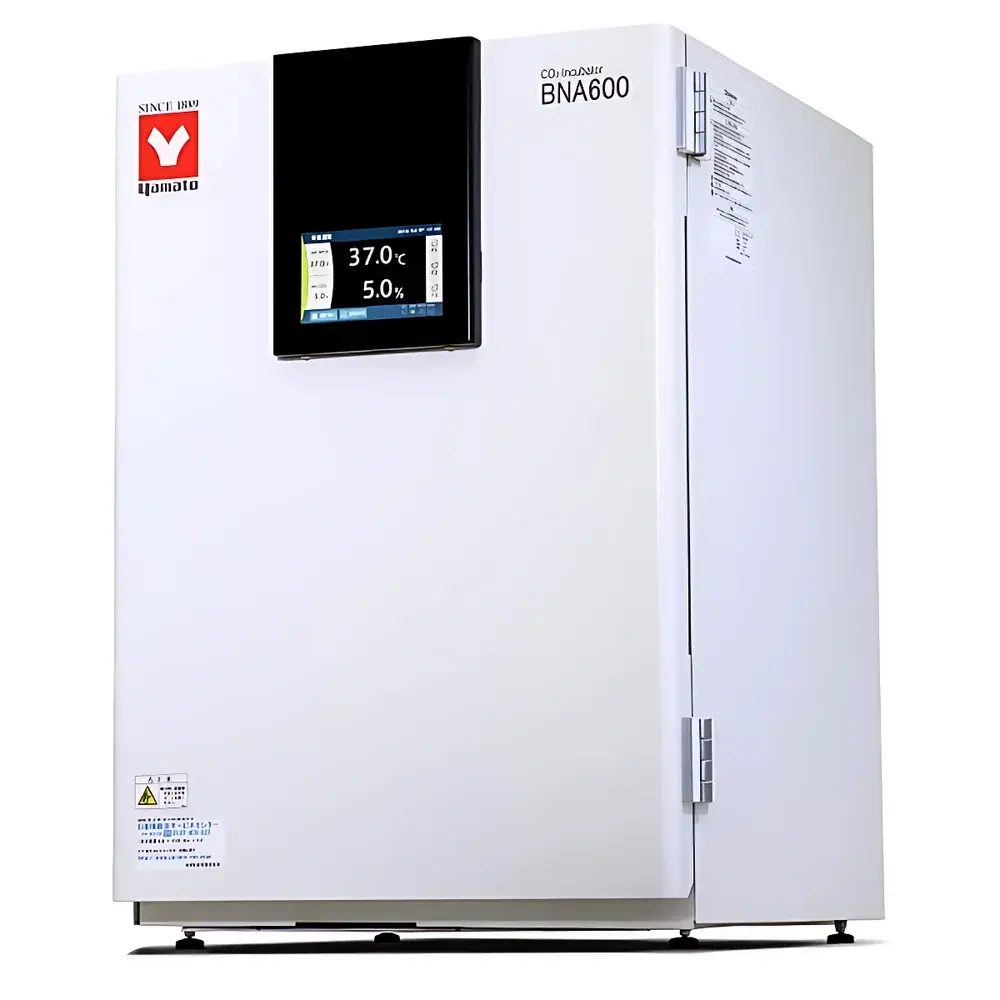
YAMATO IP610 Carbon Dioxide Incubator
| Brand | YAMATO |
|---|---|
| Origin | Japan |
| Model | IP610 |
| Temperature Range & Accuracy | Ambient +5°C to 50°C |
| Temperature Uniformity | ±2.5°C |
| Humidity Control | Up to 95% RH (non-condensing) |
| Chamber Capacity | 167 L |
| Sterilization | Dry-heat sterilization at 160°C for 2 h (sensor-intact) |
Overview
The YAMATO IP610 Carbon Dioxide Incubator is a precision-engineered, air-jacketed CO₂ incubator designed for demanding cell culture applications in pharmaceutical R&D, biomanufacturing, and academic life science laboratories. It operates on the principle of precise CO₂ concentration regulation (typically 5% v/v), combined with tightly controlled temperature and humidity environments to replicate physiological conditions required for mammalian cell proliferation. Its air-jacketed thermal architecture ensures rapid temperature recovery after door openings and minimizes thermal gradients across the chamber—critical for maintaining culture integrity during routine handling. The IP610 is engineered for operational reliability and contamination control, incorporating design features aligned with Good Manufacturing Practice (GMP) and Good Laboratory Practice (GLP) frameworks.
Key Features
- Air-jacketed heating system with independent PID-controlled heaters for stable thermal performance and fast recovery (<6 min to re-stabilize after 30-sec door opening at 37°C).
- Dry-heat sterilization cycle validated at 160°C for 120 minutes—fully compliant with Japanese Pharmaceutical Affairs Law (PAL) and consistent with ISO 13485 requirements for equipment qualification in regulated environments.
- CO₂ sensor remains installed and functional throughout dry-heat sterilization; no disassembly or recalibration required post-cycle—reducing downtime and eliminating sensor drift risks associated with repeated removal/reinstallation.
- Microprocessor-based controller with real-time digital display of CO₂ concentration (%), temperature (°C), and relative humidity (%RH); data logging capability via optional RS-232/USB interface.
- Double-sealed, heated glass door with anti-condensation heating to maintain uniform internal humidity (up to 95% RH) and prevent moisture accumulation on observation surfaces.
- Stainless steel interior chamber (SUS304) with seamless, rounded corners and electro-polished finish to inhibit microbial adhesion and simplify cleaning validation.
Sample Compatibility & Compliance
The IP610 supports standard tissue culture formats including T-flasks (up to T225), multi-well plates (6–96-well), Petri dishes, and roller bottles. Its 167 L working volume accommodates up to six stacked shelf levels (standard configuration: five shelves included). All materials in contact with the incubation environment meet USP Class VI biocompatibility standards. The unit complies with IEC 61010-1 (Safety Requirements for Electrical Equipment for Measurement, Control, and Laboratory Use) and carries PSE certification for use in Japan. While not pre-certified for FDA 21 CFR Part 11, its data logging functionality supports audit-trail implementation when integrated with validated third-party software meeting ALCOA+ principles.
Software & Data Management
The embedded controller supports manual parameter entry and recall of up to 10 user-defined protocols. Optional PC connectivity enables remote monitoring and export of time-stamped environmental logs (temperature, CO₂, RH) in CSV format. When deployed in regulated settings, the system can be qualified under IQ/OQ/PQ protocols per ASTM E2500 and ISO/IEC 17025 guidelines. Alarm events—including high/low CO₂ deviation (>±0.3%), temperature excursion (>±1.0°C), door-open duration >60 sec, and humidity failure—are stored with timestamps and retained for ≥30 days in non-volatile memory.
Applications
- Long-term maintenance and expansion of primary human and animal cell lines (e.g., HEK293, CHO-K1, MCF-7).
- Stem cell culture requiring strict environmental consistency and low contamination risk.
- Preclinical toxicology assays where batch-to-batch reproducibility depends on incubator stability.
- QC/QA testing of biologics and cell-based therapeutics under cGMP-aligned workflows.
- Microbial co-culture studies requiring simultaneous control of CO₂ and humidity without cross-contamination pathways.
FAQ
Does the IP610 require calibration of the CO₂ sensor after dry-heat sterilization?
No. The infrared (NDIR) CO₂ sensor is thermally rated for continuous exposure to 160°C and retains factory calibration post-sterilization.
Is humidity control active during the dry-heat sterilization cycle?
No—humidity generation is disabled during sterilization; the chamber operates in a dry, high-temperature state to ensure microbial lethality.
What is the maximum allowable ambient temperature for stable operation?
The unit is rated for ambient temperatures between 15°C and 32°C at ≤70% RH (non-condensing). Operation outside this range may affect temperature uniformity and humidity accuracy.
Can the IP610 be integrated into a central building management system (BMS)?
Yes—via optional analog output modules (0–5 V or 4–20 mA) for temperature and CO₂ signals, compatible with most industrial BMS platforms.
Is the stainless steel chamber passivated per ASTM A967?
Yes—the SUS304 interior undergoes nitric acid passivation and water-rinse verification in accordance with ASTM A967 Method A, ensuring optimal corrosion resistance and cleanability.