
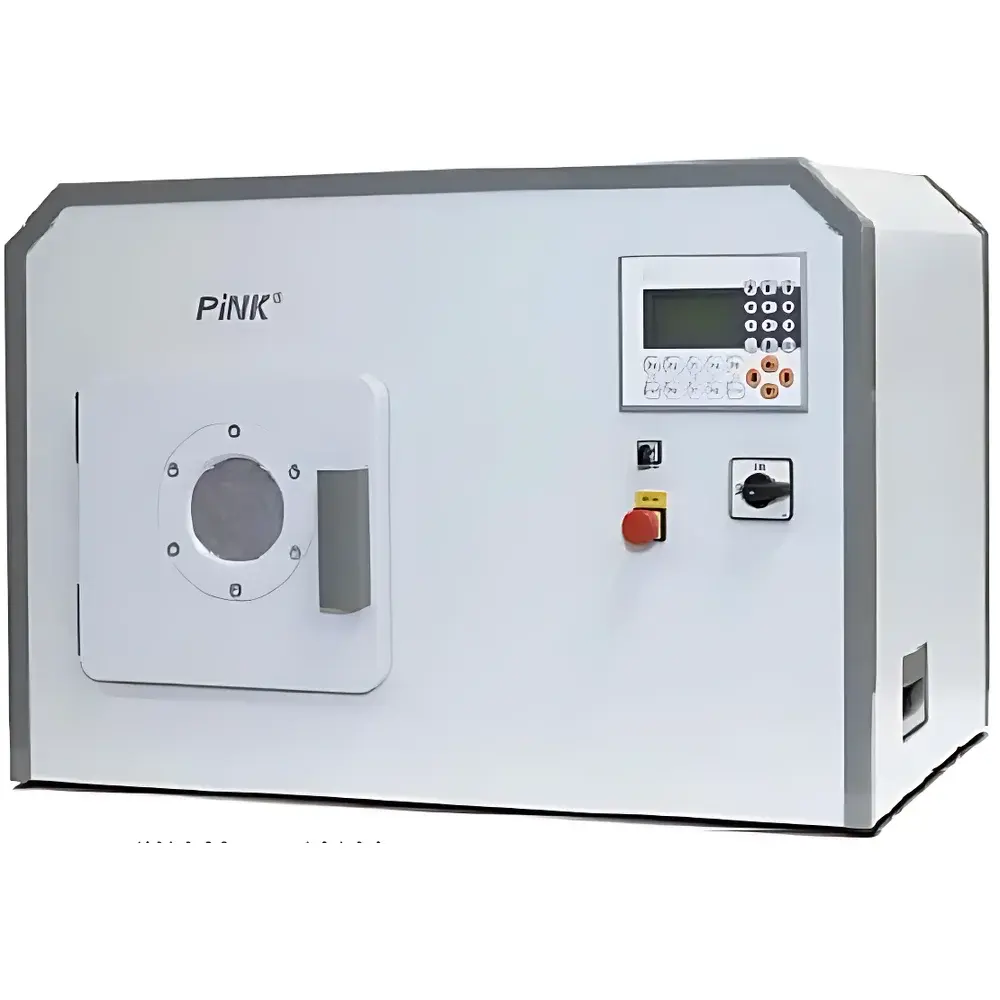
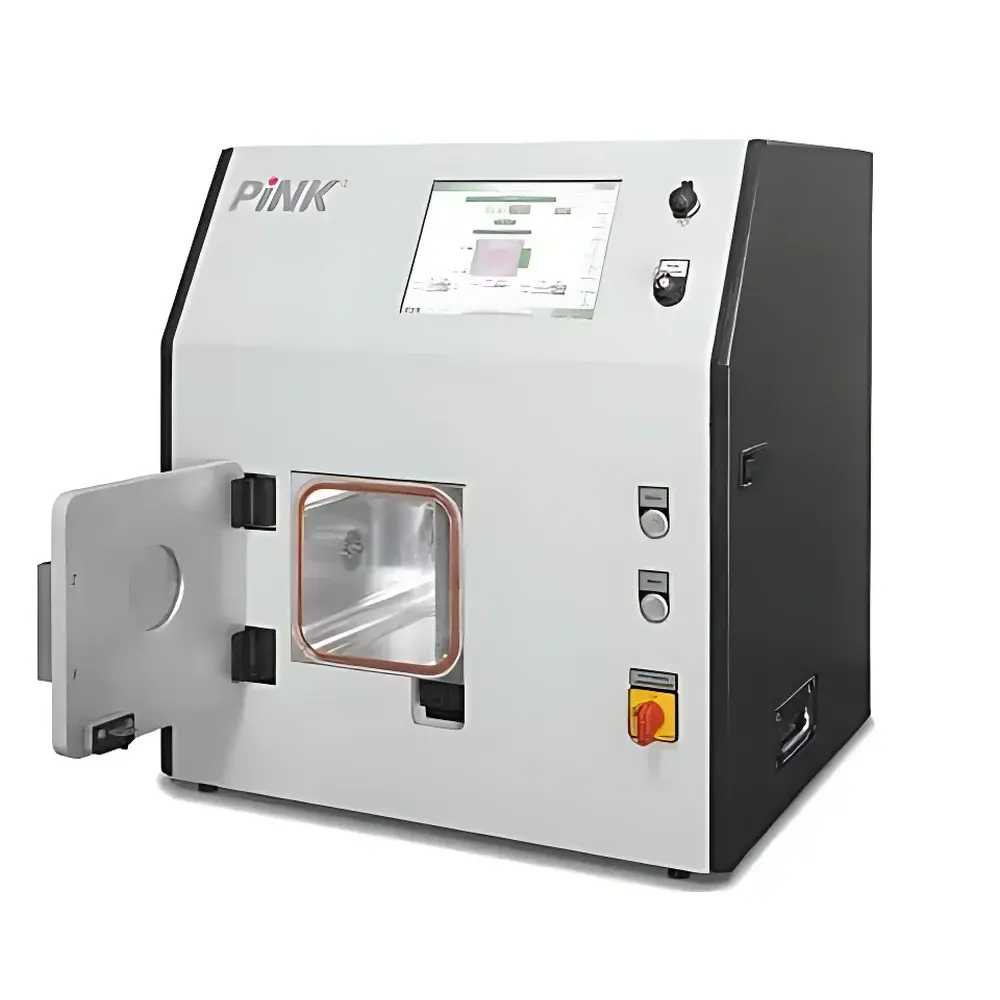
Pink V6-G Microwave Plasma Cleaner
| Brand | Pink |
|---|---|
| Origin | Germany |
| Manufacturer Type | Authorized Distributor |
| Product Category | Imported Equipment |
| Model | V6-G |
| Microwave Frequency | 2.45 GHz |
| Microwave Power Range | 50–300 W |
| Chamber Dimensions (W×D×H) | 170 × 200 × 170 mm |
| Overall Dimensions (W×D×H) | 640 × 710 × 710 mm |
| Gas Control | Standard Single MFC, Expandable |
Overview
The Pink V6-G Microwave Plasma Cleaner is an electrode-free, low-pressure plasma surface treatment system engineered for precision cleaning, activation, and functionalization of substrates in R&D and production environments. Operating at a fixed microwave frequency of 2.45 GHz, the V6-G generates high-density, spatially uniform reactive species—including atomic oxygen, nitrogen radicals, and metastable molecules—without physical electrode erosion or contamination. Unlike capacitively or inductively coupled RF plasmas, this microwave-driven system delivers stable, reproducible plasma conditions across the entire 170 × 200 × 170 mm processing chamber, making it especially suitable for batch processing of delicate components such as MEMS devices, optical lenses, semiconductor wafers, and medical-grade polymers. Designed and manufactured by PINK GmbH Thermosysteme—a division of the German vacuum technology specialist with over two decades of heritage—the V6-G adheres to DIN EN ISO 9001-certified engineering practices and integrates seamlessly into cleanroom-compatible workflows.
Key Features
- Electrode-free microwave plasma generation ensures zero sputtering, no metallic contamination, and extended service life of internal components.
- High plasma density (>1011 cm−3 typical under standard O2/Ar conditions) enables rapid removal of organic residues, photoresist residuals, and adventitious hydrocarbons down to sub-monolayer levels.
- Programmable microwave power control (50–300 W) allows fine-tuning of radical flux and ion energy for substrate-sensitive applications—e.g., PET film activation without surface ablation.
- Integrated mass flow controller (MFC) supports precise, repeatable gas dosing for single- or multi-gas chemistries (O2, Ar, N2, CF4, H2, or custom blends), with optional expansion to three independent gas lines.
- Modular plasma reactor design permits customization of chamber geometry, port configuration, and sample holder layout to accommodate specialized fixtures or inline conveyor interfaces.
- Real-time pressure monitoring and closed-loop pump speed regulation maintain optimal process pressure (typically 0.1–10 Pa), critical for consistent etch rate and surface energy modulation.
Sample Compatibility & Compliance
The V6-G accommodates rigid and flexible substrates up to 150 mm in diameter or equivalent footprint, including silicon wafers, fused silica optics, stainless steel watch components, alumina ceramics, PDMS microfluidic chips, and PET-based smart card laminates. Its non-thermal plasma regime preserves thermal integrity of temperature-sensitive materials (Tg < 80 °C). The system complies with CE marking requirements (2014/30/EU EMC Directive, 2014/35/EU LVD), conforms to DIN EN 61000-6-2/6-4 immunity/emission standards, and supports GLP-compliant operation through configurable audit trails and user-access controls. While not FDA-cleared as a medical device, its cleaning efficacy meets ASTM F2459-22 (Standard Guide for Plasma Cleaning of Medical Devices) and ISO 15883-5 (washer-disinfectors) validation benchmarks when operated per validated protocols.
Software & Data Management
The V6-G is controlled via a dedicated Windows-based HMI with intuitive touch interface, supporting recipe-driven operation, real-time parameter logging (power, pressure, gas flow, time), and CSV export for traceability. All process logs are timestamped and user-identified; optional 21 CFR Part 11 compliance package includes electronic signatures, role-based permissions, and immutable audit trails. Remote diagnostics and firmware updates are enabled via Ethernet (TCP/IP), facilitating integration into centralized lab management systems (LIMS) or MES platforms using Modbus TCP or OPC UA protocols. Data retention supports ≥12 months of continuous operation history without external storage.
Applications
- Pre-bonding surface activation of glass, silicon, and polymer substrates to enhance adhesion in wafer-level packaging and micro-optics assembly.
- Removal of mold release agents and silicone oils from injection-molded medical components prior to coating or sterilization.
- Decontamination of AFM tips, TEM grids, and X-ray optics to eliminate carbon buildup and improve signal-to-noise ratios.
- Functionalization of PDMS surfaces with amine or carboxyl groups for biosensor immobilization in diagnostic microfluidics.
- Residue-free descumming after lithography in academic nanofabrication facilities and pilot-line semiconductor labs.
- Surface hydrophilization of ITO-coated displays and AR/VR waveguide substrates to improve inkjet printing uniformity.
FAQ
What vacuum level is required for stable plasma ignition?
Stable microwave plasma ignition is achieved between 0.1 and 5 Pa; optimal cleaning uniformity occurs at 1–3 Pa using a turbomolecular pumping system (not included but specified in system integration guidelines).
Can the V6-G be integrated into an automated glovebox or cluster tool?
Yes—the unit features RS-485 and digital I/O ports for interlock signaling, chamber gate synchronization, and external PLC handshaking, enabling full integration into Class 1000+ inert-atmosphere gloveboxes or multi-chamber cluster platforms.
Is ozone generation a concern during O2 plasma operation?
Ozone is generated as a secondary product; however, the V6-G’s sealed chamber and integrated exhaust interface (DN25 KF flange) mandate connection to a certified ozone destruct unit or scrubber system per local occupational safety regulations (e.g., OSHA PEL: 0.1 ppm TWA).
What maintenance intervals are recommended for the microwave waveguide and quartz window?
Under normal operation (≤4 h/day, O2/Ar chemistry), the fused quartz plasma window requires visual inspection every 200 hours and replacement only if clouding or microcracking is observed; waveguide internals require no routine servicing but benefit from annual RF leakage testing per IEC 62471.



