
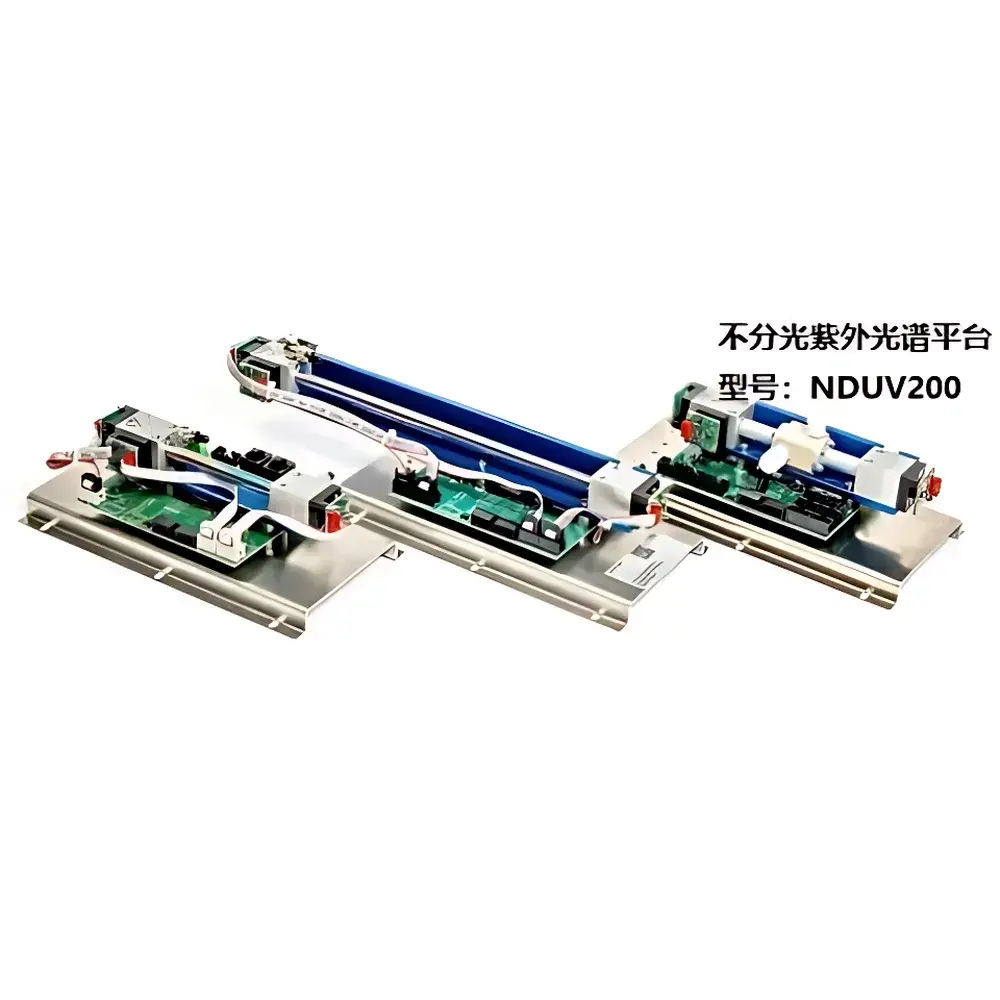
TCT NDUV200 Non-Dispersive Ultraviolet (NDUV) Gas Analysis Platform
| Brand | TCT (Xiamen Tongchuang) |
|---|---|
| Origin | Germany |
| Manufacturer Type | Authorized Distributor |
| Origin Category | Imported |
| Model | NDUV200 |
| Price | Upon Request |
Overview
The TCT NDUV200 is a compact, high-stability non-dispersive ultraviolet (NDUV) gas analysis platform engineered for quantitative detection of trace and major gaseous analytes across environmental, industrial, and laboratory applications. It operates on the fundamental principle of UV absorption spectroscopy, leveraging the characteristic electronic transitions of target molecules in the 200–500 nm spectral range. Unlike conventional dispersive systems relying on gratings or prisms, the NDUV200 employs dual-wavelength, filter-based optical architecture with two stabilized micro-UV LEDs — one serving as the measurement source and the other as a reference emitter — enabling simultaneous dual-gas quantification without spectral scanning. Concentration calculation follows the Lambert-Beer law, where absorbance (A = log10(I0/I)) is derived from the ratio of reference-channel irradiance (I0) to sample-channel irradiance (I), ensuring robust compensation for LED aging, thermal drift, and optical path contamination. The system’s optical design eliminates reliance on external calibration gases during routine operation and maintains accuracy over extended deployment cycles.
Key Features
- Dual-gas capability: Simultaneous real-time measurement of NO/NO2, SO2, O3, benzene, and other aromatic VOCs within a single compact module
- Reference-channel architecture: Integrated I0 monitoring using a dedicated UV LED or deuterium lamp (EDL) ensures long-term signal stability and minimizes baseline drift
- Thermal management: Active temperature control maintains optical components below 50 °C, reducing thermal noise and enhancing photodetector linearity
- Humidity immunity: Optical path design and signal processing algorithms eliminate cross-sensitivity to ambient humidity fluctuations — no drying or conditioning required
- Fast response: T90 < 2 seconds for step changes in concentration, suitable for dynamic process monitoring and transient emission testing
- Low-power operation: Designed for integration into portable, battery-powered, or embedded OEM systems (typical power draw < 3 W)
- Modular mechanical interface: Standardized mounting brackets enable rapid integration into CEMS analyzers, engine test benches, and mobile PEMS platforms
Sample Compatibility & Compliance
The NDUV200 supports direct analysis of undiluted, unfiltered gas streams across a wide dynamic range — from sub-ppb (e.g., ambient NO2) to percent-level (e.g., stack SO2 in flue gas). It complies with optical path requirements defined in EN 15267-3 (performance certification of automated measuring systems) and aligns with measurement principles referenced in EPA Method 6C (SO2) and Method 7E (NOx). While not a certified CEMS analyzer itself, the platform meets critical subsystem criteria for use in Type-Approved continuous emission monitoring systems under EU Directive 2010/75/EU (IED) and U.S. 40 CFR Part 60. Its optical design avoids catalytic conversion stages, eliminating the need for NO-to-NO2 molybdenum converters — a key advantage over chemiluminescence-based NOx analyzers. All optical materials are selected for UV transmission stability and resistance to photochemical degradation in aggressive industrial atmospheres.
Software & Data Management
The NDUV200 communicates via RS-232/RS-485 or optional analog 4–20 mA outputs, supporting seamless integration into SCADA, DCS, and LabVIEW environments. Firmware includes configurable digital filtering, zero/span validation routines, and timestamped raw intensity logging. When deployed in regulated environments (e.g., GLP labs or GMP-compliant manufacturing), the host system may implement audit-trail functionality per FDA 21 CFR Part 11 requirements. Calibration data — including wavelength-specific extinction coefficients, path length, and detector responsivity — is stored in non-volatile memory and accessible via diagnostic commands. Optional PC-based configuration software provides spectral diagnostics, drift trending, and multi-point calibration curve generation aligned with ISO 14644-1 cleanroom air quality protocols.
Applications
- Fixed-source emissions monitoring (CEMS) for coal-fired power plants, waste incinerators, and cement kilns
- Portable emissions measurement systems (PEMS) for RDE (Real Driving Emissions) compliance testing per UN Regulation No. 83 and EU 2016/427
- Engine and dynamometer test cells for combustion optimization and aftertreatment evaluation
- Laboratory-scale atmospheric chemistry studies, including ozone formation kinetics and VOC oxidation pathways
- Biogas upgrading and fermentation process control, where real-time H2S and SO2 monitoring informs desulfurization efficiency
- Indoor air quality (IAQ) monitoring in smart buildings and cleanrooms per ISO 16000-29
- Calibration transfer standards for field-deployable UV-DOAS spectrometers
FAQ
Does the NDUV200 require periodic zero/span calibration with certified gases?
Yes — while the reference channel significantly reduces drift, regulatory compliance (e.g., EN 14181 QAL2) mandates at least bi-weekly zero/span verification using traceable standard gases.
Can the NDUV200 be used for chlorine (Cl₂) or hydrogen sulfide (H₂S) detection?
No — Cl₂ and H₂S exhibit weak or overlapping UV absorption features below 200 nm; the NDUV200’s operational range (200–500 nm) is optimized for NOx, SO2, O3, and aromatics.
Is the optical path length customizable?
Standard path length is 100 mm; custom lengths (50–500 mm) are available for OEM integration to optimize sensitivity/resolution trade-offs.
What is the maximum operating pressure and temperature range for the gas inlet?
Gas stream compatibility: 0.8–1.2 bar absolute, −10 °C to +60 °C; condensation must be prevented upstream via heated sampling lines or permeation dryers.
How does the NDUV200 handle interference from water vapor and CO₂?
Water vapor exhibits negligible absorption above 190 nm; CO₂ has no significant UV bands in this range — both are effectively non-interfering under normal operating conditions.





