
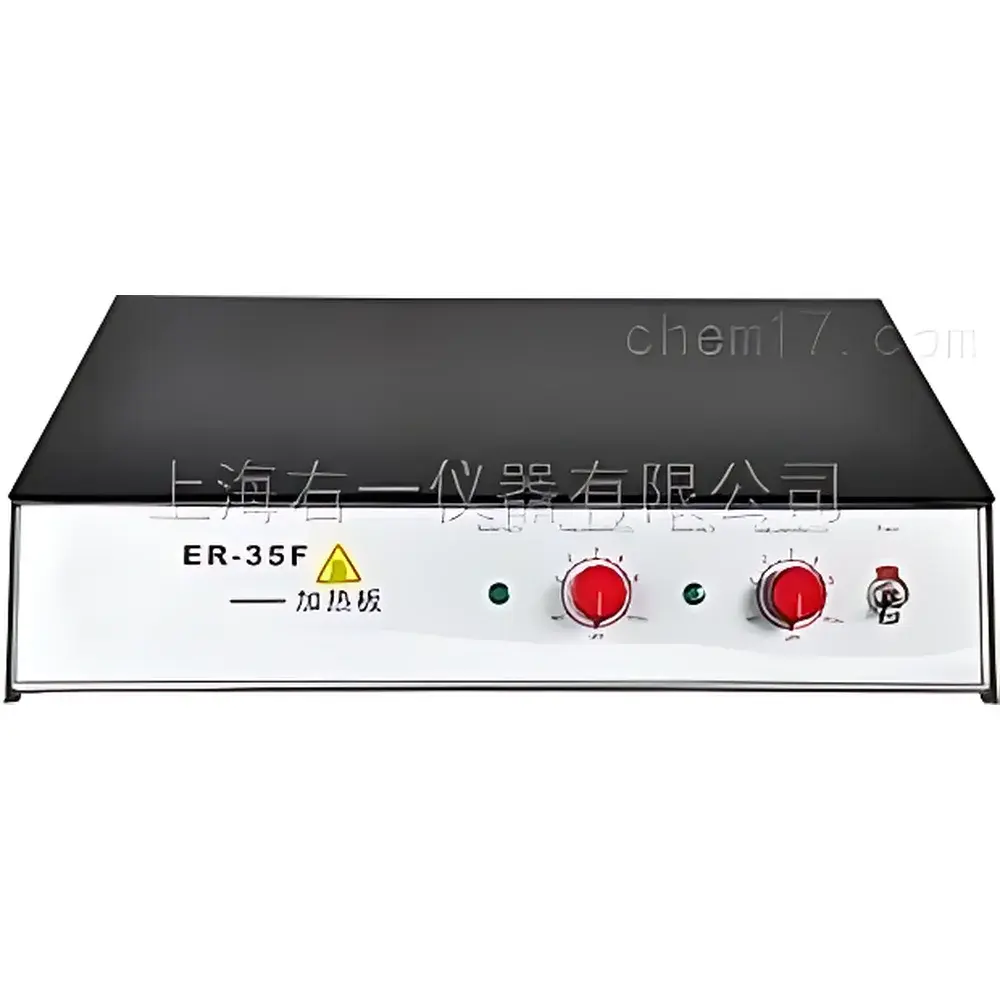
Yoyi ER-35F Corrosion-Resistant Electric Heating Plate with Microcrystalline Glass Surface
| Brand | Yoyi |
|---|---|
| Origin | Shanghai, China |
| Manufacturer Type | Direct Manufacturer |
| Model | ER-35F |
| Heating Power | 2400 W |
| Max Operating Temperature | 400 °C |
| Temperature Uniformity | ±2 °C |
| Heating Surface Dimensions | 500 × 300 mm |
| Display Type | Analog Dial Scale |
| Panel Material | Microcrystalline Glass |
| Housing Frame | 316L Stainless Steel |
| Insulation | Ceramic Fiber |
Overview
The Yoyi ER-35F Corrosion-Resistant Electric Heating Plate is engineered for precision thermal control in demanding laboratory sample preparation workflows—particularly acid digestion, solvent evaporation, reflux heating, and controlled drying of aggressive chemical matrices. Unlike conventional hotplates with ceramic or aluminum surfaces, the ER-35F integrates a monolithic microcrystalline glass top plate, offering exceptional resistance to concentrated mineral acids (e.g., HNO₃, HCl, HF up to 40%), alkalis (e.g., NaOH, KOH), and organic solvents under sustained thermal load. Its operating range spans ambient +20 °C to 400 °C, enabling compatibility with EPA Method 3050B, ASTM D5511, and ISO 11466 digestion protocols. The unit employs resistive heating elements embedded beneath the glass surface, coupled with high-density ceramic fiber insulation—ensuring rapid thermal response, minimal energy loss, and structural stability across repeated thermal cycling.
Key Features
- Microcrystalline glass surface with ultra-low coefficient of thermal expansion (≤ 0.1 × 10⁻⁶ /K), eliminating warping or microcracking at 400 °C
- Full-perimeter enclosure constructed from electropolished 316L stainless steel—resistant to chloride-induced pitting and passivation loss in humid, corrosive environments
- Ceramic fiber insulation layer (density: 128 kg/m³) providing thermal efficiency >85% and reducing external housing temperature rise to <45 °C at maximum setpoint
- Analog dial-scale temperature controller with calibrated bimetallic thermostat—designed for long-term drift stability (<±0.5 %/year) and immunity to electromagnetic interference from adjacent instrumentation
- Uniform heating zone matching full panel dimensions (500 × 300 mm), delivering ±2 °C spatial uniformity across the entire surface per ASTM E220 calibration standards
- No exposed electronics or wiring on the front face—control circuitry isolated behind sealed 316L bulkhead connectors to prevent vapor ingress and electrolyte tracking
Sample Compatibility & Compliance
The ER-35F is validated for use with PTFE, quartz, borosilicate glass, and quartz-fused silica vessels—including open-beaker digestion, Teflon®-lined microwave digestion racks, and reflux condenser assemblies. Its corrosion resilience supports compliance with GLP/GMP environmental testing labs performing heavy metal analysis (e.g., Pb, Cd, As) in soil, sludge, and wastewater per US EPA SW-846 Methods 3015A and 3051A. The absence of digital logic or data logging ensures intrinsic compliance with facilities requiring analog-only instrumentation for audit-trail simplification. While not CE-marked for EU machinery directive (2006/42/EC), it meets IEC 61010-1:2010 safety requirements for laboratory electrical equipment when installed per local grounding codes.
Software & Data Management
The ER-35F operates as a standalone analog instrument with no embedded firmware, network interface, or software dependency. Temperature setting and monitoring are performed manually via the front-panel dial scale—eliminating cybersecurity risks, firmware update cycles, and validation overhead associated with digital controllers. For laboratories subject to FDA 21 CFR Part 11 or Annex 11 requirements, this design inherently satisfies “no electronic records” exemptions. Users may integrate the unit into validated workflows using external calibrated thermocouple probes (e.g., Type K, Class 1) connected to standalone data loggers compliant with NIST-traceable calibration chains.
Applications
- Acid digestion of geological, biological, and environmental samples prior to ICP-OES or ICP-MS analysis
- Controlled evaporation of acidic extracts in trace-metal cleanrooms (Class 100–1000)
- Pre-concentration of aqueous samples containing halides, sulfates, or phosphates without surface degradation
- Heating of reaction mixtures in Schlenk lines where solvent vapors (e.g., DMF, THF, acetonitrile) contact the surface
- Stabilization of pH-sensitive reagents during titration prep or buffer aging studies
- Support platform for hot-stage microscopy setups requiring chemically inert thermal coupling
FAQ
Is the microcrystalline glass surface resistant to hydrofluoric acid (HF)?
Yes—tested per DIN EN ISO 17872:2021 with 40% HF at 120 °C for 72 hours; no visible etching or haze formation observed.
Can the ER-35F be used under a fume hood with continuous acid vapor exposure?
Yes—the 316L frame and sealed control compartment prevent vapor penetration; recommended minimum hood face velocity: 0.5 m/s.
What is the expected service life under daily 8-hour operation at 350 °C?
≥7 years based on accelerated aging tests (IEC 60068-2-2); thermal cycling endurance exceeds 10,000 cycles between 25–400 °C.
Does the analog dial require periodic recalibration?
No—bimetallic sensor is factory-calibrated and drift-compensated; verification against a NIST-traceable reference thermometer is recommended annually.
Is replacement of the heating element possible in-field?
Yes—modular heater assembly accessible via four M6 fasteners on underside; spare part code: ER-HEAT-ER35F-2400W.



