
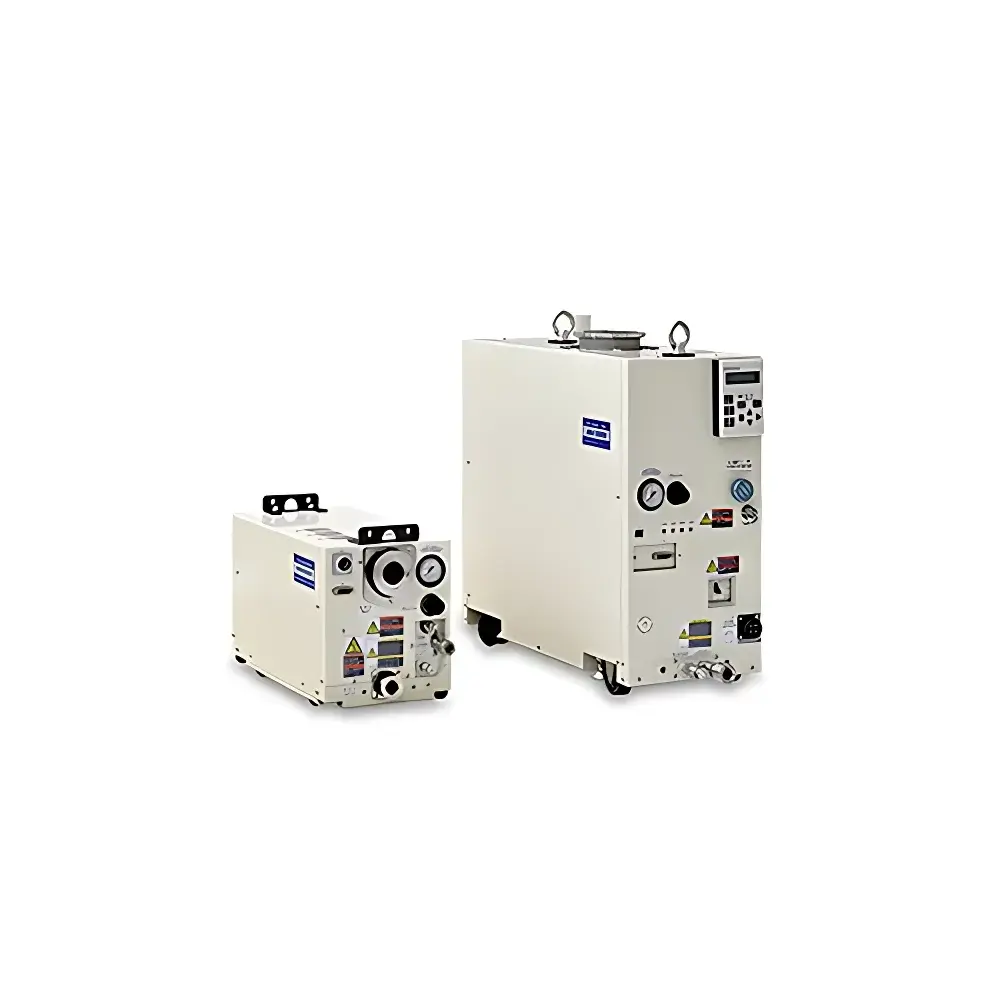
Kashiyama MU100X / MU100XN Oil-Free Scroll Vacuum Pump
| Brand | Kashiyama |
|---|---|
| Origin | Japan |
| Pump Type | Dry Scroll Vacuum Pump |
| Model | MU100X / MU100XN |
| Ultimate Pressure | 1.5 Pa |
| Pumping Speed (50/60 Hz) | 1660 L/min |
| Inlet Flange | NW50 |
| Exhaust Flange | NW25 |
| Motor Power | 2.2 kW |
| Cooling Water Requirement | 1.5–3.0 L/min at 0.2–0.5 MPa (gauge), 10–25 °C |
| Nitrogen Purge | Optional (5 SLM @ 0.05 MPa g) for corrosive gas service |
| Approx. Weight | 60 kg |
| Electrical Supply | 3-phase, 3.8 kVA, 2.0–10.8 A operating current |
| Control Interface | DB-25 connector (Japan Aviation Electronics PF-N series) |
| Lubricant | Fluorinated oil (0.1 L) |
Overview
The Kashiyama MU100X and MU100XN are high-capacity, oil-free scroll vacuum pumps engineered for continuous-duty laboratory and pilot-scale applications requiring clean, hydrocarbon-free vacuum generation. Based on Kashiyama’s proprietary dual-stage scroll compression architecture, these pumps operate without internal lubrication in the pumping chamber—eliminating oil backstreaming, vapor contamination, and routine oil changes. The scroll mechanism achieves isothermal compression through synchronized orbital motion of two spiral elements, delivering stable volumetric flow and low vibration across the full operating range. Designed for integration into analytical instrumentation (e.g., mass spectrometry sample inlets, vacuum ovens, freeze dryers), thin-film deposition systems, and semiconductor R&D tools, the MU100X/MU100XN meets stringent requirements for purity-sensitive processes where residual hydrocarbons or particulates must be avoided. Its ultimate pressure of 1.5 Pa (11 mTorr) and nominal pumping speed of 1660 L/min at both 50 Hz and 60 Hz make it suitable for rough-to-medium vacuum regimes (10⁵ to 10⁻¹ Pa), bridging the performance gap between diaphragm and turbomolecular solutions.
Key Features
- Dry scroll technology with fluorinated oil-lubricated drive bearings only—zero process-side oil exposure
- NW50 inlet and NW25 exhaust flanges compliant with ISO-KF standards for rapid, leak-tight system integration
- Integrated cooling water jacket with pressure-sensing interlock (0.2–0.5 MPa gauge) and temperature monitoring (10–25 °C inlet)
- Optional nitrogen purge interface (¼″ pipe fitting, 5 SLM @ 0.05 MPa g) for operation with corrosive or condensable vapors (e.g., HCl, NH₃, solvents)
- Three-phase induction motor (2.2 kW, 3.8 kVA) with soft-start circuitry; acceleration/deceleration times <10 s and <5 s respectively
- DB-25 control connector (PF-N type, Japan Aviation Electronics) supporting remote start/stop, fault signaling, and status monitoring per GLP-compliant lab protocols
- Robust cast-aluminum housing with IP54-rated enclosure; 60 kg mass optimized for benchtop or floor-mount stability
Sample Compatibility & Compliance
The MU100X/MU100XN is compatible with non-reactive, non-particulate, and moderately aggressive gas streams when used with optional nitrogen dilution. It is not rated for explosive, highly polymerizing, or solid-laden gases without upstream filtration or trapping. The pump conforms to JIS B 8341-1 (vacuum pump performance testing), CE marking (2014/30/EU EMC Directive and 2014/35/EU Low Voltage Directive), and RoHS 2011/65/EU. When integrated into regulated environments (e.g., pharmaceutical QC labs), its DB-25 interface supports audit-trail-capable control systems compliant with FDA 21 CFR Part 11 when paired with validated SCADA or LIMS platforms. No ISO 8573-1 Class 0 certification is claimed due to external bearing lubricant presence; however, process-side effluent is verified Class 1 (≤0.1 mg/m³ total oil aerosol) per IEC 61508 functional safety assessment.
Software & Data Management
While the MU100X/MU100XN operates as a standalone unit, its DB-25 control port enables seamless integration with third-party vacuum management software via standard TTL-level digital I/O. Pin assignments support discrete inputs for run status, overtemperature alarm, water flow failure, and nitrogen purge enable signal, alongside open-collector outputs for remote fault indication. Users may log operational parameters—including cumulative runtime, thermal history, and interlock event timestamps—using generic industrial data acquisition systems (e.g., LabVIEW, Ignition SCADA). For GxP-aligned deployments, the pump’s deterministic response time (<100 ms) and hardware-enforced safety cutoffs (cooling loss → automatic shutdown within 3 s) satisfy ALCOA+ data integrity criteria when instrumented with calibrated external sensors.
Applications
- Rough vacuum backing for turbomolecular and cryogenic pumps in surface science and UHV systems
- Continuous evacuation of gloveboxes handling air-sensitive catalysts or battery electrode materials
- Process vacuum for solvent recovery, rotary evaporation, and lyophilization under cGMP conditions
- Gas sampling loops and pre-concentrator modules in environmental VOC monitoring stations
- Plasma etch and PECVD tool base-pressure maintenance in microfabrication labs
- Leak detection test benches using helium mass spectrometry (with appropriate foreline trap)
FAQ
What is the difference between the MU100X and MU100XN models?
The MU100XN includes factory-installed nitrogen purge fittings and enhanced sealing for extended operation with mildly corrosive gases; the MU100X is configured for inert or ambient gas duty only.
Can this pump be mounted vertically?
No—Kashiyama specifies horizontal orientation only to ensure proper bearing lubrication distribution and scroll alignment; deviation voids warranty and risks premature wear.
Is a dedicated cooling tower required?
No; closed-loop recirculating chillers or municipal water supplies meeting flow/pressure/temperature specs are sufficient. Inline pressure regulators and flow meters are recommended for validation.
Does the pump require periodic calibration?
Not for vacuum performance—but cooling water pressure, nitrogen purge flow, and motor current should be verified annually against factory baseline values during PM maintenance.
How is compliance with ISO/IEC 17025 demonstrated for vacuum system validation?
By documenting pump-specific parameters (ultimate pressure, pumping speed, leak rate) using traceable reference gauges (e.g., capacitance manometer, calibrated Pirani) per ISO 21809-2 Annex D procedures.



