
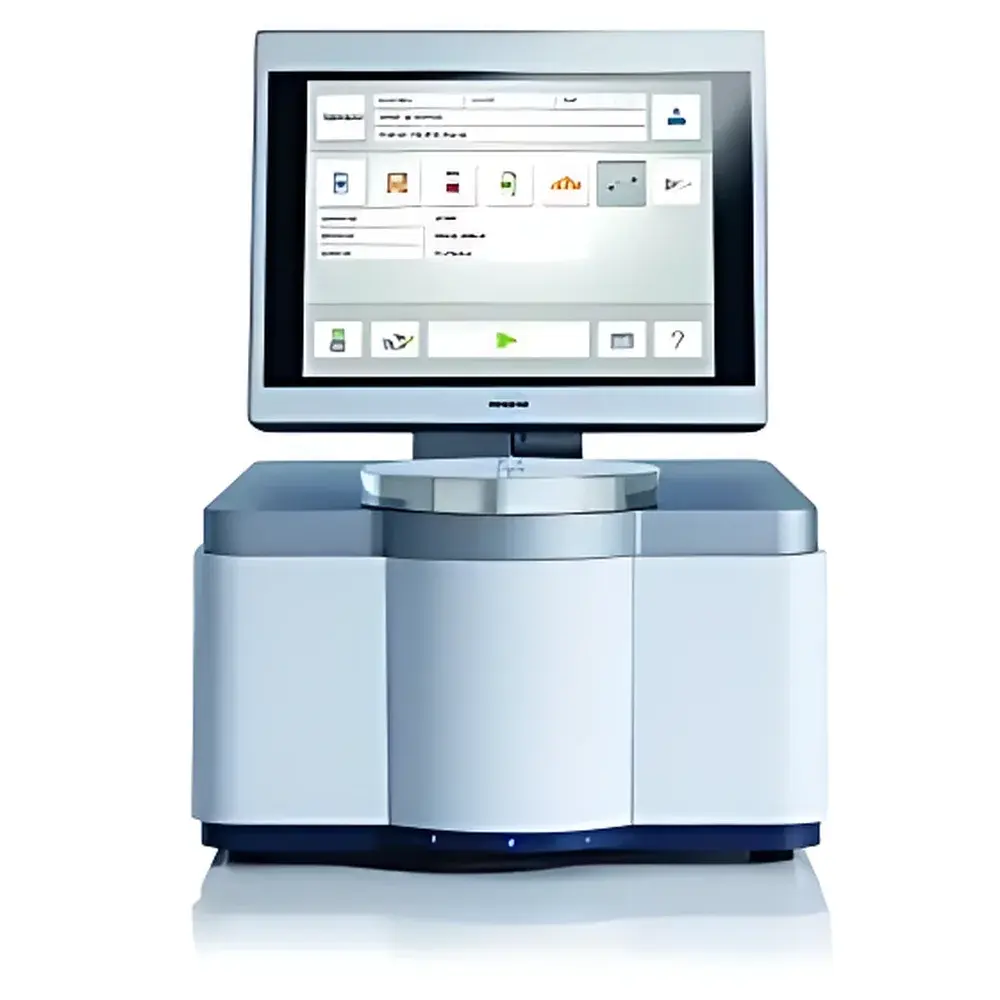
Bruker TANGO Miniaturized Fourier Transform Near-Infrared Spectrometer
| Brand | Bruker |
|---|---|
| Origin | Germany |
| Model | TANGO |
| Principle | Fourier Transform (FT) |
| Wavelength Range | 11500–4000 cm⁻¹ |
| Scan Speed | 8 scans/sec |
| Data Sampling Interval | 4 cm⁻¹ |
| Measurement Modes | Diffuse Reflectance / Transmission |
| Chemometrics Software | OPUS |
Overview
The Bruker TANGO is the world’s first miniaturized Fourier Transform Near-Infrared (FT-NIR) spectrometer engineered for laboratory-grade performance in a compact, robust footprint. Leveraging Bruker’s three-decade heritage in interferometric spectroscopy and proprietary RockSolid™ interferometer technology, the TANGO delivers high-fidelity spectral data with exceptional long-term stability and mechanical resilience. Its core optical architecture is based on Michelson-type FT-NIR principles: broadband NIR radiation from a stabilized tungsten-halogen source is split, recombined after path-length modulation by a moving mirror, and detected via a DigiTect™ all-digital InGaAs detector. The resulting interferogram is Fourier-transformed in real time to yield absorbance or reflectance spectra across the 11500–4000 cm⁻¹ range (i.e., 870–2500 nm), supporting quantitative and qualitative analysis of organic functional groups (e.g., O–H, C–H, N–H) in complex matrices.
Key Features
- RockSolid™ Interferometer: Utilizes monolithic 3D corner-cube retroreflectors to ensure permanent optical alignment—no recalibration required after transport or vibration; maintains spectral reproducibility under dynamic lab conditions (e.g., glovebox, fume hood, mobile cart).
- DigiTect™ Digital Detector: Fully integrated detector module comprising InGaAs photodiode, low-noise transimpedance amplifier, and 24-bit analog-to-digital converter; outputs native digital signals to eliminate analog drift and enable cross-instrument model transfer without spectral rescaling.
- Gold-Coated Optics: All reflective surfaces—including beam splitter, mirrors, and integrating sphere interior—are vacuum-deposited with high-purity gold, achieving >98% reflectivity above 4000 cm⁻¹ and superior oxidation resistance versus aluminum coatings—ensuring stable throughput and extended service life.
- Integrated IVU Calibration Unit & PerformanceGuard™ Diagnostics: Built-in reference laser and NIST-traceable ceramic standard enable automated daily validation; PerformanceGuard™ continuously monitors laser intensity, detector response, mirror position accuracy, and thermal drift—logging all parameters for GLP/GMP-compliant audit trails.
- Modular Sampling Configurations: TANGO-R variant includes motorized gold-coated integrating sphere (10 mm spot size, sample rotation stage, auto-switching gold background); TANGO-T variant features thermostatted transmission cell holder (20–80 °C, ±0.2 °C control, real-time vial temperature sensing).
Sample Compatibility & Compliance
The TANGO supports direct, non-destructive analysis of solids (powders, tablets, granules, polymers) via diffuse reflectance and liquids (solutions, suspensions, oils) via transmission—without solvent extraction, derivatization, or dilution. Its sampling interfaces comply with ASTM E1655 (standard practices for NIR quantitative analysis) and ISO 12099 (cereal and feed analysis). The instrument meets IEC 61000-6-3 (EMC emission standards) and IEC 61010-1 (safety requirements for lab equipment). Firmware and OPUS software support FDA 21 CFR Part 11 compliance through electronic signatures, role-based access control, and immutable audit logs—fully traceable for pharmaceutical QC/QA and regulated manufacturing environments.
Software & Data Management
Controlled via the industry-standard OPUS software platform (v8.5+), the TANGO provides intuitive touch-screen operation (Windows 10 IoT Enterprise) or Ethernet-based remote control (TCP/IP). OPUS includes full chemometrics toolsets: PCA, PLS regression, SIMCA classification, and model validation (cross-validation, residual analysis). All spectral acquisitions are stored in Bruker’s proprietary OPUS format (.0), which embeds metadata (instrument ID, user, timestamp, calibration status, environmental logs). Batch processing, method templating, and LIMS integration (via ASTM E1578-compliant XML export) are natively supported. Raw interferograms and processed spectra can be exported as CSV, JCAMP-DX, or ASCII for third-party modeling tools.
Applications
- Pharmaceutical: API assay, blend uniformity, moisture content in lyophilized powders, tablet coating thickness.
- Food & Agriculture: Protein/fat/moisture in grains, dairy, meat; authenticity screening (e.g., olive oil adulteration).
- Polymers & Chemicals: Monomer conversion in curing resins, additive concentration, polymer crystallinity.
- Academic Research: Reaction monitoring in flow chemistry setups, catalyst characterization, biomolecular conformation studies.
- Quality Control Labs: Rapid release testing of raw materials and finished products with validated PLS models deployed directly on instrument.
FAQ
Is the TANGO suitable for GMP-regulated environments?
Yes—OPUS software with audit trail, electronic signatures, and instrument qualification packages (IQ/OQ/PQ) enables full compliance with FDA 21 CFR Part 11 and EU Annex 11 requirements.
Can calibration models developed on other Bruker FT-NIR instruments be transferred to the TANGO?
Yes—DigiTect™ digital detection and RockSolid™ interferometer ensure spectral equivalence; OPUS includes built-in model porting tools with automatic wavenumber alignment and noise normalization.
What maintenance is required for long-term operation?
No optical alignment needed; laser and source modules are pre-aligned, field-replaceable in <5 minutes without tools or opening the optical bench.
Does the TANGO support external triggering or synchronization with process equipment?
Yes—TTL-compatible trigger input/output ports enable synchronized acquisition with peristaltic pumps, robotic samplers, or PLC-controlled reactors.
How is temperature controlled during liquid measurements?
The TANGO-T uses a Peltier-based thermostatic cell holder with PID control, calibrated Pt100 sensor embedded in the sample vial cradle, and real-time feedback to maintain setpoint within ±0.2 °C over 20–80 °C range.




