
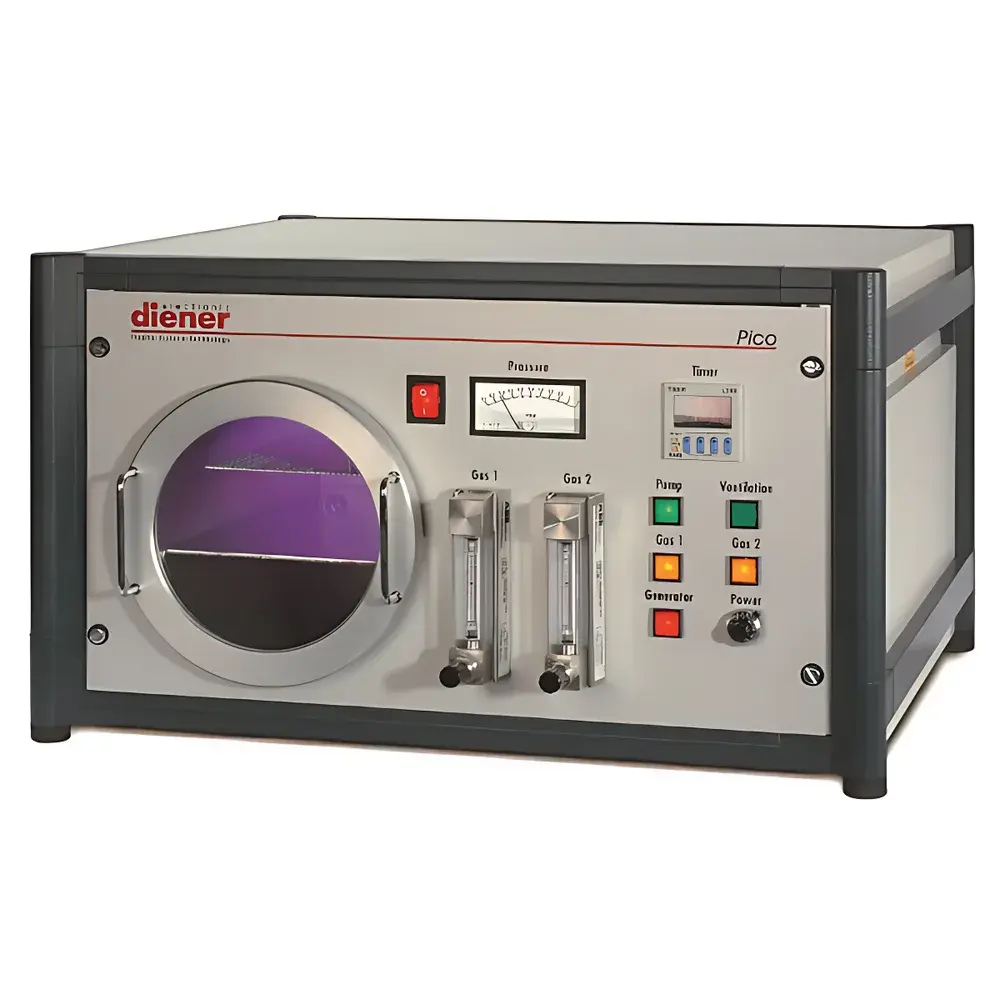
Diener PICO Plasma Cleaner
| Brand | Diener |
|---|---|
| Origin | Germany |
| Model | PICO |
| RF Frequency | 13.56 MHz |
| Power Range | 0–500 W |
| Chamber Dimensions | Ø150 mm × 320 mm |
| Chamber Volume | 4–15 L |
| Chamber Material | Quartz |
| Gas Inlets | 2 channels |
| Control System | Automated |
Overview
The Diener PICO Plasma Cleaner is a compact, high-precision low-pressure plasma system engineered for surface activation, cleaning, etching, and functionalization of substrates in research laboratories and pilot-scale production environments. Operating on the principle of capacitively coupled radio-frequency (RF) plasma generation at 13.56 MHz, the PICO system ionizes process gases—including oxygen, argon, nitrogen, air, or custom gas mixtures—to produce reactive species (ions, electrons, radicals, and UV photons) that interact with surface contaminants and modify surface chemistry without thermal damage. Its modular architecture supports integration into automated workflows, glovebox interfaces, or standalone benchtop configurations. Designed and manufactured in Germany, the PICO adheres to stringent CE, EMC, and RoHS directives, ensuring compliance with EU regulatory frameworks for laboratory instrumentation.
Key Features
- RF generator operating at 13.56 MHz with continuously adjustable output (0–500 W), enabling precise control over plasma density and treatment intensity.
- Quartz vacuum chamber (Ø150 mm × 320 mm) offering excellent optical transparency, chemical inertness, and thermal stability—ideal for real-time process observation and aggressive chemistries.
- Dual independent gas inlets equipped with precision needle valves and optional mass flow controllers (MFCs) for reproducible gas dosing and multi-step process sequences.
- Integrated Pirani and Baratron pressure gauges (the latter compatible with corrosive gases) for accurate pressure monitoring across the operational range (10−3 to 10 mbar).
- Automated control interface based on Microsoft Windows CE or Windows POS Ready 2009, supporting programmable recipes, timer-based operation, and event logging.
- Modular electrode configuration: single- or multi-layer RIE-compatible electrodes; optional water-cooled sample stages, quartz boats, rotating drums (for powders or bulk parts), and TEM grid holders.
- Benchtop footprint with 230 V AC power supply; optional 400 V/3-phase configuration available for higher-power variants.
Sample Compatibility & Compliance
The PICO accommodates a broad spectrum of sample geometries and materials—including silicon wafers, polymers (e.g., PDMS, PET, PC), metals (Au, Al, Ti), ceramics, glass slides, TEM grids, and biomedical implants—without requiring conductive coatings. Its quartz chamber enables uniform plasma exposure across irregular or delicate samples. The system complies with ISO 14644-1 (cleanroom compatibility), ASTM F2067 (plasma surface modification of medical devices), and supports GLP/GMP-aligned documentation through audit-trail-capable software logs. Optional Faraday shielding ensures electromagnetic compatibility in sensitive analytical environments (e.g., adjacent to SEM/TEM labs). Corrosive-gas-ready configurations (with Baratron gauge and fluoropolymer-sealed components) meet requirements for fluorinated or chlorine-based chemistries.
Software & Data Management
Control firmware provides intuitive recipe management, real-time parameter visualization (power, pressure, gas flow, time), and timestamped event logging. All operational data—including start/stop times, setpoints, and alarm states—are exportable in CSV format for traceability and quality assurance. The system supports 21 CFR Part 11-compliant user access levels (administrator, operator, viewer) when deployed with validated software extensions. Remote diagnostics and firmware updates are facilitated via Ethernet or USB, minimizing downtime during routine maintenance or method transfers.
Applications
- Surface preparation prior to thin-film deposition (e.g., sputtering, ALD, evaporation) to remove organic residues and enhance adhesion.
- Hydrophilization of polymer surfaces for microfluidic device bonding or cell culture substrate functionalization.
- Residue-free removal of photoresist, epoxy, or solder flux in failure analysis (FA) labs supporting SEM/EDS and TEM sample preparation.
- Low-temperature sterilization validation studies for heat-sensitive medical components (ISO 11137-1 compliant protocols possible with O2/H2O plasma).
- Archaeological artifact conservation—gentle removal of sulfide tarnish or organic encrustations from metal or ceramic specimens.
- Plasma polymerization using monomer vapors (e.g., HMDSO, acrylic acid) for hydrophobic or bioactive coating synthesis.
FAQ
What vacuum level is required for stable plasma ignition?
Stable plasma ignition is achieved between 0.01 and 5 mbar, depending on gas type and power setting. The system includes dual-stage vacuum monitoring for optimal process window definition.
Can the PICO be integrated into a nitrogen-purged glovebox?
Yes—the PICO features standardized KF-25 and CF-35 flange options, enabling direct coupling to inert-atmosphere gloveboxes with vacuum interlock compatibility.
Is remote operation supported?
Standard Ethernet connectivity allows for LAN-based remote monitoring and control; full remote desktop access requires optional security-hardened configuration per institutional IT policy.
What maintenance intervals are recommended?
Routine inspection of O-rings and electrode surfaces every 200 operating hours; RF matching network calibration annually or after major component replacement.
Does Diener provide application-specific method development support?
Yes—Diener’s global application lab offers protocol optimization services, including DOE-based parameter screening and surface characterization (XPS, contact angle, AFM) correlation studies.



