
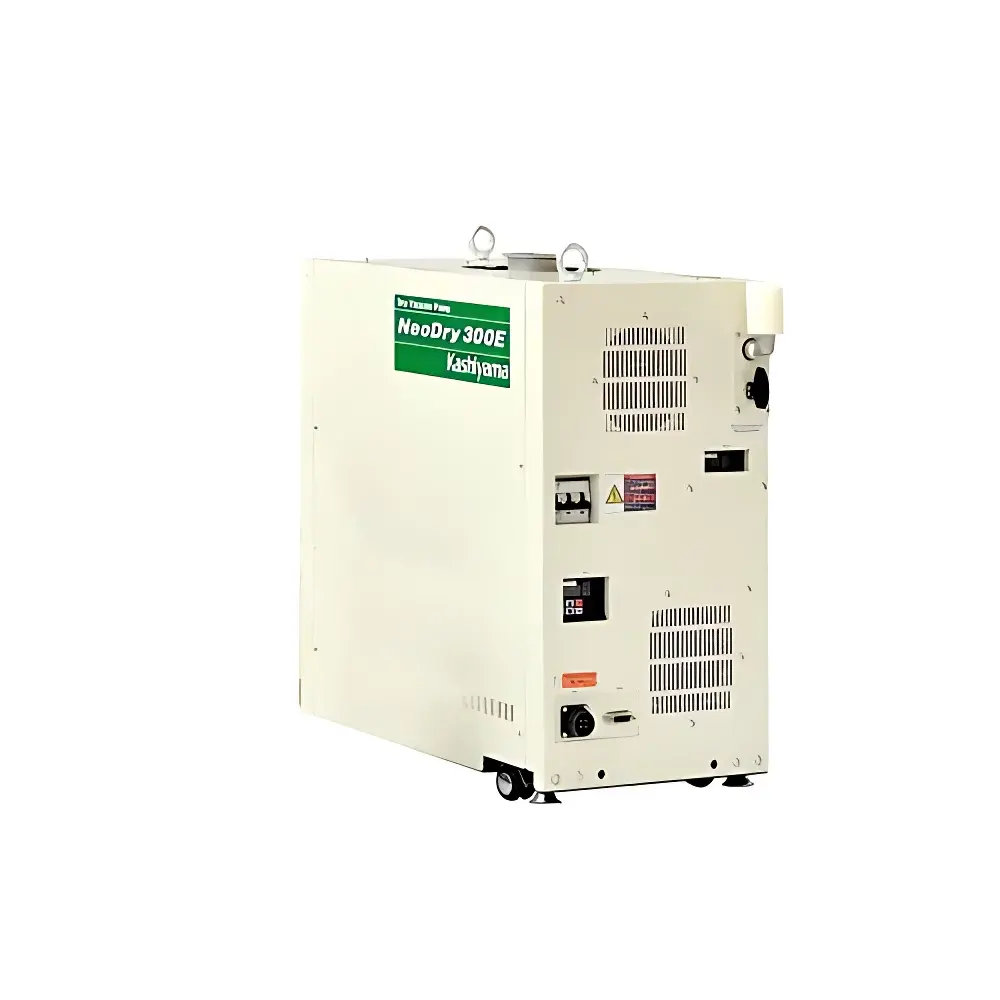
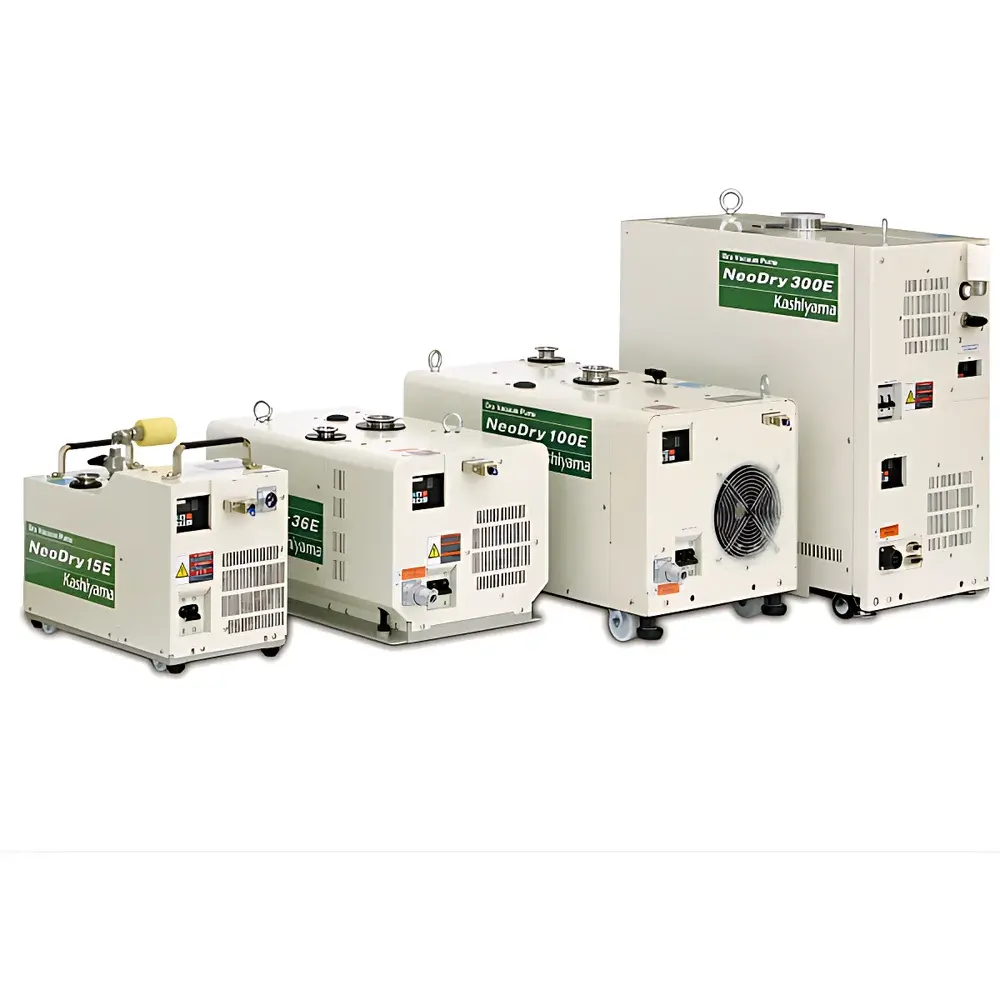
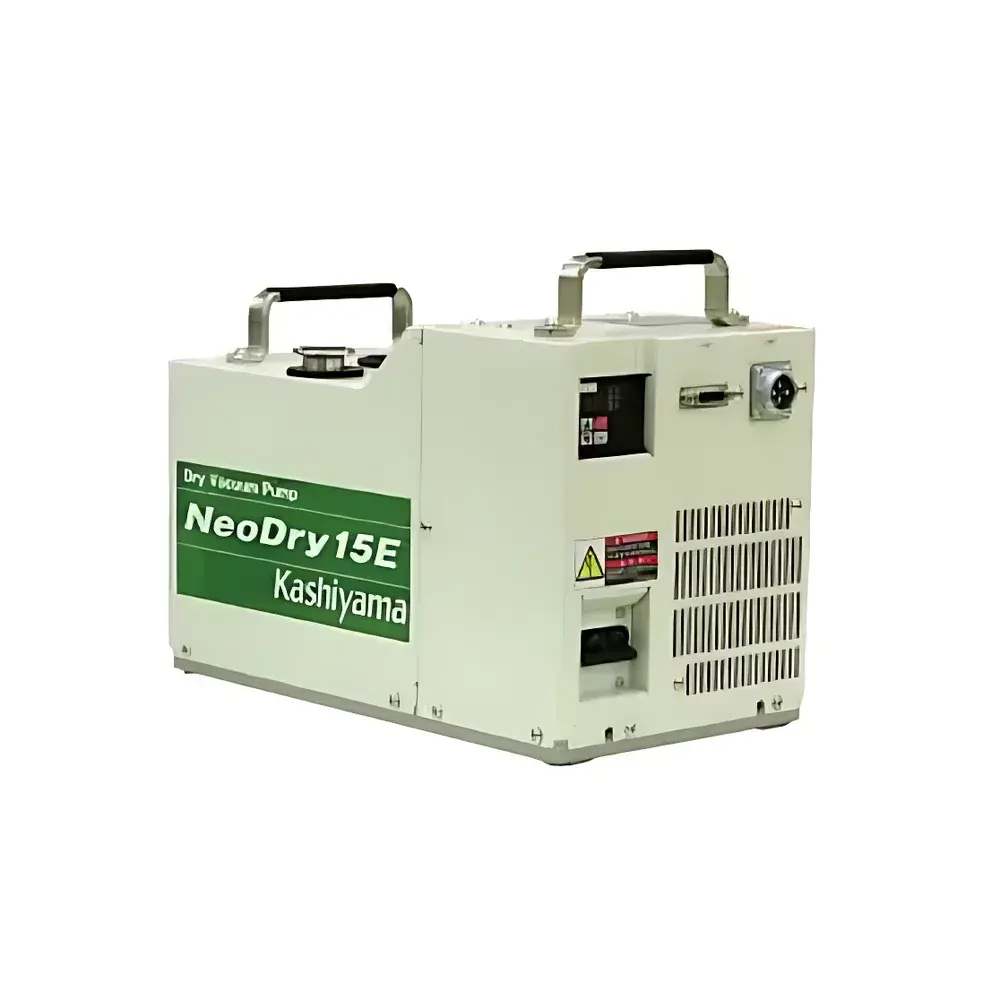
Kashiyama NeoDry300E Oil-Free Dry Scroll Vacuum Pump
| Brand | Kashiyama |
|---|---|
| Origin | Japan |
| Model | NeoDry300E |
| Pump Type | Oil-Free Dry Scroll Vacuum Pump |
| Ultimate Vacuum (without gas ballast) | 0.3 Pa |
| Maximum Pumping Speed | 5,000 L/min |
| Gas Ballast | Standard |
| Max Water Vapor Handling Capacity (with gas ballast) | 600 g/h |
| Noise Level | ≤72 dB(A) |
| Vibration | ≤8 μm p-p |
| Motor Power | Not specified |
| Cooling Method | Air-Cooled |
| Inlet Flange | NW50 |
| Outlet Flange | NW25 |
| Dimensions (L×W×H) | 574×304×575 mm |
| Weight | 125 kg |
| Power Supply | 3-phase AC 200–240 V, 50/60 Hz |
Overview
The Kashiyama NeoDry300E is an oil-free dry scroll vacuum pump engineered for high-reliability, continuous-duty laboratory and industrial applications requiring clean, hydrocarbon-free vacuum environments. Based on Kashiyama’s proprietary dry scroll technology, the NeoDry300E operates without lubricating oil—eliminating risk of backstreaming contamination, oil degradation, or maintenance-related downtime associated with oil-sealed pumps. Its core mechanism relies on two precisely matched spiral scrolls (one fixed, one orbiting) that create progressively smaller crescent-shaped chambers to compress and exhaust gas axially. This contact-free operation—where the orbiting scroll floats on a thin film of process gas—ensures zero mechanical friction between scrolls or between scroll and housing, enabling exceptional long-term dimensional stability and minimal wear under nominal operating conditions.
Key Features
- Oil-free dry scroll architecture: Guarantees contaminant-free vacuum essential for sensitive processes including lithium-ion battery drying, electron microscopy sample preparation, and analytical instrumentation.
- Gas ballast system (standard): Enables stable pumping of condensable vapors—particularly water vapor—by introducing controlled inert gas into the compression chamber prior to final discharge, preventing condensation-induced performance loss or corrosion.
- Air-cooled thermal management: Eliminates dependency on external cooling water circuits—reducing footprint, installation complexity, and risks of leakage or scaling in lab infrastructure.
- Low-noise, low-vibration operation: Engineered with precision-balanced rotor dynamics and vibration-damped mounting; noise level ≤72 dB(A) and peak-to-peak vibration ≤8 μm meet stringent requirements for shared laboratory spaces and vibration-sensitive equipment (e.g., SEM, TEM, AFM).
- Extended maintenance interval: Designed for ≥3-year service cycles under clean, non-abrasive gas handling conditions—significantly reducing total cost of ownership compared to conventional rotary vane or diaphragm pumps.
- Robust 3-phase motor drive: Compatible with standard 200–240 V AC, 50/60 Hz power supplies; motor specifications comply with IEC 60034 standards for industrial-grade reliability.
Sample Compatibility & Compliance
The NeoDry300E is suitable for non-corrosive, non-particulate, and non-explosive gases and vapors. It is not rated for solvent-laden, acidic, or halogenated process streams without upstream trapping or scrubbing. As a general-purpose dry pump, it meets ISO 8573-1 Class 0 (oil-free air) certification requirements for compressed gas purity and complies with CE marking directives (2014/30/EU EMC, 2014/35/EU LVD). While not intrinsically safe, its design supports integration into vacuum systems conforming to IEC 61000-6-2 (immunity) and IEC 61000-6-4 (emission) standards. For regulated environments—including GLP/GMP labs—the pump’s consistent performance, traceable calibration history, and absence of consumable oils facilitate audit readiness and documentation of vacuum integrity.
Software & Data Management
The NeoDry300E operates as a standalone unit with no embedded digital interface or communication port. However, its electrical and mechanical behavior is fully compatible with third-party vacuum system controllers (e.g., via analog 0–10 V or 4–20 mA feedback signals when paired with optional pressure transducers and PLCs). Users integrating the pump into automated workflows—such as vacuum ovens, gloveboxes, or deposition systems—can log operational parameters (on/off status, runtime hours, fault indicators) using external SCADA or LabVIEW-based data acquisition platforms. No firmware updates or cloud connectivity are required; all diagnostics rely on visual inspection, acoustic monitoring, and periodic verification against manufacturer-specified base pressure and pumping speed curves (S–P curve provided in technical documentation).
Applications
- Vacuum drying of hygroscopic materials (e.g., cathode/anode powders in Li-ion battery manufacturing)
- Pre-vacuum stages for high-vacuum systems (e.g., as a forepump for turbomolecular or cryogenic pumps in mass spectrometry and surface analysis)
- Deaeration of resins, adhesives, and coatings prior to casting or molding
- Vacuum packaging of moisture-sensitive electronic components and pharmaceutical intermediates
- Gas purging and inert atmosphere conditioning in gloveboxes and reaction chambers
- Support vacuum for freeze dryers, rotary evaporators, and electron beam evaporation systems
- Continuous vacuum conveyance of fine powders in R&D-scale powder handling systems
FAQ
Is the NeoDry300E suitable for pumping solvent vapors?
No—solvent vapors (e.g., acetone, ethanol, chloroform) are not recommended without upstream cold traps or chemical scrubbers, as they may condense internally or degrade scroll coating integrity.
Can the pump be operated continuously at ultimate vacuum?
Yes—designed for 24/7 duty cycles under clean gas conditions; however, prolonged operation near 0.3 Pa with significant water vapor load requires active gas ballast use and periodic verification of base pressure.
Does the pump require a dedicated exhaust line?
Yes—exhaust must be vented to a well-ventilated area or fume hood when handling potentially hazardous or odorous gases; NW25 outlet flange enables direct connection to standard vacuum tubing or rigid piping.
What is the expected service life under typical lab usage?
With proper inlet filtration and avoidance of particulates or corrosive species, mean time between failures (MTBF) exceeds 20,000 hours; scroll stack replacement is typically required only after >60,000 hours of cumulative operation.
Is remote monitoring or IoT integration supported?
Not natively—the pump has no built-in sensors or communication interfaces; integration into smart lab ecosystems requires external pressure/vibration/temperature sensing and programmable logic control.



