
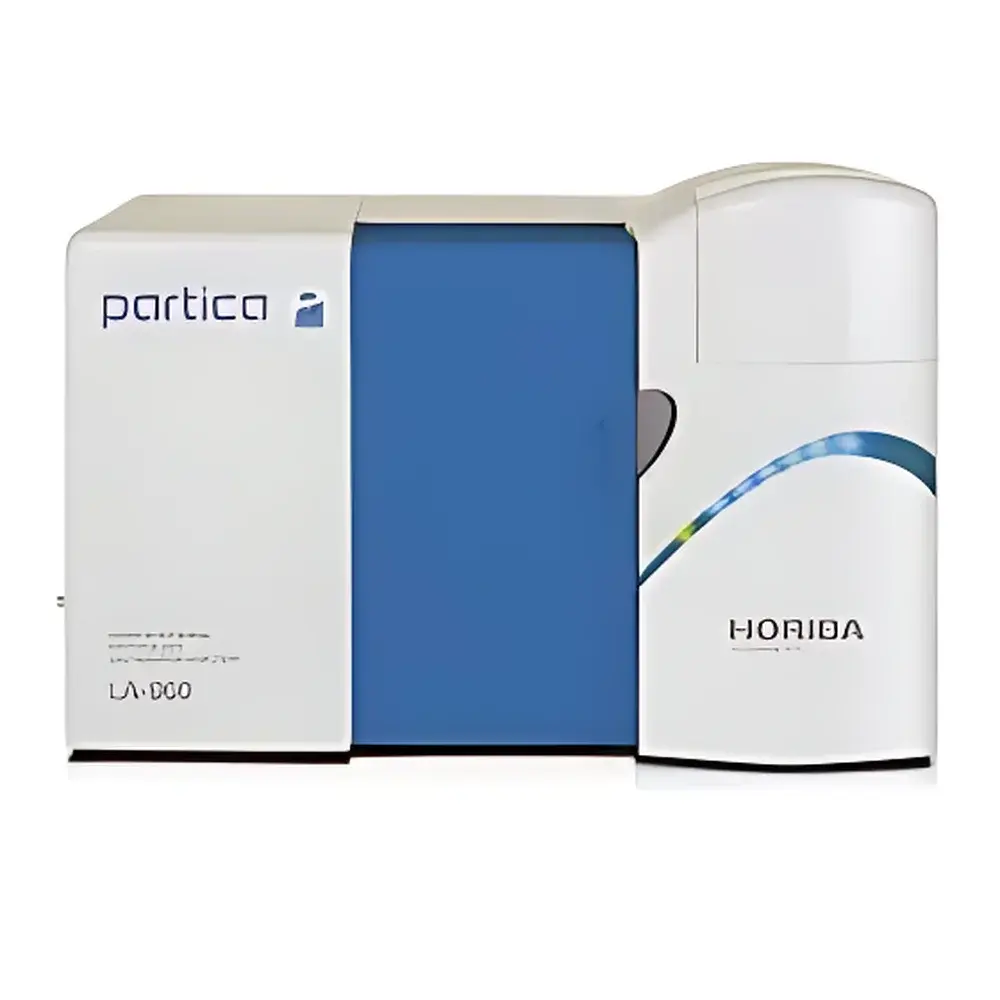
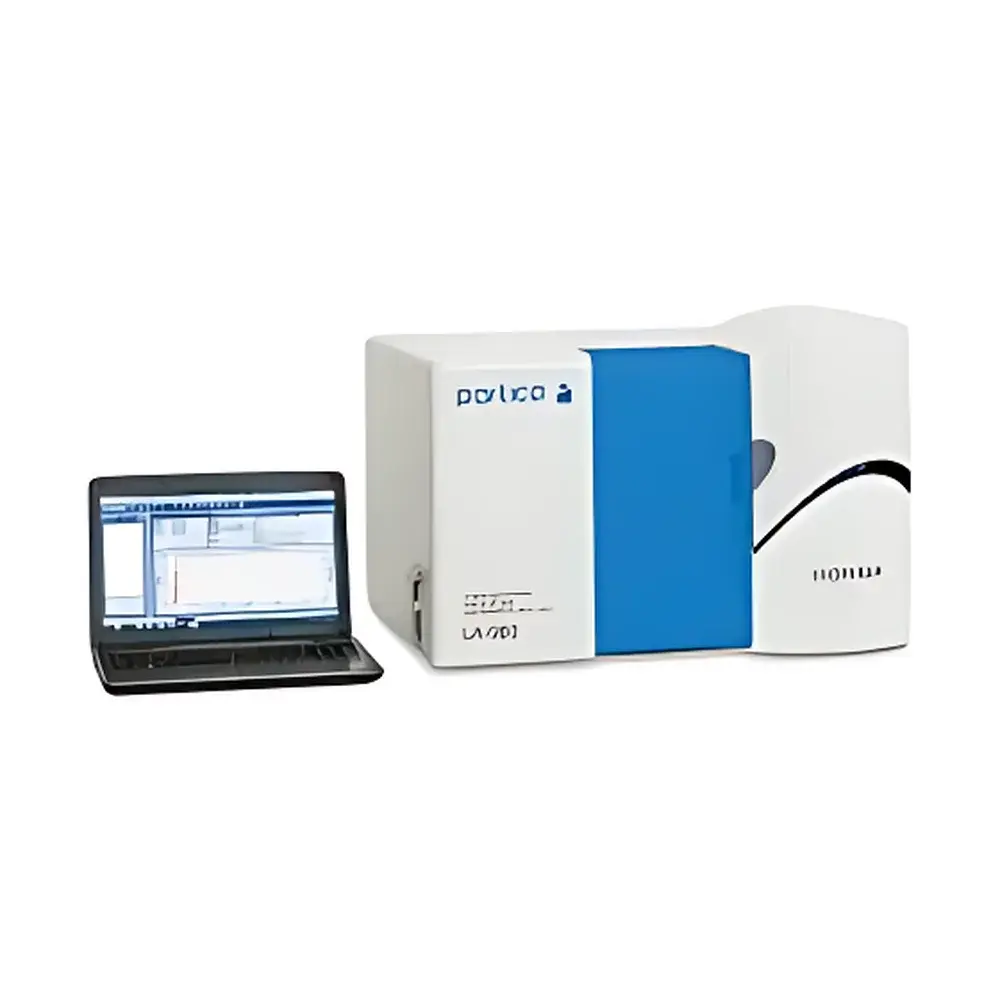
HORIBA LA-960 Laser Particle Size Analyzer
| Brand | HORIBA |
|---|---|
| Origin | Japan |
| Model | LA-960 |
| Dispersion Method | Dry & Wet |
| Measurement Range | 0.01–5000 µm |
| Repeatability | <0.1% |
| Measurement Time | <10 s |
| Compliance | ISO 13320 |
| Accuracy | ±0.6% |
Overview
The HORIBA LA-960 Laser Particle Size Analyzer is an advanced, research-grade instrument engineered for high-precision particle size distribution (PSD) analysis across an exceptionally broad dynamic range—from 0.01 µm (10 nm) to 5000 µm—using the principle of laser diffraction. Based on Mie and Fraunhofer light scattering theory, the LA-960 employs a proprietary three-dimensional optical layout that captures full angular scattering intensity profiles with high fidelity. Unlike conventional two-dimensional detector arrays, its optimized optical architecture integrates precise modeling of lens aberrations, detector responsivity, and source coherence into real-time data inversion algorithms. This enables robust discrimination between sub-20 nm nanoparticles and coarse granules within a single measurement cycle—without hardware reconfiguration or user intervention. Designed as the successor to the LA-950V2, the LA-960 incorporates refined computational optics and enhanced signal-to-noise ratio (SNR) processing to meet stringent requirements in pharmaceutical development, battery material R&D, catalyst characterization, and advanced ceramic manufacturing.
Key Features
- Ultra-wide measurement range: 0.01–5000 µm, validated down to certified 20 nm reference standards
- High repeatability: <0.1% relative standard deviation (RSD) for sequential measurements under controlled conditions
- Rapid analysis: Full PSD acquisition and report generation in less than 10 seconds per sample
- Dual dispersion capability: Integrated dry powder dispersion module (with adjustable jet velocity and vacuum control) and wet dispersion unit (with ultrasonic probe, programmable stirrer, and peristaltic pump)
- Optimized optical design: Patented multi-lens detection system with 128-channel photodiode array and collimated He-Ne laser (632.8 nm) with <0.1% power stability
- ISO 13320-compliant operation: Fully traceable calibration protocol aligned with international standards for laser diffraction methodology
- Robust mechanical architecture: Stainless-steel fluidic pathways, corrosion-resistant wet module housing, and vibration-damped optical bench
Sample Compatibility & Compliance
The LA-960 accommodates diverse sample types—including aqueous suspensions, organic solvents, emulsions, dry powders, and agglomerated nanomaterials—without requiring hardware modification. Its wet dispersion system supports refractive indices from 1.33 to 2.40, enabling accurate analysis of metal oxides, polymers, and biological colloids. For regulated environments, the instrument supports audit-trail-enabled operation compliant with FDA 21 CFR Part 11 when used with optional secure software modules. All measurement protocols adhere to ISO 13320:2020 for laser diffraction particle sizing, and calibration verification follows NIST-traceable reference materials (e.g., NIST SRM 1963, 8012). The system is routinely deployed in GLP and GMP laboratories for QC release testing, formulation development, and stability studies.
Software & Data Management
Operating on Windows-based HORIBA Particle Analysis Software (v4.x), the LA-960 provides intuitive workflow management—from automated method selection and real-time scatter pattern visualization to advanced deconvolution of multimodal distributions. The software includes built-in reporting templates compliant with ASTM E2917 and USP , export options for CSV, PDF, and XML formats, and database integration via ODBC. Raw scattering data files are stored with full metadata (instrument ID, operator, timestamp, environmental conditions, dispersion parameters), ensuring full traceability. Optional network licensing enables centralized administration across multi-user lab environments, while encrypted data storage and role-based access control support regulatory compliance requirements.
Applications
- Pharmaceuticals: Excipient characterization, inhaler formulation optimization, nanoparticle drug carrier validation
- Battery materials: Cathode/anode active material sizing, graphite flake distribution, slurry homogeneity assessment
- Catalysis: Supported metal nanoparticle dispersion analysis, zeolite crystallite size determination
- Coatings & Inks: Pigment agglomeration monitoring, rheology–particle interaction correlation
- Food & Agriculture: Starch granule morphology, dairy protein aggregate quantification, pesticide suspension stability
- Environmental science: Sediment grain-size classification, microplastic identification in water matrices
FAQ
What is the smallest detectable particle size supported by the LA-960?
The LA-960 achieves reliable detection and quantification down to 0.01 µm (10 nm) using optimized Mie theory inversion and low-noise optical detection—validated against NIST-traceable 20 nm polystyrene latex standards.
Does the LA-960 require annual recalibration?
While no mandatory annual recalibration is stipulated, HORIBA recommends quarterly performance verification using certified reference materials and biannual optical alignment checks conducted by certified service engineers.
Can the LA-960 be integrated into an automated production line?
Yes—the instrument supports Ethernet/IP and Modbus TCP communication protocols, enabling direct integration with MES/SCADA systems for at-line or in-process particle size monitoring.
Is wet dispersion compatible with aggressive solvents such as THF or DMF?
The wet module’s fluidic path is constructed from PTFE, PEEK, and sapphire components, making it chemically resistant to most organic solvents; compatibility with specific media should be confirmed using HORIBA’s chemical resistance guide.
How does the LA-960 handle highly polydisperse or bimodal samples?
Its advanced iterative inversion algorithm applies regularization constraints and residual minimization techniques to resolve overlapping modes with high fidelity—even for distributions spanning >5 orders of magnitude in diameter.



