
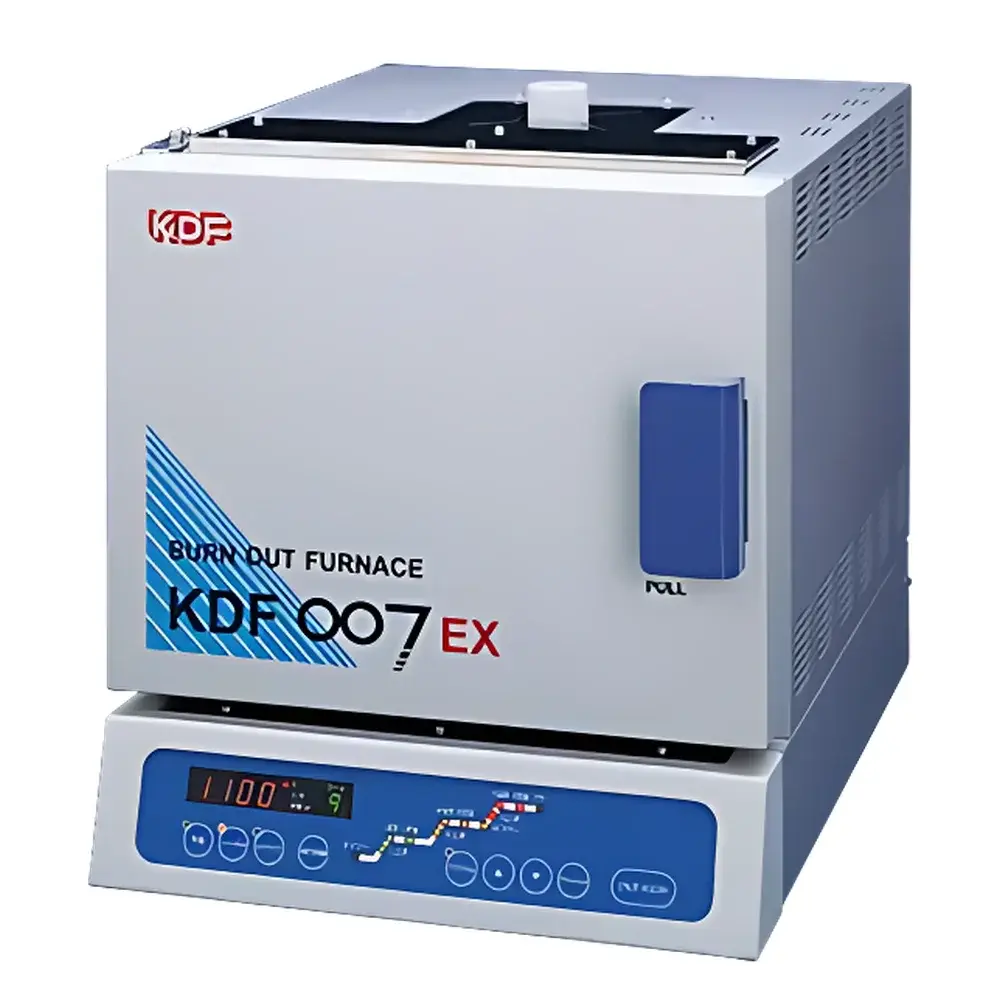
KDF KDF-007EX Benchtop Muffle Furnace
| Brand | KDF |
|---|---|
| Origin | Japan |
| Model | KDF-007EX |
| Instrument Type | Box-Type Muffle Furnace |
| Maximum Temperature | 1100 °C |
| Heating Method | Resistance Wire Heating |
| Internal Dimensions | 120 (W) × 110 (H) × 220 (D) mm |
| Maximum Power | 1800 W |
| Ramp Time to 1100 °C (empty chamber) | 25 min |
| Power Supply | AC 100–240 V ±10%, 50/60 Hz |
| Standby Power Consumption | ~1.8 W |
| Net Weight | 18 kg |
| Operating Ambient | 10–40 °C, 30–90% RH |
| Thermocouple Type | JIS Class K |
| Programmable Profiles | 10 stored programs |
| Temperature Ramp Rate | 1–20 °C/min (adjustable in 1 °C/min increments) |
| Soak Duration | Up to 99 h 50 min (10-min resolution for long holds) |
| Alarm Options | Adjustable audible alert (High/Medium/Low volume or OFF) |
Overview
The KDF KDF-007EX is a compact, high-performance benchtop muffle furnace engineered for precise thermal processing in research laboratories, quality control environments, and small-scale production settings. Designed around a robust resistance-wire heating architecture with ceramic fiber insulation, it delivers rapid, uniform heating up to 1100 °C — a critical threshold for ashing organic samples, heat treatment of ceramics, sintering of metal oxides, and thermal gravimetric pre-conditioning per ASTM E1131 and ISO 11358. Its fully enclosed muffle chamber isolates samples from combustion byproducts and external atmosphere, ensuring contamination-free thermal exposure consistent with GLP-compliant sample preparation workflows. The unit operates without catalytic or gas-assisted heating, relying solely on electrically driven resistive elements calibrated against JIS Class K thermocouples — a standard widely accepted in Japanese industrial metrology and traceable to national temperature standards.
Key Features
- Optimized thermal geometry: Largest internal chamber (120 × 110 × 220 mm) among sub-1200 °C benchtop muffle furnaces in its class, accommodating multiple crucibles or large-format sample trays without compromising temperature homogeneity.
- Programmable multi-stage thermal profiles: Supports up to 10 user-defined programs, each with 1–3 independent segments — including ramp, soak, and cooling phases — enabling standardized calcination, annealing, or loss-on-ignition (LOI) protocols.
- Precise thermal control interface: Digital front-panel controller with intuitive LED status indicators for program stage, active parameter (ramp rate, setpoint, hold time), and alarm condition — eliminating ambiguity during unattended operation.
- Energy-efficient architecture: Standby power draw of only ~1.8 W minimizes parasitic load during idle periods; full-load consumption remains within 1.8 kW, compatible with standard laboratory 15 A circuits.
- Thermocouple-integrated feedback loop: JIS Class K thermocouple mounted directly within the muffle wall ensures real-time, spatially representative temperature monitoring — critical for compliance with USP <631> and ASTM D5630 for ash content determination.
- Modular accessory compatibility: Designed to accept optional Φ90 mm or Φ30 mm crucible support rings (up to two large or thirty-five small units), facilitating parallel sample processing under identical thermal conditions.
Sample Compatibility & Compliance
The KDF-007EX accommodates standard porcelain, alumina, and platinum crucibles as well as quartz boats and silica dishes — all rated for continuous use at ≤1100 °C. Its sealed muffle design prevents cross-contamination between sequential runs, satisfying ISO/IEC 17025 clause 7.2.2 requirements for equipment suitability in accredited testing labs. The furnace meets IEC 61010-1:2010 safety standards for electrical laboratory equipment and complies with Japan’s JIS B 7751-1 for industrial furnaces. While not intrinsically rated for explosive atmospheres, its closed-loop thermal isolation renders it suitable for controlled ashing of halogenated polymers and pharmaceutical excipients under SOP-defined ventilation protocols.
Software & Data Management
This model operates via embedded firmware with no external PC dependency. All program parameters — including ramp rates (1–20 °C/min), soak durations (1 min to 99 h 50 min), and target temperatures — are stored non-volatile memory, retaining configurations after power interruption. Audit-ready operation is supported through visual status logging: LED indicators track active phase, elapsed soak time, and deviation alarms. For laboratories requiring electronic records per FDA 21 CFR Part 11, optional RS-232 or USB-to-serial adapters (sold separately) enable integration with validated LIMS or ELN platforms using ASCII-based command protocols — enabling timestamped export of start/stop events, final soak temperature, and total cycle duration.
Applications
- Gravimetric analysis: Ash content determination in foodstuffs (AOAC 942.05), soils (EPA Method 9080), and plastics (ASTM D5630).
- Material synthesis: Pre-sintering of ferrites, lithium-ion cathode precursors, and sol-gel derived oxides.
- Metallurgical testing: Heat treatment of small alloy coupons prior to hardness or microstructural evaluation.
- Environmental lab workflows: Residue ignition in TSS/TDS filtration protocols and catalyst regeneration studies.
- Educational use: Demonstrating Arrhenius kinetics, phase transitions, and thermal decomposition mechanisms in undergraduate chemistry and materials science curricula.
FAQ
What is the temperature uniformity across the chamber at 1100 °C?
Measured uniformity is ±8 °C (±0.7%) within the central 70% volume when stabilized for ≥30 min, per internal validation report KDF-007EX-TP-2023-04.
Can this furnace be used for inert-atmosphere processing?
No — the KDF-007EX is air-atmosphere only. For nitrogen or argon purging, a dedicated tube furnace with gas inlet/outlet ports is recommended.
Is calibration certificate included with shipment?
A factory-as-tested verification report (including thermocouple offset at 500 °C and 1000 °C) is supplied. NIST-traceable calibration documentation requires separate purchase and on-site verification.
What maintenance is required to sustain performance?
Annual inspection of heating element continuity, thermocouple junction integrity, and ceramic fiber insulation density is advised. No lubrication or consumable replacement is specified under normal operating conditions.
Does the unit support remote monitoring or network connectivity?
Not natively. Integration with building management systems or SCADA networks requires third-party analog signal converters (e.g., 4–20 mA output modules) interfaced to the internal thermocouple signal path.



