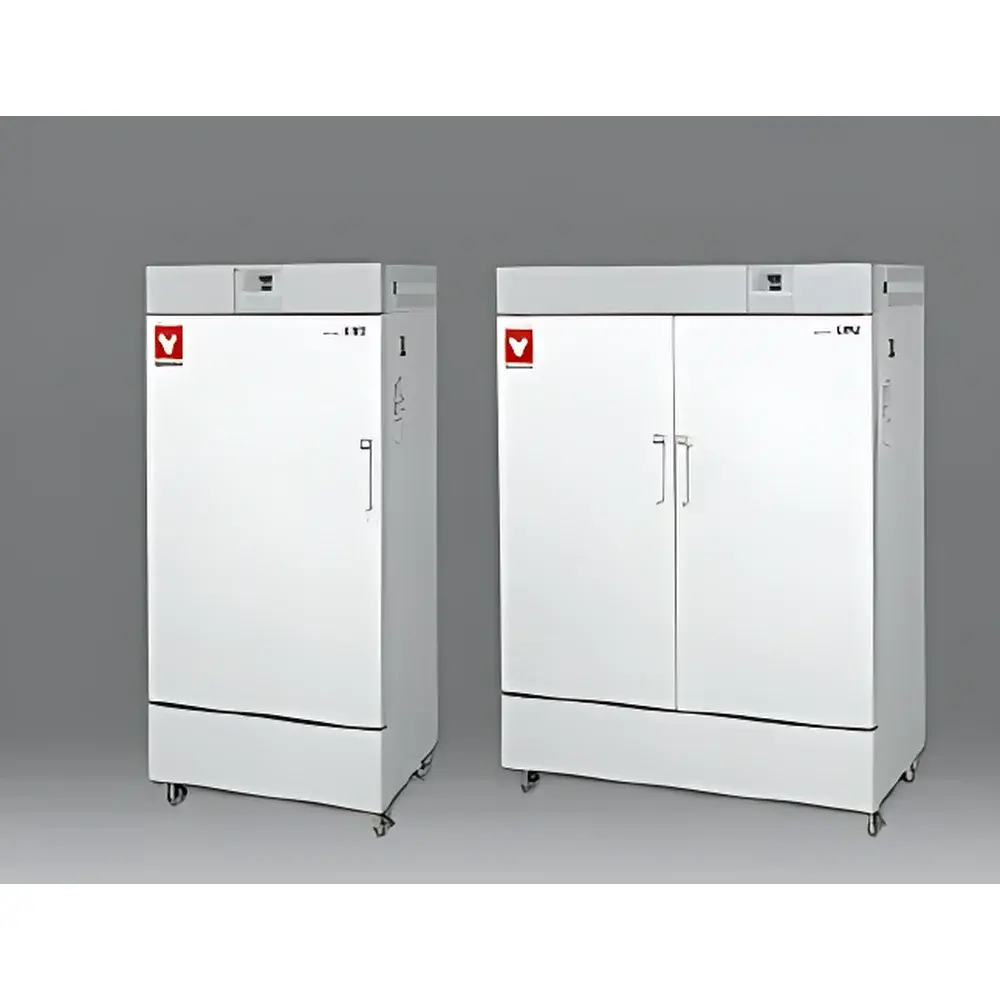
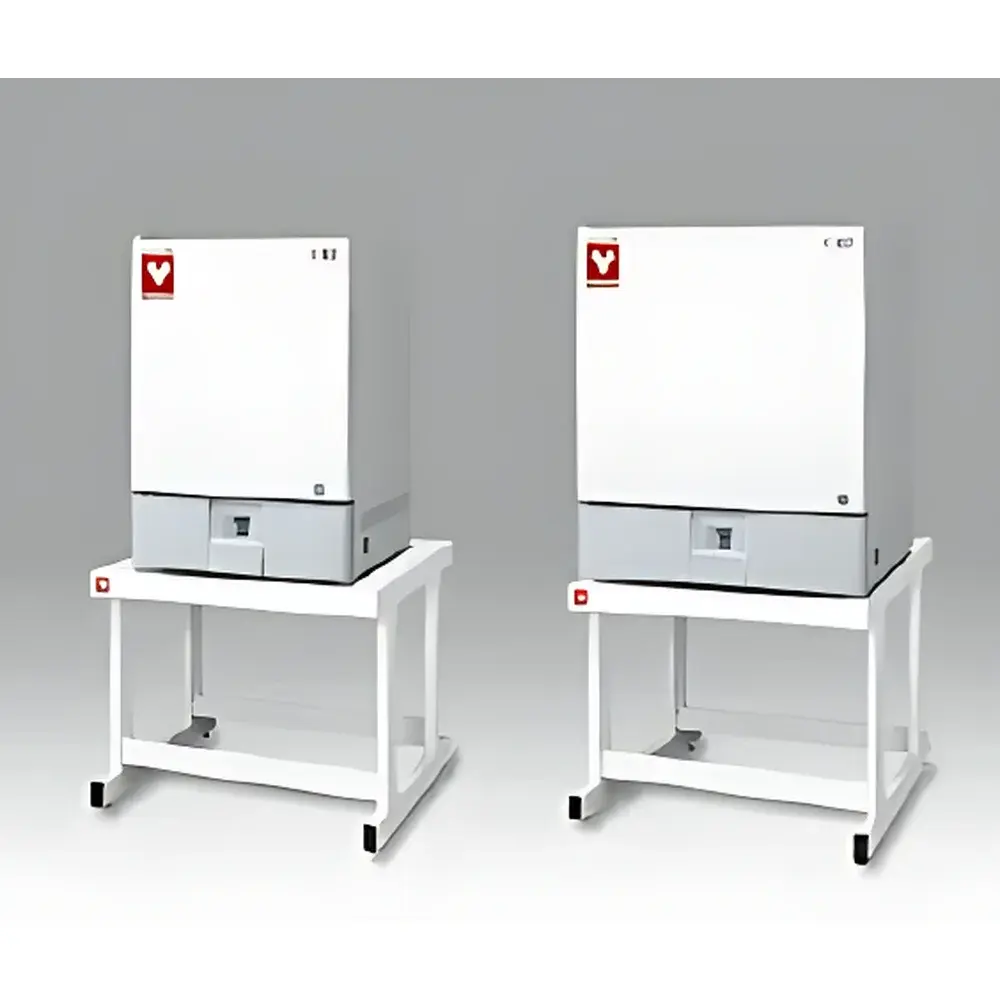
YAMATO IC812C Forced-Air Constant-Temperature Incubator
| Brand | YAMATO |
|---|---|
| Origin | Japan |
| Model | IC812C |
| Temperature Range | Ambient +5°C to 80°C |
| Temperature Uniformity | ±1.0°C (at 37°C, steady state) |
| Capacity | 318 L |
| Humidity Control | None (Dry Incubation Only) |
| Heating Method | Air-Jacketed Forced Convection |
| Door Configuration | Dual-Door with Tempered Glass Inner Door |
| Safety Features | Dual Independent Over-Temperature Protection, Heater Circuit Break Detection, SSR Fault Monitoring, Ground-Fault Circuit Interrupter (GFCI), Keypad Lock, Self-Diagnostic System |
Overview
The YAMATO IC812C is a high-reliability, air-jacketed forced-convection constant-temperature incubator engineered for stable, long-term thermal environments in life science laboratories. Designed for dry incubation applications—such as bacterial culture propagation, enzyme activity assays, cell line maintenance (non-CO₂-dependent), and material stability testing—the IC812C employs an optimized airflow architecture that ensures uniform heat distribution across its 318 L working chamber. Unlike water-jacketed systems, the air-jacketed design eliminates condensation risk, reduces startup time, and enables rapid temperature recovery after door openings. The unit operates within a precisely controlled range of ambient +5°C to 80°C, with temperature uniformity maintained at ±1.0°C (measured per ISO 15265:2021 methodology at 37°C under steady-state conditions). Its robust mechanical construction, including reinforced insulation and dual-door sealing, minimizes thermal drift and energy consumption during extended operation.
Key Features
- Air-jacketed forced convection system with tangential blower and baffle-guided airflow for enhanced thermal homogeneity
- Dual-door configuration: outer insulated door and inner tempered glass door—enabling real-time visual monitoring without compromising chamber integrity
- Microprocessor-based PID temperature controller with programmable setpoint memory and deviation correction capability
- Multi-stage operational modes: constant-value operation, automatic start/stop scheduling, and fast cool-down termination
- Comprehensive safety architecture: dual independent over-temperature cutoffs (mechanical and electronic), heater open-circuit detection, SSR short-circuit monitoring, and GFCI-protected power supply
- User-accessible keypad lock function to prevent unauthorized parameter changes—critical for GLP-compliant workflows
- Integrated self-diagnostic routine that continuously monitors sensor integrity, heating element continuity, and control circuit health
Sample Compatibility & Compliance
The IC812C accommodates standard laboratory vessels—including Petri dishes, multi-well plates, flasks, and test tubes—on adjustable stainless-steel shelves (standard configuration: 3 shelves, load capacity ≤15 kg per shelf). Its dry incubation design excludes humidity control, making it suitable for applications where moisture-induced condensation or microbial cross-contamination must be avoided. The unit complies with IEC 61010-1:2010 for electrical safety in laboratory equipment and meets EMC requirements per IEC 61326-1:2020. While not certified for medical device use under ISO 13485, its operational repeatability and traceable temperature performance support adherence to ISO/IEC 17025:2017 calibration requirements when paired with external NIST-traceable thermistors.
Software & Data Management
The IC812C operates via embedded firmware with no external PC dependency; all parameters are configured through a front-panel membrane keypad and LCD interface. Real-time temperature logging is not natively supported, but optional analog output (0–10 V DC) allows connection to third-party data acquisition systems for continuous monitoring and archival. For regulated environments, users may integrate the unit into facility-wide environmental monitoring networks using external validated chart recorders or compliant SCADA platforms. Though the device does not implement FDA 21 CFR Part 11 electronic signature functionality, its keypad lock and diagnostic logs provide foundational audit trail elements aligned with basic GLP documentation practices.
Applications
- Bacterial and fungal culture incubation (e.g., E. coli, S. aureus, A. niger) per ASTM D5589 and ISO 8587
- Enzyme kinetics studies requiring stable thermal conditions between 25°C and 60°C
- Stability testing of pharmaceutical excipients and diagnostic reagents under ICH Q1A(R2) guidelines
- Seed germination and plant tissue culture pre-incubation (non-humidified protocols)
- Material aging tests for polymers and adhesives per ASTM D3045
- Quality control incubation for food microbiology labs operating under ISO 7218
FAQ
Does the IC812C support CO₂ or humidity control?
No. The IC812C is a dry, temperature-only incubator with no integrated humidification or gas regulation system.
What is the recommended calibration interval for routine use?
YAMATO recommends annual verification using NIST-traceable reference thermometers; more frequent checks are advised in GxP environments or after mechanical impact.
Can the inner glass door be removed for cleaning or maintenance?
Yes—the tempered glass inner door is tool-free removable and autoclavable up to 121°C for decontamination.
Is the IC812C suitable for BSL-2 applications?
It is not inherently BSL-2 certified; however, when installed in a certified biosafety cabinet or containment room with appropriate exhaust management, it may be used for non-aerosol-generating procedures.
What type of temperature sensor is used in the IC812C?
A platinum resistance thermometer (Pt100) with Class B tolerance (IEC 60751) is employed for primary chamber sensing.