
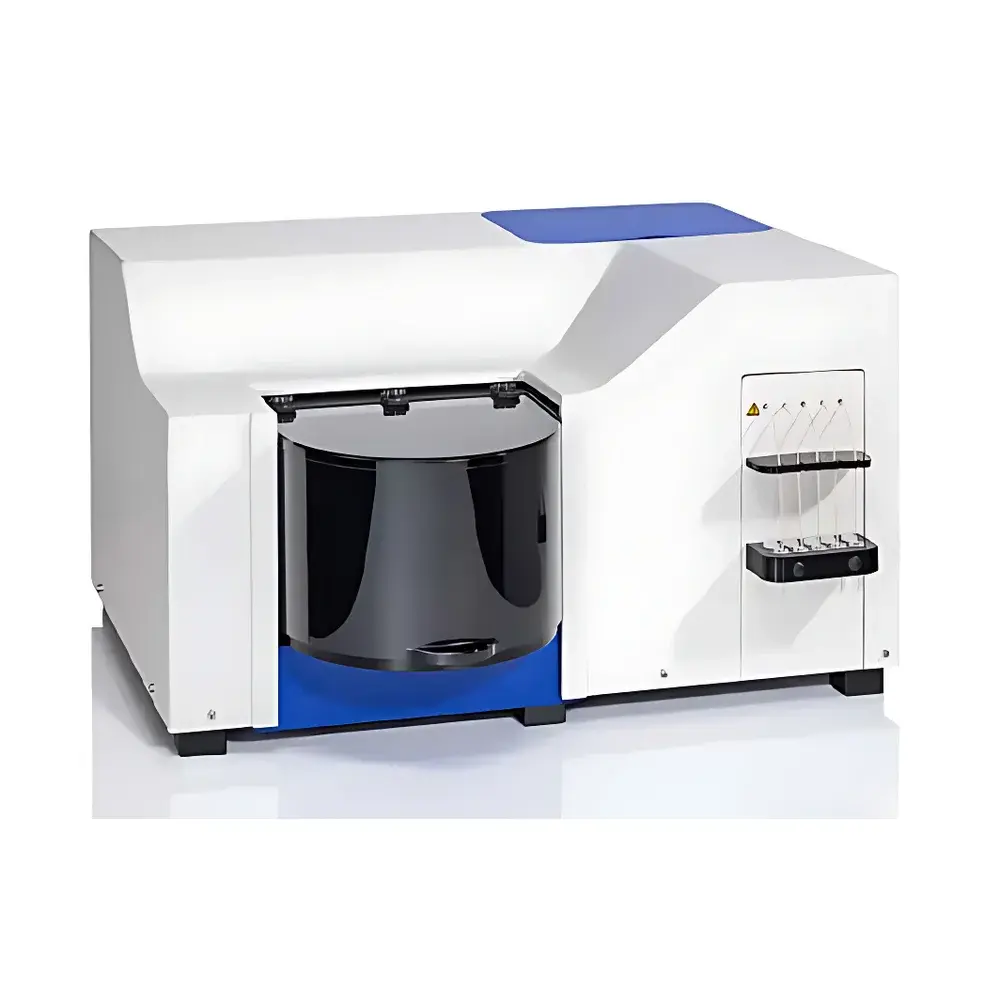
Biametrics b-screen High-Throughput Label-Free Molecular Interaction Analyzer
| Brand | Biametrics |
|---|---|
| Origin | Germany |
| Model | b-screen |
| Channel Type | Multi-channel |
| Sample Capacity | >20,000 spots per run |
| Analysis Rate | 1–10 Hz |
| Detection Principle | SCORE (Single-Colour Reflectometry) based on optical interference |
| Sensitivity | 1 pg/mm² |
| Kinetic Range | kₐ = 10³–10⁷ M⁻¹s⁻¹ |
| Sample Matrix Compatibility | DMSO-containing buffers, cell culture media, urine, plasma, serum, whole blood |
| Sample Types | Proteins, antibodies, peptides, DNA/RNA, polysaccharides, lipids, small molecules, cells, viruses, nanoparticles |
| Consumable | High-density biochip (>20,000 immobilization sites) |
Overview
The Biametrics b-screen High-Throughput Label-Free Molecular Interaction Analyzer is an engineered platform for real-time, quantitative analysis of biomolecular interactions without the need for fluorescent, enzymatic, or radioactive labeling. It leverages patented SCORE (Single-Colour Reflectometry) technology—a label-free optical detection method grounded in thin-film interference principles—where binding-induced changes in the effective optical thickness of a functionalized sensor surface modulate the intensity of reflected monochromatic light. This enables highly reproducible, mass-sensitive detection at sub-pg/mm² resolution across thousands of parallel reaction sites. Designed specifically for industrial-scale screening and translational research environments, the b-screen delivers kinetic and affinity data under physiologically relevant conditions—including complex biological matrices—while maintaining robust signal-to-noise performance and minimal non-specific binding artifacts.
Key Features
- True high-throughput architecture supporting >20,000 independent interaction measurements per single chip run—enabling full dose-response matrices, epitope binning panels, or large-scale target engagement profiling in one experiment.
- Real-time kinetic acquisition at up to 10 Hz per spot, facilitating accurate determination of association (kₐ) and dissociation (kd) rate constants across six orders of magnitude (kₐ: 10³–10⁷ M⁻¹s⁻¹; kd: 10⁻⁶–0.5 s⁻¹).
- Direct quantification of analyte concentration in crude samples (e.g., cell lysates, serum, whole blood) without calibration curves—leveraging stoichiometric binding response and reference-subtracted baseline correction.
- Automated microfluidic flow system with precise temperature control (15–40 °C) and integrated pressure regulation to ensure laminar, low-shear delivery across the entire biochip surface.
- Modular sensor chip design compatible with standard amine-, thiol-, or streptavidin-based immobilization chemistries, enabling rapid assay development for diverse biomolecule classes including membrane proteins, glycans, and extracellular vesicles.
Sample Compatibility & Compliance
The b-screen accommodates a broad spectrum of sample types and matrices without pre-purification or dilution: recombinant proteins, monoclonal antibodies, synthetic peptides, oligonucleotides, glycoconjugates, lipid bilayers, primary immune cells, enveloped viruses, and polymeric nanoparticles. Its optical detection scheme is inherently insensitive to absorbance or turbidity, permitting direct analysis in 10% DMSO, 50% human plasma, or undiluted cell culture supernatants. The instrument meets essential regulatory requirements for GxP-aligned workflows: raw data files are timestamped, immutable, and stored with full audit trail metadata; software supports user role-based access control and electronic signatures compliant with FDA 21 CFR Part 11. All assays can be documented per ISO/IEC 17025 and aligned with ICH Q5C stability guidance for biologics characterization.
Software & Data Management
The b-screen Control & Analysis Suite provides integrated experimental design, real-time monitoring, and model-based fitting within a validated, version-controlled environment. Kinetic analysis employs global fitting algorithms (1:1 Langmuir, bivalent analyte, heterogeneous ligand) with residual mapping and parameter correlation diagnostics. Batch processing supports automated QC flagging (e.g., drift threshold, Rmax deviation, chi² > 1.5), while export modules generate MIAME-compliant reports and structured CSV/TSV outputs for LIMS integration. Raw sensorgrams and processed results are archived in HDF5 format—ensuring long-term readability and interoperability with Python-based analysis pipelines (e.g., SciPy, PySPR).
Applications
- High-throughput screening of antibody-antigen binding kinetics during lead optimization and developability assessment.
- Label-free characterization of protein-protein interaction networks in signaling pathway reconstitution studies.
- Cell-based binding assays using intact adherent or suspension cells captured on functionalized chips—enabling receptor occupancy quantification under native membrane context.
- Diagnostic biomarker validation via direct detection of autoantibodies or pathogen-specific IgG/IgM in clinical serum cohorts.
- Binding stoichiometry and avidity analysis of multivalent interactions (e.g., FcγR engagement, lectin-glycan clustering) where traditional SPR suffers from mass transport limitation.
FAQ
What sample preparation is required prior to analysis on the b-screen?
Minimal preparation is needed: samples may be loaded directly in native buffers, cell culture media, or clinical matrices—provided particulates are removed by centrifugation (10,000 × g, 5 min) or filtration (0.22 µm). No labeling, biotinylation, or purification is mandatory.
Can the b-screen quantify binding affinities in complex mixtures such as serum or lysate?
Yes—its matrix-tolerant detection and reference-compensated signal processing allow accurate KD determination even in 100% human serum, provided the target concentration exceeds the LOD (~10 pM for IgG-class analytes).
Is the b-screen compatible with Good Manufacturing Practice (GMP) environments?
The system supports 21 CFR Part 11 compliance through secure user authentication, electronic signatures, and tamper-evident audit logs—making it suitable for release testing and comparability studies in regulated biomanufacturing.
How frequently must the sensor chip be replaced?
Each high-density biochip supports ≥50 regeneration cycles using mild pH or chaotropic washes, depending on immobilization chemistry—translating to hundreds of experiments per chip when used in screening mode.
Does the b-screen support custom assay development services?
Biametrics offers application support packages including chip functionalization protocols, kinetic assay validation reports, and GLP-compliant method transfer documentation for contract research organizations and pharmaceutical QA/QC labs.





