
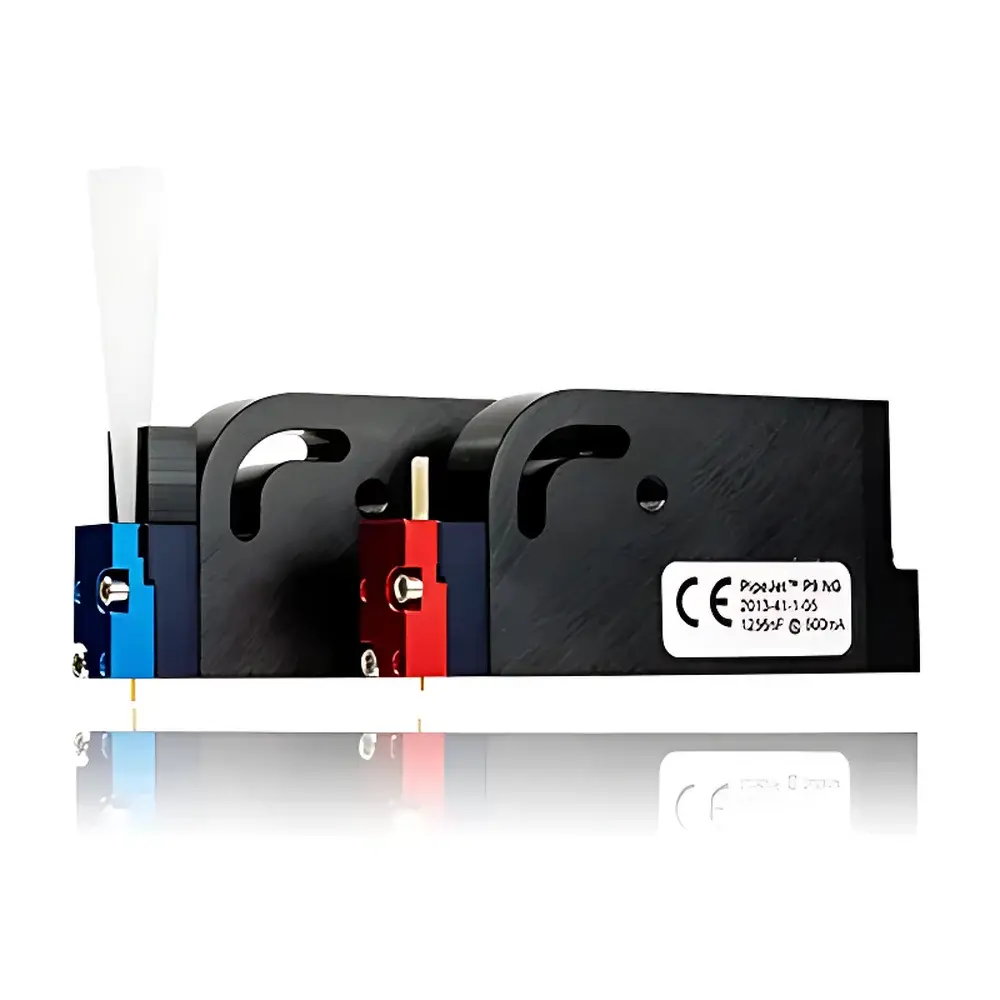
BioFluidix SiJet/PipeJet Piezoelectric Non-Contact Dispensing Modules for Biochip Spotting Systems
| Brand | BioFluidix |
|---|---|
| Origin | Germany |
| Model | SiJet/PipeJet Pipe |
| Dispensing Range (SiJet) | 150–250 pL |
| Dispensing Range (PipeJet) | 1–70 nL |
| Actuation Principle | Piezoelectric piston-driven microfluidic displacement |
| Compatible Platforms | BioSpot microfluidic liquid handling workstations and other third-party spotting systems |
| Sample Types | Nucleic acids, proteins, carbohydrates, antibodies, oligonucleotides, and other biomolecular solutions |
| Regulatory Context | Designed for GLP-compliant lab environments |
Overview
The BioFluidix SiJet and PipeJet piezoelectric dispensing modules are precision-engineered non-contact liquid handling components designed for high-fidelity deposition in biochip fabrication, microarray printing, and miniaturized assay development. These modules operate on a displacement-based microfluidic principle: the SiJet utilizes an integrated microfluidic chip where piezoelectric actuation induces controlled gas–liquid volume displacement, enabling sub-nanoliter droplet generation; the PipeJet employs a compliant microcapillary tube (the “dispensing pipe”) that is dynamically compressed by a piezoelectric piston—generating pressure pulses that eject discrete nanoliter-scale volumes without nozzle contact or wetting. Both architectures eliminate cross-contamination risks associated with contact printing and support ultra-low-volume delivery with high shot-to-shot reproducibility (<3% CV at nominal volumes), making them suitable for applications demanding spatial resolution down to 100 µm and spot uniformity across heterogeneous substrates including glass slides, silicon wafers, nitrocellulose membranes, and functionalized polymer surfaces.
Key Features
- Piezoelectric actuation ensures rapid response time (<100 µs) and precise temporal control over droplet ejection frequency (up to 1 kHz for PipeJet, up to 500 Hz for SiJet)
- Non-contact dispensing eliminates tip clogging, surface scratching, and carryover—critical for viscous or particulate-laden biological samples
- Modular design enables seamless integration into BioSpot liquid handling platforms as well as custom-built spotting systems via standardized mechanical and electrical interfaces (e.g., TTL trigger input, 24 V DC power)
- Calibration-free operation across defined volume ranges: SiJet delivers 150–250 pL per pulse; PipeJet delivers 1–70 nL per pulse—both traceable to SI units via gravimetric and interferometric verification protocols
- Thermally stable housing (operating range: 15–30 °C) minimizes thermal drift during extended print runs; optional temperature-controlled stage interface available for humidity-sensitive formulations
Sample Compatibility & Compliance
These modules accommodate a broad spectrum of aqueous and low-viscosity biological solutions—including DNA/RNA probes (0.1–100 ng/µL), recombinant proteins (0.05–5 mg/mL), glycoproteins, monoclonal antibodies, and carbohydrate conjugates—without requiring surfactants or carrier matrices. Surface tension and viscosity limits are empirically validated up to 15 mN/m and 10 cP respectively. All wetted materials (e.g., FEP capillaries, PEEK manifolds, platinum–iridium electrodes) comply with USP Class VI biocompatibility standards and are certified non-pyrogenic. The system architecture supports audit-ready data integrity workflows: dispensing logs—including timestamped pulse count, voltage amplitude, and environmental sensor readings—can be exported in CSV or HDF5 format for FDA 21 CFR Part 11–compliant record retention.
Software & Data Management
BioFluidix provides the open-architecture BioControl Suite SDK (C++/Python APIs) for direct integration with LabVIEW, MATLAB, or custom LIMS environments. Real-time monitoring includes piezo drive waveform visualization, pulse synchronization diagnostics, and automated self-test routines prior to each print session. All dispensing parameters—including dwell time, acceleration profile, and backpressure compensation—are programmable per spot group, enabling gradient printing, multi-analyte co-spotting, and spatially resolved dose-response arrays. Exported datasets include XY coordinates, volume metadata, and hardware status flags—structured to align with MIAME and MIAPE reporting guidelines for microarray data submission.
Applications
- High-density nucleic acid microarrays for genotyping, expression profiling, and methylation analysis
- Protein microarrays for epitope mapping, serological screening, and kinase substrate identification
- Carbohydrate microarrays supporting glycomics and lectin-binding studies
- On-chip cell patterning via immobilized extracellular matrix proteins or synthetic adhesion peptides
- Preparation of QC reference slides for digital pathology image calibration and AI training datasets
- Deposition of CRISPR gRNA libraries onto functionalized surfaces for pooled screening platforms
FAQ
What is the minimum recommended surface tension for reliable SiJet/PipeJet dispensing?
Surface tension should remain between 25–40 mN/m for optimal meniscus stability and drop formation; lower values may require solvent adjustment or surfactant optimization.
Can these modules dispense glycerol-containing storage buffers?
Yes—up to 20% (v/v) glycerol is supported; higher concentrations require reduced dispensing frequency and elevated drive voltage calibration.
Is nozzle cleaning required between sample changes?
No physical cleaning is needed due to non-contact operation; however, a 30-second air purge cycle is recommended to evacuate residual vapor from the microcapillary path.
How is volume accuracy verified during routine operation?
Gravimetric validation using certified analytical balances (0.1 µg resolution) and fluorescent dye dilution assays (measured via microplate fluorometry) are performed quarterly per ISO/IEC 17025-accredited internal SOPs.
Are OEM integration kits available for custom instrument developers?
Yes—BioFluidix offers mechanical mounting fixtures, electrical interface boards (with opto-isolated triggers), and firmware development support under NDA.



