
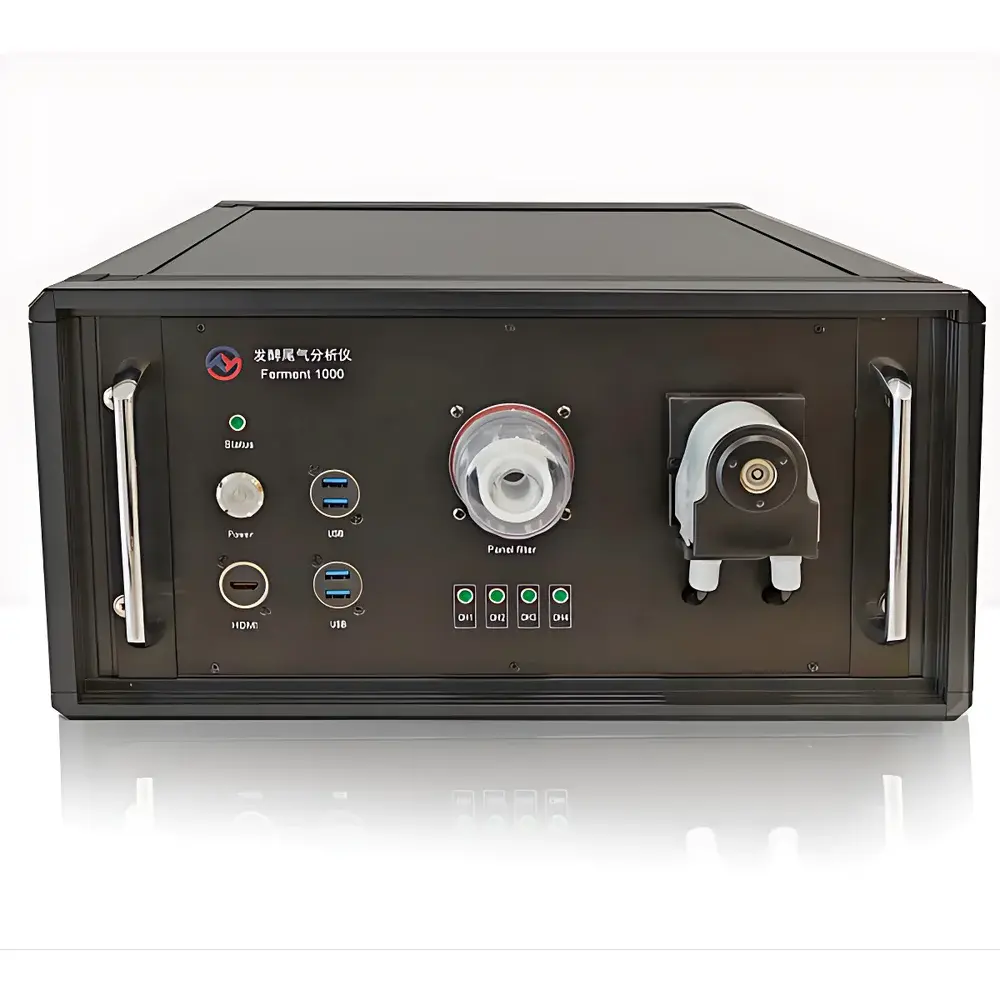
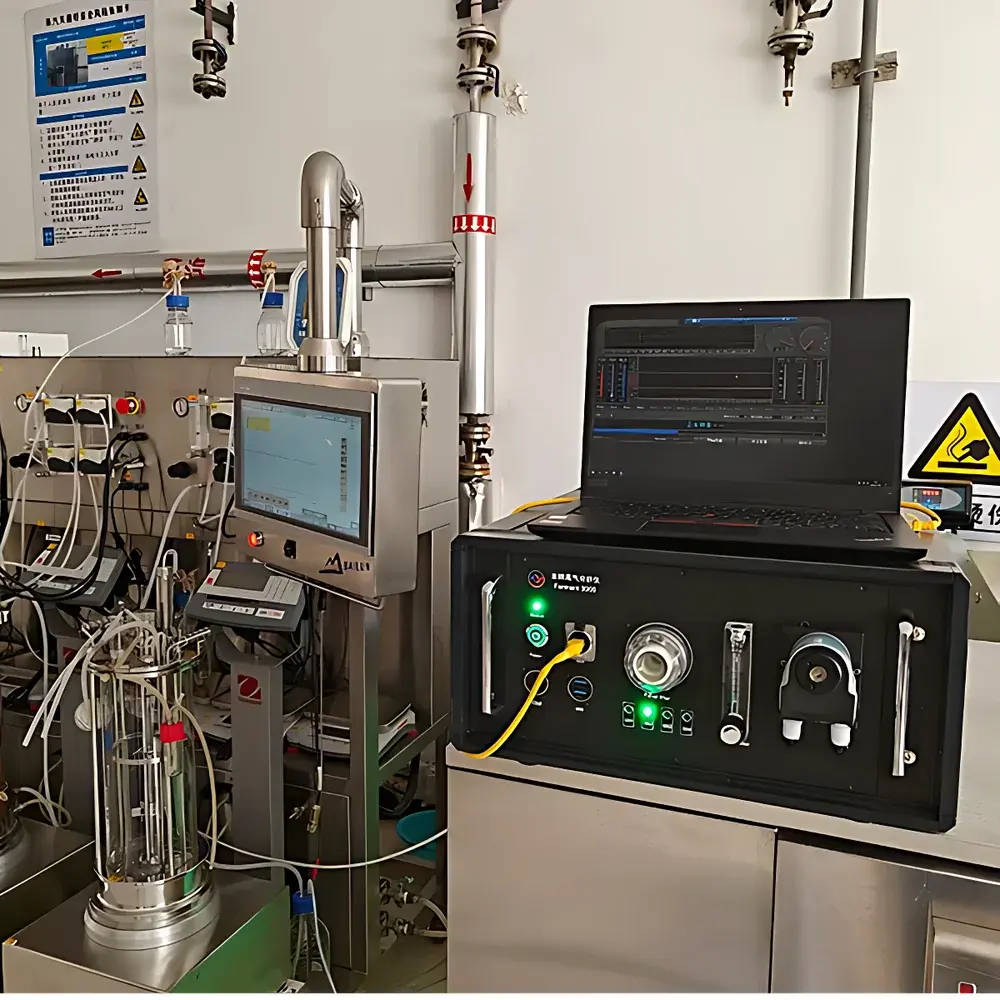
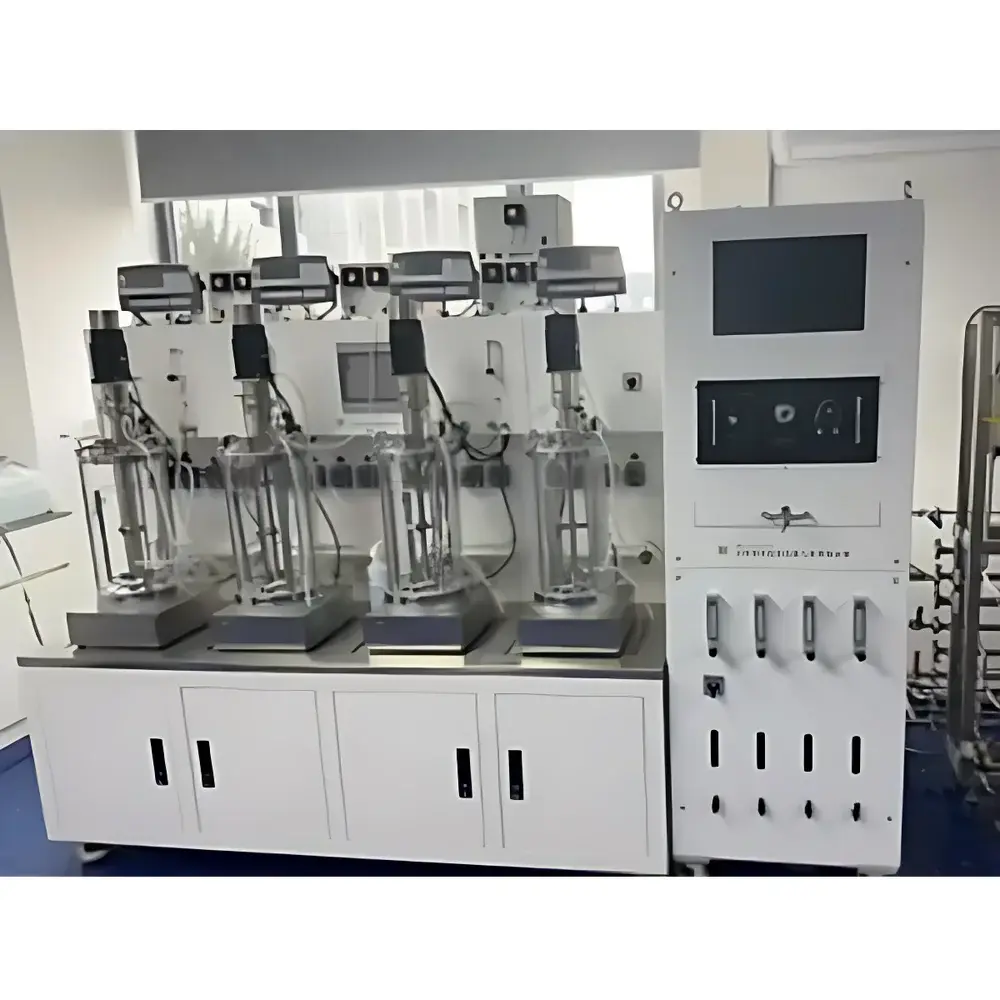
TCT FERMENT1000 Online Fermentation Off-Gas Analyzer
| Brand | TCT (Xiamen Tongchuang) |
|---|---|
| Origin | Fujian, China |
| Instrument Type | Fully Automated |
| Detection Method | NDIR (CO₂, CH₄), NDUV (H₂S), Electrochemical or PMD Paramagnetic (O₂) |
| Measured Gases | CO₂, O₂, CH₄, H₂S |
| Accuracy | ≤ ±1.5% of reading or ±0.2% FS (CO₂/CH₄), ≤ ±1.5% of reading or ±1% FS (H₂S) |
| Zero Drift | CO₂ ≤ ±0.1%/8h |
| Span Drift | CO₂ ≤ ±0.1% FS/8h |
| Repeatability | CO₂ ≤ ±1% FS |
| Linearity | 0.99 ≤ slope ≤ 1.01 |
| Response Time (T90) | < 3 s (at inlet) |
| Sampling Frequency | 1 Hz |
| Gas Conditioning | Integrated electronic cooler (4–5°C), particulate filter, flow meter, condensate detection |
| Output | Standard Modbus RTU (RS-485), optional analog (0–5 V / 4–20 mA) |
| Channels | Configurable 1–12 multi-tank sequential sampling |
| Dimensions (W×H×D) | 450 mm × 370 mm × 310 mm |
| Weight | ~20 kg (EC-4 configuration) |
| Operating Temperature | 5–45 °C |
| Storage Temperature | −25 to +65 °C |
| Relative Humidity | ≤95% RH (non-condensing) |
| Power Supply | 230 V AC |
| Warm-up Time | < 1 h (at 20 °C) |
| Ingress Protection | IP20 |
Overview
The TCT FERMENT1000 is a fully automated, multi-channel online fermentation off-gas analyzer engineered for continuous, real-time monitoring of metabolic gas exchange in aerobic and anaerobic bioprocesses. It employs industry-validated physical detection principles—non-dispersive infrared (NDIR) spectroscopy for CO₂ and CH₄, non-dispersive ultraviolet (NDUV) absorption for H₂S, and either electrochemical or paramagnetic (PMD) sensing for O₂—to deliver high-fidelity, trace-level concentration data directly from exhaust streams. Unlike offline GC or manual sampling methods, the FERMENT1000 enables uninterrupted acquisition at 1 Hz resolution, with built-in temperature and pressure compensation, electronic cooling (4–5 °C), and integrated particulate filtration to ensure measurement stability under variable fermentation conditions. Its core function extends beyond raw gas quantification: embedded firmware performs on-the-fly stoichiometric calculations—including oxygen uptake rate (OUR), carbon dioxide evolution rate (CER), and respiratory quotient (RQ)—using standardized mass balance equations compliant with ISO 14851 and ASTM E1338 protocols. This transforms transient gas signals into actionable biokinetic parameters essential for process understanding, scale-up validation, and regulatory documentation.
Key Features
- Multi-analyte capability: Simultaneous real-time detection of CO₂ (0–1% to 0–20% vol), O₂ (0–25% vol electrochemical; 0–5%/25%/100% vol PMD), CH₄ (0–1% vol), and H₂S (0–5000 ppm) with dual-range NDIR modules and auto-ranging logic
- High-stability optical architecture: German-sourced NDIR/NDUV detectors with < ±0.1% FS zero drift (CO₂, 8 h) and < ±0.03% FS repeatability (PMD O₂), minimizing recalibration frequency in GMP environments
- Intelligent gas conditioning: Integrated Peltier-cooled condenser (precisely regulated at 4–5 °C), hydrophobic particulate filter, and real-time condensate level monitoring to prevent sensor fouling and water ingress
- Flexible multi-tank operation: Configurable 1–12 channel sequential sampling with programmable dwell time per vessel, automatic zero-check prior to channel switching, and solenoid-valve–driven pneumatic routing to eliminate cross-contamination
- Embedded industrial computing: Onboard PC with SSD storage, preloaded with deterministic real-time OS for >30-day continuous data logging (timestamped, channel-tagged, audit-trail–ready)
- Regulatory-ready I/O: Standard Modbus RTU (RS-485) interface for SCADA integration; optional isolated 0–5 V / 4–20 mA analog outputs; compliance-ready architecture supporting FDA 21 CFR Part 11–aligned user access control and electronic signature workflows
Sample Compatibility & Compliance
The FERMENT1000 is validated for direct interfacing with stainless-steel or fluoropolymer-lined exhaust lines from laboratory-scale (1 L) to production-scale (20,000 L+) bioreactors. It accommodates variable gas composition (e.g., high-humidity, low-O₂, or H₂S–containing streams from anaerobic digesters), with flow-rate adaptability via calibrated needle valves (0.1–2 L/min). All wetted materials meet USP Class VI and FDA-compliant polymer standards. The system conforms to IEC 61000-6-2 (EMC immunity) and IEC 61010-1 (safety for laboratory equipment). Data integrity features—including immutable timestamping, cyclic redundancy checksums per data packet, and configurable retention policies—support GLP/GMP audits. When operated with PMD O₂ sensors and enabled audit-trail logging, it satisfies critical requirements for Annex 11 (EU GMP) and ALCOA+ data governance frameworks.
Software & Data Management
TCT’s proprietary FermentView™ software provides a browser-accessible, role-based interface for configuration, visualization, and export. It displays synchronized real-time traces of all measured gases and derived rates (OUR, CER, RQ) with adjustable timebases (1 s to 24 h). Trend overlays support comparative analysis across batches or vessels. All data are stored in structured CSV and SQLite formats with metadata headers (channel ID, timestamp, sensor status, calibration epoch). Batch export includes automated naming by date/time/vessel ID and supports direct import into MATLAB, Python (pandas), or commercial MES/LIMS platforms via RESTful API. Audit logs record every user action (login, parameter change, calibration event) with IP address and timestamp—fully compliant with 21 CFR Part 11 Subpart B requirements for electronic records and signatures.
Applications
- Biopharmaceutical process development: Monitoring induction kinetics in recombinant E. coli or CHO cultures; correlating RQ shifts with metabolic transitions (e.g., acetate overflow, lactate accumulation)
- Scale-down model validation: Matching off-gas profiles between micro-bioreactors and pilot-scale systems to de-risk tech transfer
- Fermentation fault detection: Early identification of contamination events via anomalous O₂ depletion or CO₂ suppression patterns
- Metabolic flux analysis (MFA): Providing boundary constraints for ¹³C-MFA modeling using steady-state OUR/CER values
- Continuous and perfusion culture optimization: Real-time feedback control of air/oxygen sparging ratios based on dynamic RQ thresholds
- Industrial biotechnology: Process characterization for bioethanol, organic acid, or enzyme production where H₂S or CH₄ co-monitoring is required
FAQ
What gas detection technologies does the FERMENT1000 use, and why are they selected?
It combines NDIR for CO₂/CH₄ (high selectivity, minimal cross-sensitivity), NDUV for H₂S (resistance to humidity interference), and either electrochemical (cost-effective, field-serviceable) or PMD (long-term stability, no consumables) for O₂—ensuring method-appropriate accuracy across diverse fermentation matrices.
Can the system operate unattended for extended periods?
Yes. With onboard SSD storage, scheduled self-zeroing, condensate alarms, and Modbus-triggered maintenance alerts, it supports >30 days of autonomous operation without manual intervention.
How is data integrity ensured for regulatory submissions?
All measurements include embedded hardware timestamps, digital signatures per data packet, and write-once audit logs. Optional 21 CFR Part 11 mode enforces user authentication, electronic signatures, and immutable record archiving.
Is the analyzer suitable for hazardous area installations?
The base unit carries IP20 rating and is designed for controlled laboratory or utility room environments. For Zone 1/2 classified areas, external explosion-proof enclosures or purge systems must be implemented per IEC 60079-0.
What support is provided for method validation and IQ/OQ/PQ?
TCT supplies full DQ/IQ/OQ documentation templates, certified reference gas protocols, and on-site PQ execution support aligned with ISO/IEC 17025 and ASTM E2656 guidelines.
Related Products



