
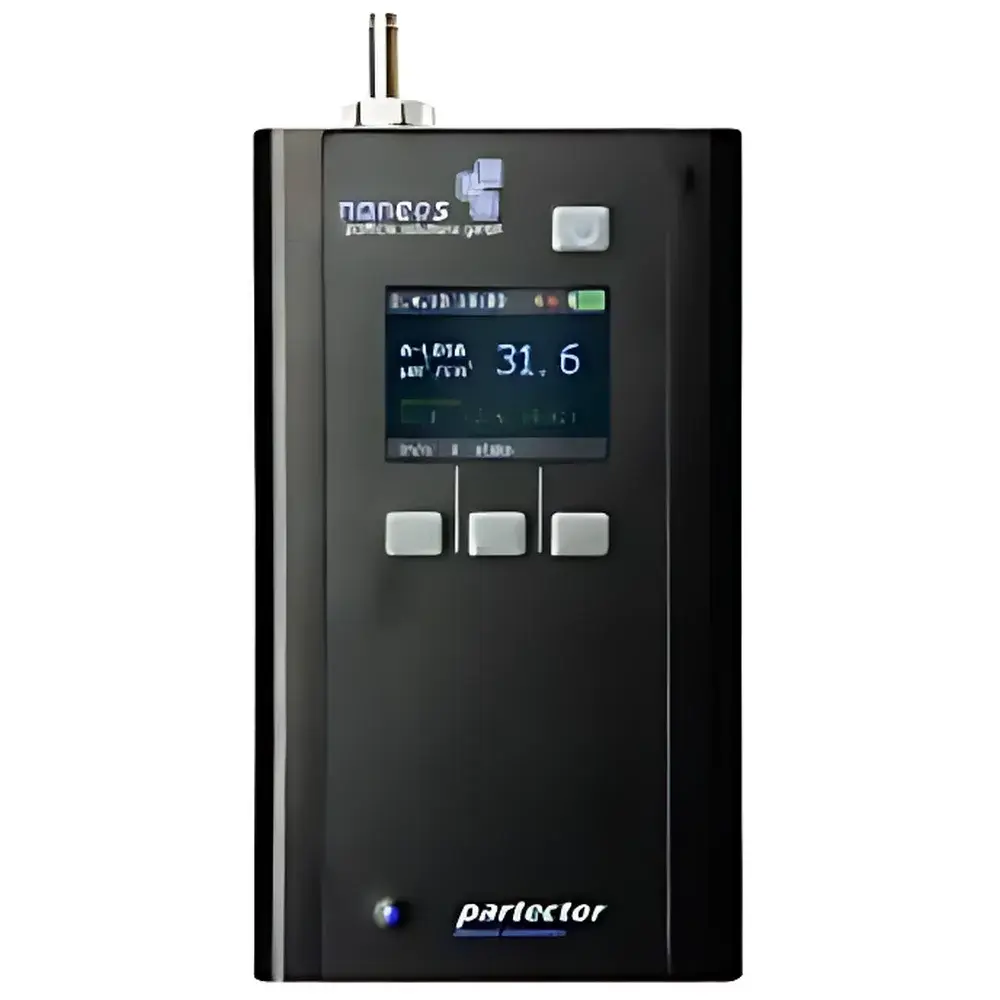
PARTECTOR TEM Particulate Sampler by Palas
| Key | Origin: Fujian, China |
|---|---|
| Manufacturer Type | Distributor |
| Model | PARTECTOR TEM |
| Flow Rate | 0.45 L/min |
| Sampling Efficiency | ~3% at 50 nm |
| Particle Size Range | 10 nm – 10 µm |
| Concentration Range | 1–20,000 µm²/cm³ |
| Temporal Resolution | 1 s (instrument time constant: 4 s) |
| Dimensions | 142 × 78 × 29 mm |
| Weight | 430 g |
| Power | Rechargeable Li-ion battery |
| Data Storage | microSD card (multi-year capacity) |
| Display | Graphical LCD |
| Alarm | Configurable high-concentration threshold |
| Software | Java-based analysis tool compatible with Windows, macOS, Linux |
Overview
The PARTECTOR TEM Particulate Sampler by Palas is a compact, field-deployable instrument engineered for real-time, quantitative sampling of airborne nanoparticles directly onto standard 3.05 mm transmission electron microscopy (TEM) grids. Unlike conventional cascade impactors or filter-based samplers, the PARTECTOR TEM employs electrostatic deposition—based on unipolar diffusion charging and controlled laminar flow—to achieve selective, low-disturbance particle collection optimized for subsequent single-particle morphological and compositional analysis via TEM. Its core function bridges occupational hygiene monitoring and nanomaterial characterization: it enables rapid source identification during workplace surveys while simultaneously generating TEM-ready samples without post-sampling handling artifacts. The device operates autonomously with onboard concentration measurement (via Lung Deposited Surface Area, LDSA), dynamically terminating sampling when optimal grid coverage is reached—thereby eliminating under- or over-loaded specimens that compromise TEM imaging fidelity and quantitative particle counting.
Key Features
- Real-time LDSA-based concentration monitoring with 1-second temporal resolution and 4-second internal time constant—enabling responsive, adaptive sampling control.
- Integrated electrostatic deposition module calibrated for direct deposition onto standard 3.05 mm TEM grids; no solvent transfer, no filtration artifacts, no agglomeration bias.
- Automated endpoint detection: continuously calculates deposited surface area density (µm²/cm³) and halts sampling upon reaching user-defined or algorithmically optimized coverage thresholds.
- Ultra-portable form factor (142 × 78 × 29 mm, 430 g) with ergonomic design for personal monitoring, belt-mounting via included chloroprene protective case.
- Six interchangeable TEM grid holders—pre-loaded in-lab and swapped in-field without tools—supporting parallel sampling campaigns or multi-location exposure assessment.
- Onboard graphical display showing live concentration, accumulated surface area, battery status, and alarm state; configurable high-concentration alerts per ISO/TR 12885 and EN 17185 guidelines.
- Embedded microSD storage with years of timestamped, metadata-rich datasets (LDSA, flow, battery, grid ID); data export via USB adapter for traceable GLP-compliant reporting.
Sample Compatibility & Compliance
The PARTECTOR TEM is validated for sampling solid, non-volatile nanoparticles across a physicochemically diverse range—including metal oxides (e.g., TiO₂, SiO₂), carbonaceous nanomaterials (CNTs, graphene flakes), and engineered nanocomposites. It complies with key principles outlined in ISO/TS 12901-2:2014 (Nanotechnologies — Occupational risk management applied to engineered nanomaterials — Part 2: Use of the control banding approach) and aligns with the exposure assessment framework of EU REACH Annex XVII and NIOSH Current Intelligence Bulletin 63. While not a certified reference method per ISO 13121, its LDSA output correlates strongly with deposited alveolar dose metrics used in health-based occupational limit derivations. All firmware and data logging adhere to ALCOA+ principles (Attributable, Legible, Contemporaneous, Original, Accurate, Complete, Consistent, Enduring, Available), supporting audit readiness under GLP and GMP environments.
Software & Data Management
Data acquisition and post-processing are supported by Palas’ cross-platform Java-based analysis suite, compatible with Windows, macOS, and Linux. The software imports binary .dat files from the microSD card, reconstructs time-series LDSA profiles, computes cumulative deposition curves, and exports annotated CSV reports with ISO 8601 timestamps, instrument serial number, grid identifier, and calibration metadata. Exported datasets include raw sensor readings (voltage, current, temperature-compensated flow), enabling third-party validation against reference instruments such as CPCs or SMPS systems. Audit trails are embedded within each file header; no data modification is possible post-acquisition, satisfying FDA 21 CFR Part 11 requirements for electronic records when deployed in regulated laboratories.
Applications
- Workplace exposure assessment during nanomaterial synthesis, handling, or packaging—especially where real-time feedback informs engineering controls or PPE selection.
- Source identification and emission profiling in R&D labs, pilot plants, and cleanroom facilities using TEM-based particle fingerprinting.
- Validation of local exhaust ventilation (LEV) performance by comparing upstream/downstream nanoparticle surface area concentrations.
- Field studies supporting epidemiological research into ultrafine particle respiratory deposition patterns.
- Educational use in aerosol science curricula—demonstrating the link between airborne concentration metrics and biologically relevant dose surrogates.
FAQ
What particle size range does the PARTECTOR TEM effectively sample for TEM analysis?
It deposits particles from 10 nm to 10 µm with measurable efficiency; peak electrostatic collection occurs between 20–200 nm, and sampling at 50 nm yields ~3% efficiency relative to total aerosol number concentration.
Can the PARTECTOR TEM be used for regulatory compliance reporting?
While not a certified reference method, its LDSA output supports qualitative and semi-quantitative exposure ranking per ISO/TR 12885 and serves as primary evidence in control banding workflows under EU-OSHA guidance.
How is sampling time determined automatically?
The instrument continuously measures LDSA concentration and integrates it over time; when the calculated deposited surface area reaches the preset threshold (default: 1000 µm²/cm²), sampling stops and the grid holder locks to prevent overloading.
Is calibration traceable to national standards?
Flow calibration is performed using NIST-traceable mass flow meters; electrostatic deposition efficiency is verified against monodisperse PSL aerosols in accordance with ISO 27891 and Palas’ internal SOP-TEM-001.
Does the device require external power during field operation?
No—it operates entirely on its rechargeable Li-ion battery (typical runtime: 8–12 h at 0.45 L/min); optional USB-powered continuous operation mode is available for stationary monitoring.







