
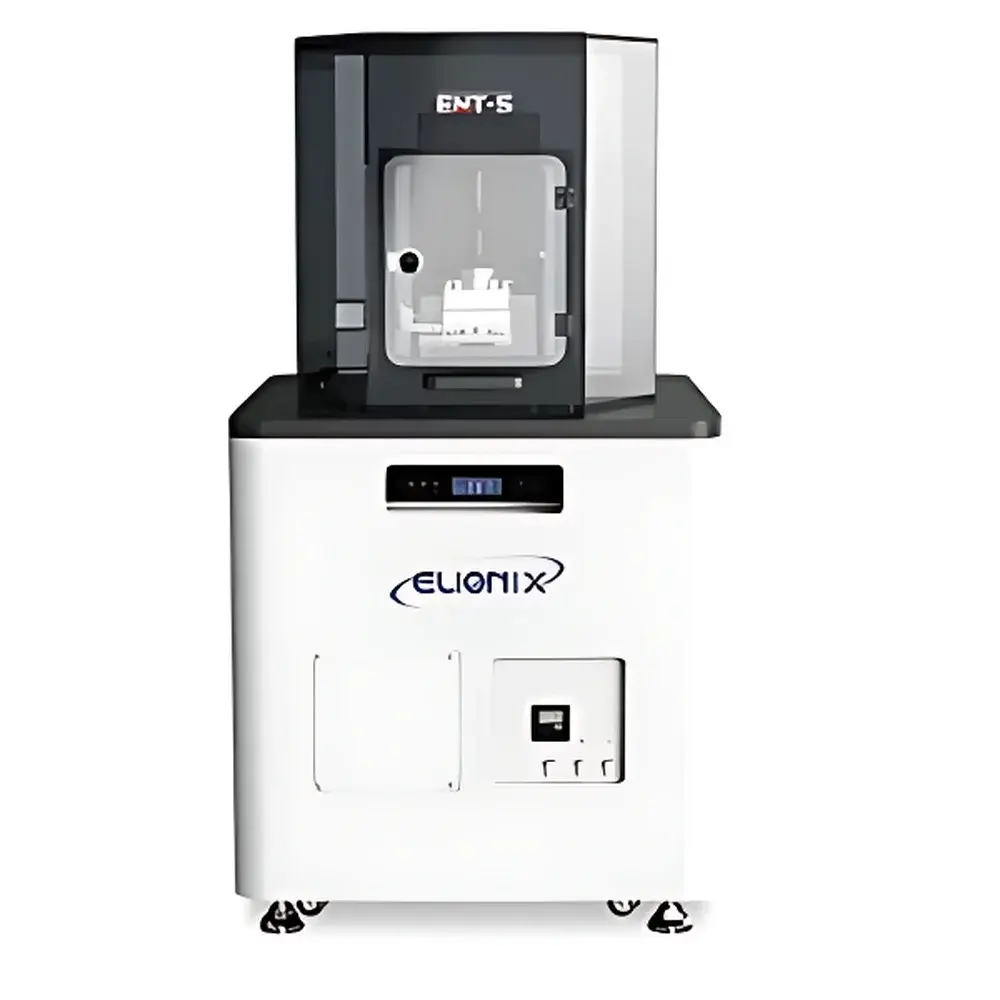
ELIONIX ENT-5 Nanoindenter
| Brand | ELIONIX INC. |
|---|---|
| Origin | Japan |
| Manufacturer Type | Authorized Distributor |
| Product Category | Imported Instrument |
| Model | ENT-5 |
| Instrument Type | Nanoindenter |
| Effective Load Range | 0.5 µN–10 mN (low-load mode), 5 µN–2000 mN (high-load mode) |
| Load Resolution | 0.03 nN (low-range), 5 nN (high-range) |
| Displacement Resolution | 0.1 µm |
Overview
The ELIONIX ENT-5 Nanoindenter is a high-precision, dual-range mechanical property characterization system engineered for quantitative nanoscale indentation testing in research laboratories and industrial quality control environments. Based on the continuous stiffness measurement (CSM) method and quasi-static load–displacement actuation, the ENT-5 delivers traceable, ISO 14577-1 and JIS Z 2255 compliant measurements of hardness, reduced elastic modulus, creep behavior, and contact stiffness across heterogeneous surfaces—from ultrathin functional coatings (e.g., DLC, SiC, TiN) to polymeric thin films, surface-modified layers, microparticles, and powder compacts. Its dual-load architecture enables seamless transition between sub-micron mechanical probing (down to 0.5 µN) and macro-scale indentation (up to 2 N), eliminating the need for instrument reconfiguration when evaluating multilayer systems or graded interfaces.
Key Features
- Thermally stabilized measurement environment: Integrated ±0.1 °C air-curtain temperature control suppresses thermal drift in both specimen and frame; critical components—including the indenter stage and displacement sensor housing—are fabricated from Invar-grade low-expansion alloy (Novelloy®) to minimize thermomechanical hysteresis.
- Sub-micron positioning accuracy: Leverages ELIONIX’s proprietary electron-beam lithography stage technology—capable of 0.1 µm minimum step resolution—with motorized XYZ motion, 20× optical objective, and digital zoom enabling precise targeting at up to 2000× effective magnification.
- Active vibration isolation: Standard-equipped with a wide-bandwidth active damping system combined with a wedge-type anti-vibration platform, ensuring measurement stability under typical laboratory floor noise conditions (≤ 1 µm/s RMS).
- Dual-load modular design: Interchangeable high- and low-load transducers allow rapid adaptation to application-specific force ranges; calibration transfer between modules is performed via built-in reference standards, minimizing instrument downtime.
- Automated drift compensation: Real-time thermal drift correction algorithms, coupled with in-situ tip geometry verification (Berkovich, cube-corner, spherical calibrations), ensure long-term measurement fidelity without manual recalibration cycles.
Sample Compatibility & Compliance
The ENT-5 supports planar, curved, and particulate samples up to 150 mm in diameter and 50 mm in height. It accommodates conductive and non-conductive substrates—including silicon wafers, glass slides, metal foils, polymer films, ceramic tiles, and sintered powders—without requiring metallization or vacuum compatibility. All indentation protocols adhere to ISO 14577-1:2015 (Metallic materials — Instrumented indentation test — Part 1: Test method) and JIS Z 2255:2015, with full audit trail logging for GLP/GMP-aligned workflows. Optional integration with environmental chambers (humidity, inert gas) extends compliance to ASTM E2546 and ISO 20502 for time-dependent mechanical response analysis.
Software & Data Management
The bundled ENT-5 Control Suite provides intuitive workflow-driven operation: automated tip calibration, load–displacement curve fitting (Oliver–Pharr method), depth-sensing creep analysis, and multi-point grid mapping with statistical reporting. Raw data are stored in HDF5 format with embedded metadata (timestamp, operator ID, environmental logs, calibration history). The software supports 21 CFR Part 11-compliant user access controls, electronic signatures, and change tracking—fully auditable for regulated pharmaceutical, aerospace, and medical device R&D settings. Export options include CSV, MATLAB .mat, and ASTM E2546-compliant XML.
Applications
- Quantitative hardness and elastic modulus mapping of PVD/CVD coatings (DLC, AlTiN, CrN) on automotive and cutting tool substrates.
- Mechanical profiling of polymer electrolyte membranes (PEMs), photoresists, and biomedical hydrogels at sub-100 nm indentation depths.
- Interfacial adhesion assessment via nano-scratch testing with simultaneous acoustic emission monitoring (optional add-on).
- Creep and stress relaxation quantification in amorphous metals, metallic glasses, and nanocomposites under constant load conditions.
- Statistical nano-mechanical characterization of powder compacts and sintered ceramics for process validation in additive manufacturing QA.
FAQ
Does the ENT-5 support ISO 14577-1 compliant hardness calculation?
Yes—the system implements the Oliver–Pharr method with automatic unloading curve segmentation, contact depth correction, and area function calibration per ISO 14577-1 Annex A.
Can the same indenter be used across both low-load and high-load modes?
No—each load module uses a dedicated transducer and calibrated indenter holder; however, tip exchange is tool-free and completed in under 90 seconds.
Is environmental chamber integration available as a factory option?
Yes—temperature-humidity controlled chambers (−20 °C to +150 °C, 10–95% RH) and inert-gas glovebox adapters are supported with full software synchronization.
What data security features are included for regulated industries?
Full 21 CFR Part 11 compliance including role-based permissions, biometric or token-based login, electronic signature capture, and immutable audit logs of all parameter changes and test executions.
How often is recalibration required under routine use?
Annual transducer and displacement sensor calibration is recommended; daily tip geometry verification and thermal drift checks are automated within the software startup sequence.



