
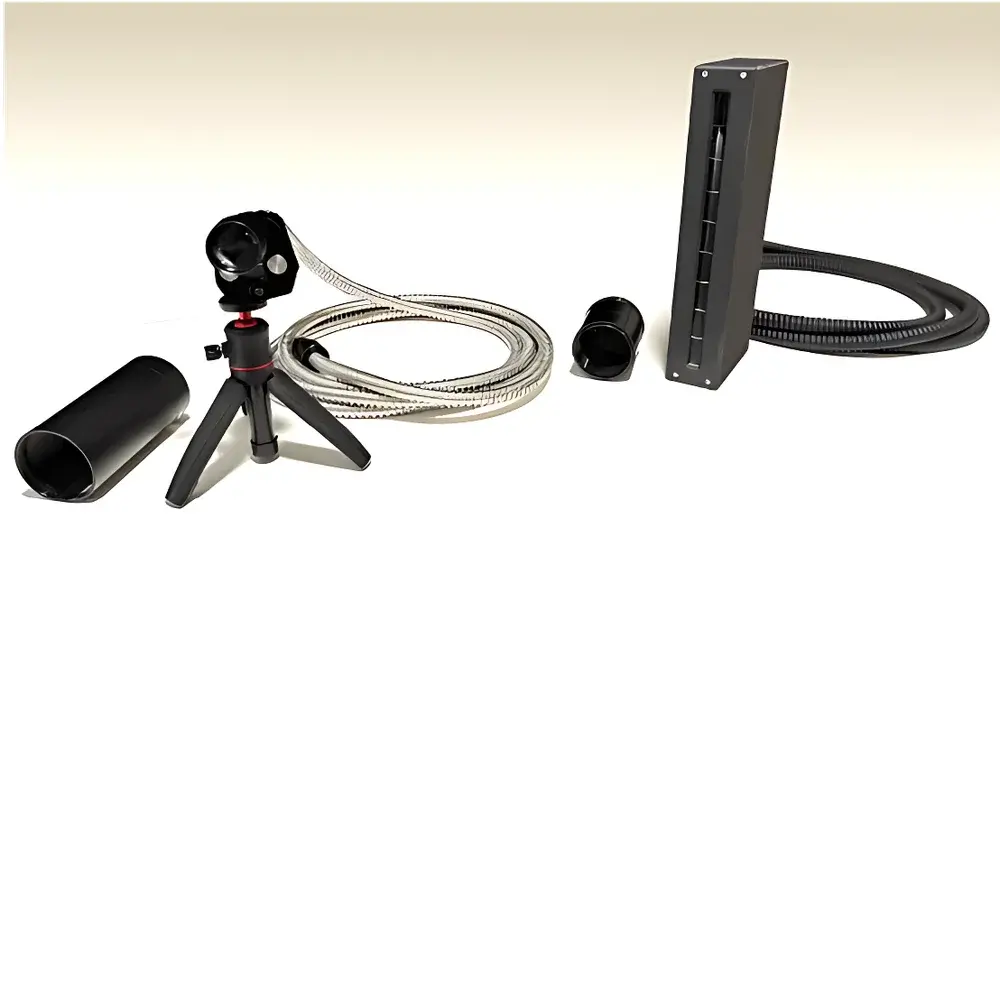
ParticleLab SVI-S10220 Contamination Visualization System
| Brand | ParticleLab |
|---|---|
| Origin | Japan |
| Manufacturer Type | Authorized Distributor |
| Origin Category | Imported |
| Model | SVI-S10220 |
| Price Range | USD 950–2,700 (FOB) |
| Unit Weight | 12 kg |
| Operating Temperature | 0 °C to 45 °C |
Overview
The ParticleLab SVI-S10220 Contamination Visualization System is a non-contact, optical imaging platform engineered for real-time visualization and qualitative assessment of suspended and deposited particulate contaminants in the sub-micrometer size range—down to approximately 0.1 µm—within industrial process environments. Unlike laser-based particle counters that rely on light scattering intensity thresholds and require calibrated aerosol standards, the SVI-S10220 employs high-sensitivity visible-light microscopy coupled with optimized coaxial illumination to achieve direct optical contrast enhancement of low-refractive-index particles in air or inert gas streams. This principle enables detection without laser safety interlocks, alignment dependency, or fluidic sampling constraints—making it uniquely suited for inline integration into cleanrooms, filling lines, wafer handling stations, and pharmaceutical isolators where conventional particle counters exhibit limited sensitivity below 0.3 µm or fail under high-humidity, low-concentration, or electrostatically charged particle conditions.
Key Features
- Sub-micron visual resolution: Capable of resolving suspended particles as small as ~0.1 µm via high-numerical-aperture optics and low-noise CMOS imaging sensor (12-bit dynamic range, global shutter)
- Non-laser illumination architecture: Uses broadband LED-based coaxial bright-field illumination; eliminates Class 3B/4 laser compliance requirements and associated operational overhead
- Modular form factor: Compact optical head (W × H × D: 120 × 85 × 160 mm) and lightweight design (12 kg total system mass) enable direct mounting onto process equipment frames, glovebox ports, or laminar flow hoods without structural reinforcement
- Dual-mode imaging capability: Simultaneous support for both airborne particle tracking (time-resolved video capture at up to 60 fps) and static surface contamination mapping (high-resolution still acquisition with auto-focus stacking)
- Environmental resilience: Rated for continuous operation across 0 °C–45 °C ambient temperature range and relative humidity ≤85% non-condensing—compatible with ISO Class 5–7 cleanroom infrastructure
Sample Compatibility & Compliance
The SVI-S10220 is designed for use in regulated manufacturing settings including semiconductor front-end fabrication, sterile pharmaceutical filling (USP , ), and automotive electronics assembly. It does not perform quantitative particle counting per ISO 21501-4 or JIS B 9921; rather, it provides traceable visual evidence for root-cause analysis and procedural validation. Image metadata—including timestamp, exposure parameters, lens focus position, and operator ID—is embedded in EXIF-compliant TIFF or PNG outputs. When deployed with optional audit-trail-enabled software modules, the system supports ALCOA+ data integrity principles and aligns with FDA 21 CFR Part 11 requirements for electronic records in GMP environments. No calibration certificate is issued by default; users are advised to perform periodic verification using NIST-traceable polystyrene latex (PSL) microsphere reference slides (e.g., 0.1 µm, 0.3 µm, 0.5 µm).
Software & Data Management
Bundled ParticleVision™ v3.2 software provides real-time display, adjustable contrast enhancement, motion-triggered recording, and annotated image export. All acquired frames are stored with SHA-256 checksums and immutable timestamps. Optional modules include batch reporting (PDF/CSV), multi-camera synchronization, and integration with MES/SCADA systems via OPC UA or Modbus TCP. Raw image datasets can be exported for third-party analysis in MATLAB, Python (OpenCV), or ImageJ—facilitating custom algorithm development for particle trajectory modeling or deposition pattern classification. Data retention policies are configurable per site SOP, supporting both local SSD storage (256 GB standard) and network-attached storage (NAS) backup protocols.
Applications
- Sterile drug product monitoring: Visual verification of filter integrity, vial stopper seating anomalies, and fill needle drip residue during aseptic processing
- Wafer fab contamination forensics: Localization of sub-100 nm debris originating from robotic end-effectors, chuck surfaces, or purge gas lines
- EV battery electrode coating QC: Detection of agglomerated conductive carbon particles (>0.2 µm) prior to calendaring, reducing risk of micro-shorts
- Medical device packaging validation: Real-time observation of fiber shedding from Tyvek® lids or particulate generation during peel-force testing
- Process troubleshooting: Correlation of particle burst events with pump actuation, valve switching, or vacuum venting cycles
FAQ
Does the SVI-S10220 replace ISO 21501-4 compliant particle counters?
No—it complements them. It addresses scenarios where traditional counters lack sensitivity (<0.3 µm), suffer from coincidence error in dense clouds, or cannot operate due to spatial or regulatory constraints.
Can it quantify particle concentration (e.g., #/m³)?
Not natively. It delivers spatially resolved visual evidence—not volumetric concentration data. Quantification requires user-defined ROI analysis and assumptions about sampling volume, which must be validated separately.
Is the system compatible with nitrogen-purged environments?
Yes. The optical head is sealed to IP54 and operates reliably in inert atmospheres with dew point control ≤−40 °C.
What maintenance is required?
Annual verification using PSL reference standards and quarterly inspection of lens cleanliness and LED output stability per ParticleLab Technical Bulletin TB-SVI-007.
Does it support remote diagnostics?
Yes—via encrypted VNC over TLS 1.3 when connected to enterprise networks with appropriate firewall rules and VLAN segmentation.







