
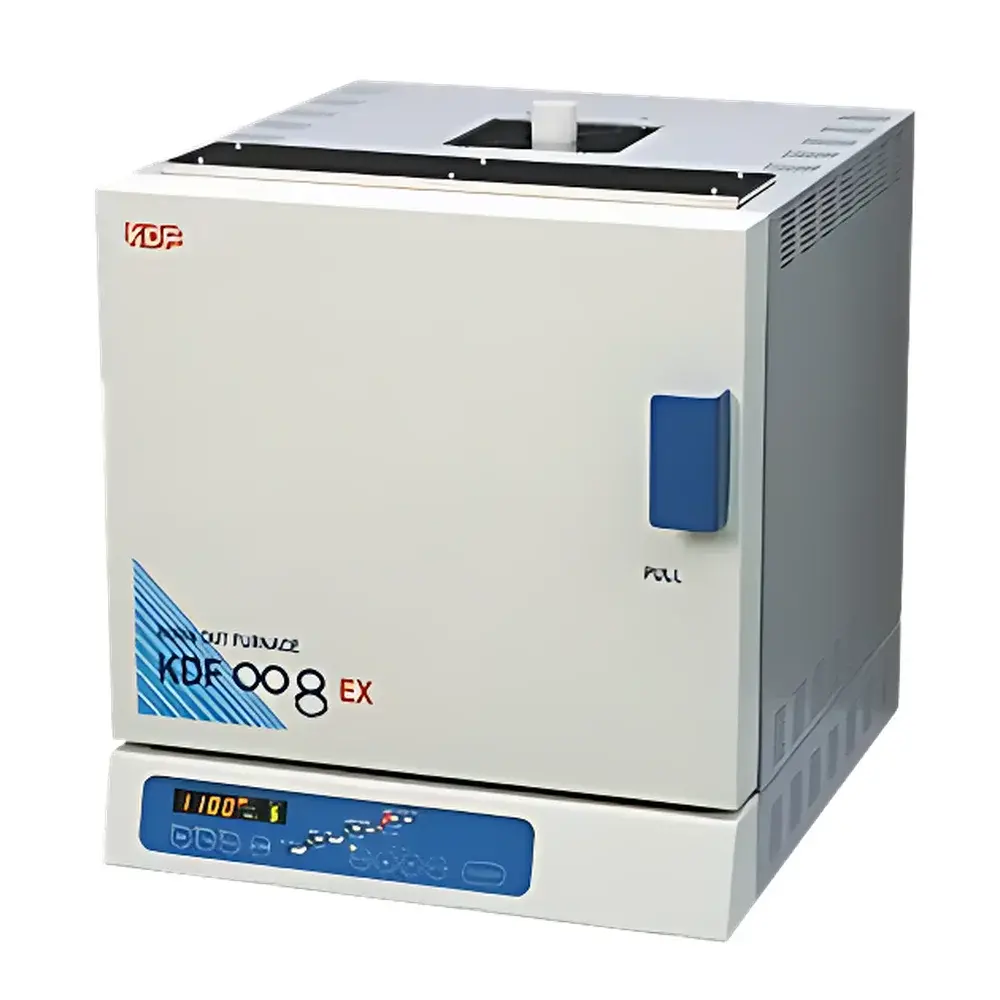
KDF KDF008EX Microcomputer-Controlled Medium-Sized Muffle Furnace
| Brand | KDF |
|---|---|
| Origin | Japan |
| Model | KDF008EX |
| Furnace Type | Box-Type Muffle Furnace |
| Max Temperature | 1100 °C |
| Max Power | 1800 W |
| Heating Rate (to 1100 °C) | 29 min (empty chamber) |
| Internal Dimensions | 180 (W) × 155 (H) × 250 (D) mm |
| Heating Element | Resistance Wire |
| Voltage | AC 200–240 V ±10%, 50/60 Hz |
| Power Consumption | 3.0 kVA |
| Standby Power | 1.8 VA |
| Weight | 35 kg |
| Thermocouple Type | JIS Class K |
| Operating Ambient | 10–40 °C, 30–90% RH |
| Programmable Profiles | 10 |
| Temperature Ramp Stages | Up to 3 per program |
| Ramp Rate Range | 1–20 °C/min (L/M/H selectable), or full-range ramp (0–1100 °C/min) |
| Soak Duration | 0–9 h 59 min (1 min increment) / 0–99 h 50 min (10 min increment) |
| Timer Resolution | 10 min |
| Audible Alert | Adjustable volume (High/Medium/Low/OFF) |
Overview
The KDF KDF008EX is a microcomputer-controlled medium-sized box-type muffle furnace engineered for precise thermal processing in research laboratories, quality control environments, and small-scale production settings. Designed around resistive wire heating architecture with three-sided (dual lateral + bottom) element placement, the furnace achieves superior temperature uniformity across its 180 × 155 × 250 mm internal chamber—critical for reproducible calcination, ashing, sintering, and heat-treatment protocols. Its maximum operating temperature of 1100 °C complies with standard thermal procedures defined in ASTM E1112 (standard specification for laboratory muffle furnaces), ISO 8573-1 (for clean process validation), and common pharmacopeial methods requiring controlled high-temperature exposure. The unit operates on universal single-phase AC 200–240 V power, making it compatible with standard European and APAC laboratory electrical infrastructure without external transformers.
Key Features
- Three-zone resistive heating configuration (left/right side walls + floor) ensures radial and vertical thermal symmetry; measured uniformity is ≤±5 °C at 1000 °C across the working zone per IEC 60068-3-5.
- Microprocessor-based controller supports up to 10 programmable thermal profiles, each configurable with up to three independent ramp-and-soak stages—including customizable ramp rates (1–20 °C/min in fine increments) and soak durations (1-minute resolution up to 10 hours; 10-minute resolution up to 100 hours).
- Dedicated visual status indicators display active program number, current stage, elapsed time, and target temperature—enabling rapid operational verification without menu navigation.
- Integrated JIS Class K thermocouple provides traceable temperature feedback with inherent stability under repeated thermal cycling; calibrated range spans 0–1100 °C.
- Low standby power consumption (1.8 VA) minimizes energy overhead during idle periods, supporting sustainability objectives aligned with ISO 50001 lab energy management frameworks.
- Structural design accommodates standardized crucible support accessories—including capacity for six Φ90 mm casting rings or ninety Φ30 mm rings—facilitating batch consistency in metallurgical and dental laboratory workflows.
Sample Compatibility & Compliance
The KDF008EX is validated for use with ceramic crucibles (alumina, quartz), stainless steel boats, and refractory metal trays conforming to ASTM C20 and ISO 18434-1 specifications. Its sealed muffle chamber isolates samples from combustion byproducts, meeting requirements for ash content determination per AOAC 942.05 and USP <281>. The furnace’s ambient operating envelope (10–40 °C, 30–90% RH non-condensing) aligns with CLSI EP25-A guidelines for environmental control of analytical instrumentation. While not inherently 21 CFR Part 11 compliant, its programmable logic supports audit-ready documentation when paired with external electronic lab notebook (ELN) systems implementing ALCOA+ data integrity principles.
Software & Data Management
The embedded controller stores all executed programs and real-time thermal logs internally (non-volatile memory). Timestamped cycle records—including start time, peak temperature, total duration, and deviation alerts—are exportable via RS-232 serial interface (optional cable required) for integration into LIMS or CSV-compatible analysis platforms. No proprietary software is bundled; raw ASCII-formatted output enables direct ingestion into Python/Pandas, MATLAB, or LabVIEW environments for statistical process control (SPC) modeling. Firmware updates are performed manually via USB-to-serial adapter and manufacturer-provided hex files—ensuring version traceability per GLP Annex 11 expectations.
Applications
- Residue quantification in pharmaceutical excipients (USP <281>, Ph. Eur. 2.2.35)
- Loss-on-ignition (LOI) testing of cementitious materials (ASTM C114)
- Pre-sintering of ceramic green bodies prior to HIP or pressureless sintering
- Thermal decomposition studies of polymers and composites (ISO 11358)
- Calcination of catalyst precursors (e.g., NiO, Co₃O₄) in heterogeneous catalysis R&D
- Dental alloy investment burnout (ADA Specification No. 10)
FAQ
What is the temperature uniformity specification across the chamber at 1000 °C?
Measured uniformity is ≤±5 °C at setpoint, verified using nine-point mapping per IEC 60068-3-5.
Can the furnace be integrated into an automated workflow via digital I/O?
No native digital I/O ports are provided; only RS-232 serial communication is available for remote command execution and log retrieval.
Is the thermocouple replaceable by the end user?
Yes—the JIS Class K thermocouple is field-replaceable using standard M4 threaded fittings; calibration certificate reissuance requires third-party accredited service.
Does the unit include overtemperature protection?
Yes—a redundant mechanical limit switch cuts power at 1150 °C, independent of the main controller.
What maintenance intervals are recommended for optimal performance?
Visual inspection of heating elements and insulation integrity every 200 operating hours; thermocouple recalibration annually or after 500 thermal cycles above 900 °C.



