
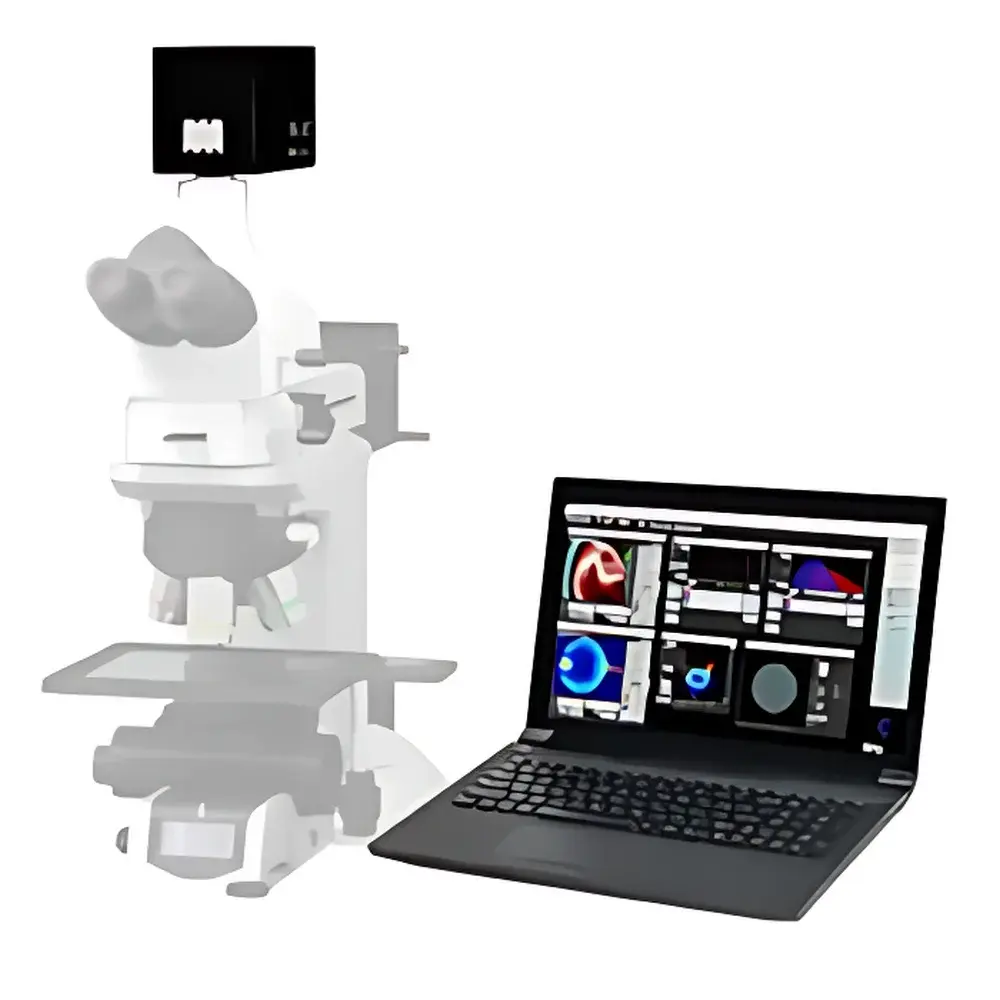
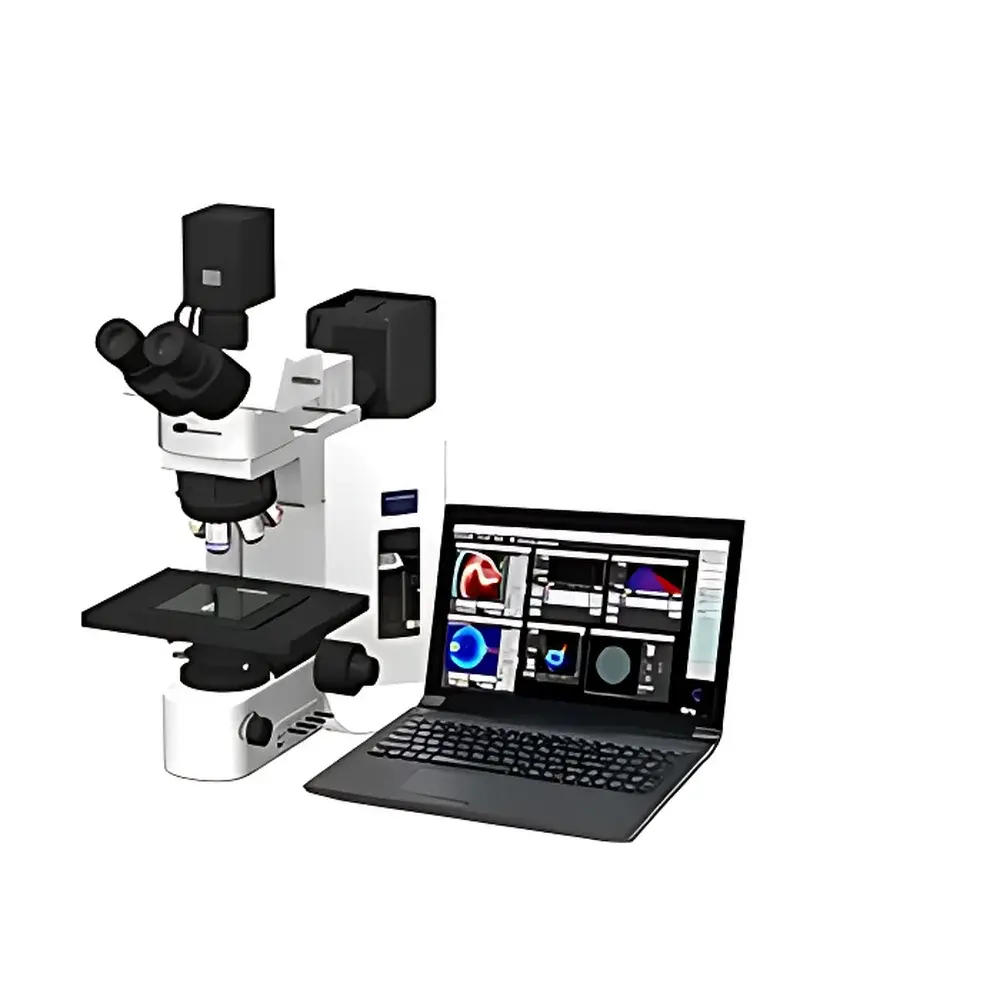
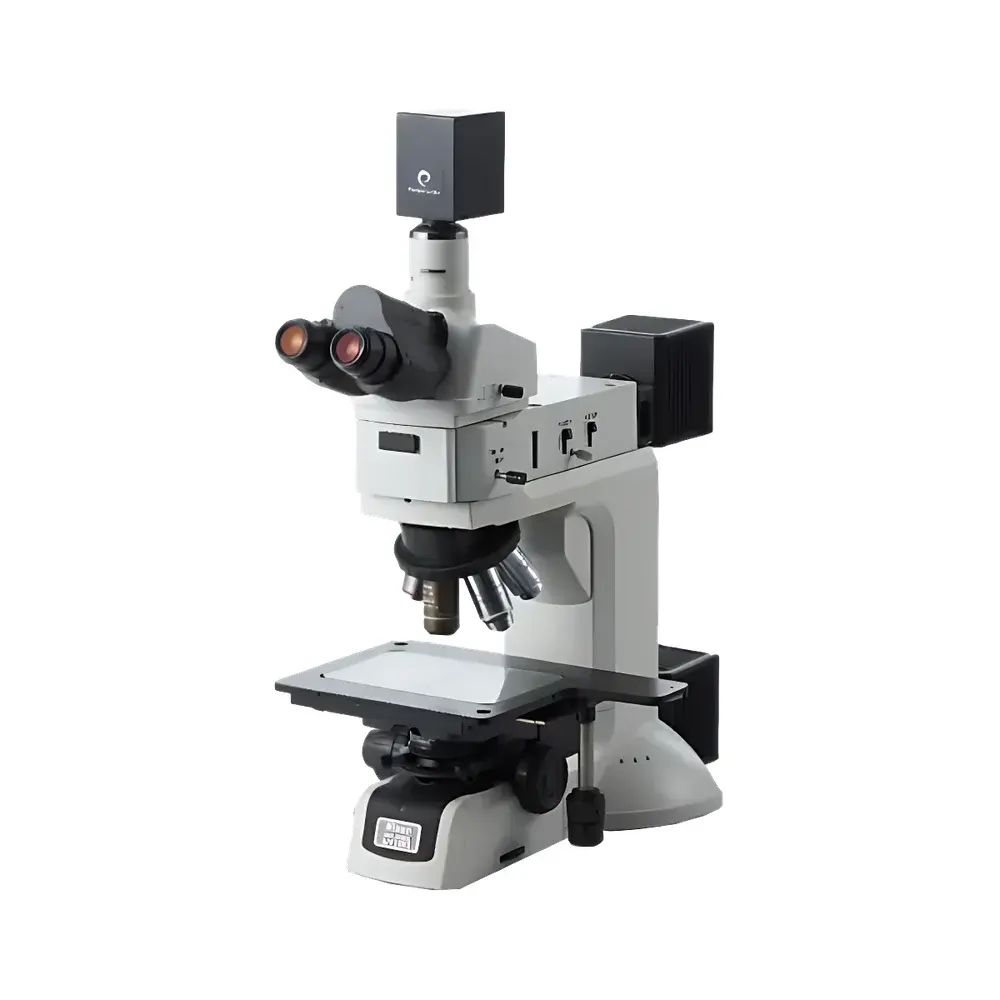
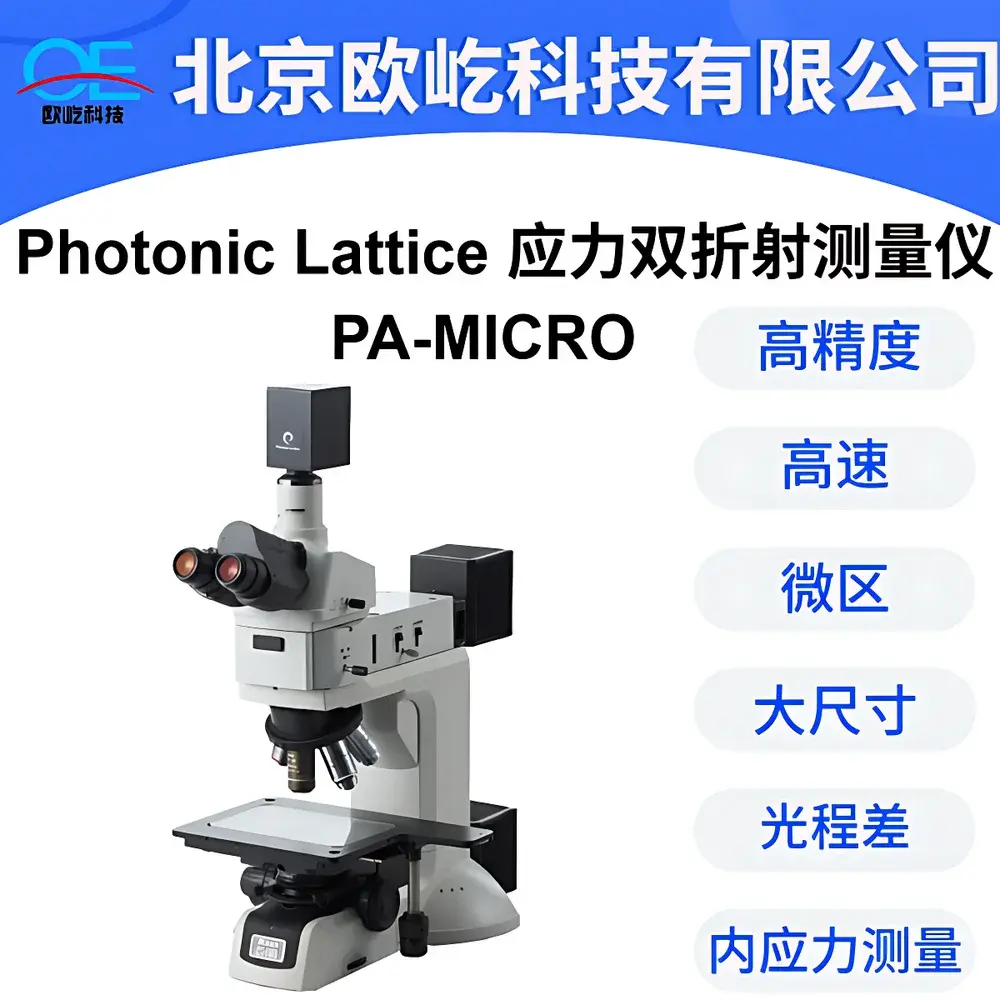
Photonic Lattice PA-Micro Microscopic Photoelastic Stress Birefringence Analyzer
| Brand | Photonic Lattice |
|---|---|
| Origin | Japan |
| Model | PA-Micro |
| Measurement Wavelength | 520 nm |
| Birefringence Range | 0–130 nm |
| Minimum Resolution | 0.001 nm |
| Repeatability | ±1 nm |
| Field of View | 142 × 170 µm to 3.5 × 4.2 mm (with ×2, ×5, ×10, ×20, ×50 objectives) |
| Output Parameters | Retardation (nm), Fast Axis Orientation (°), Stress-Converted Retardation (MPa, optional) |
| Optional Modules | Real-time Analysis Software, Lens Evaluation Software, Data Processing Suite, External Control Interface |
| Microscope Compatibility | Olympus or Nikon upright/brightfield microscopes |
Overview
The Photonic Lattice PA-Micro is a high-precision microscopic photoelastic stress birefringence analyzer engineered for quantitative, spatially resolved measurement of optical retardation and fast-axis orientation in transparent, isotropic, and anisotropic materials at the microscale. Based on full-field, polarization-resolved imaging interferometry at a stabilized 520 nm illumination wavelength, the system captures complete birefringence maps across the microscope field of view—delivering calibrated retardation values in nanometers and axis orientation in degrees with sub-milliradian angular fidelity. Unlike point-scanning polarimeters or conventional stress-optic bench systems, the PA-Micro acquires 5-megapixel (2448 × 2048) birefringence distributions in a single exposure, enabling rapid, non-contact assessment of residual stress, crystallinity gradients, molecular alignment, and internal strain fields in optically thin samples. Its design targets applications where micron-scale spatial resolution, high dynamic range (0–130 nm), and trace-level sensitivity (0.001 nm resolution) are critical—particularly in advanced optics manufacturing, photonic crystal fiber development, semiconductor packaging, and biomedical polymer characterization.
Key Features
- Full-field, snapshot acquisition of retardation and fast-axis orientation across 5 million pixels—eliminating mechanical scanning artifacts and enabling real-time process monitoring.
- Calibrated measurement range of 0–130 nm retardation with <0.001 nm resolution and ±1 nm repeatability under controlled thermal and vibration-isolated conditions.
- Modular integration with industry-standard upright microscopes from Olympus and Nikon—including compatibility with standard infinity-corrected objective turrets (×2 to ×50) and transmitted illumination paths.
- Configurable field of view spanning 142 × 170 µm (at ×50) to 3.5 × 4.2 mm (at ×2), supporting both localized defect analysis and macro-scale stress mapping within a single platform.
- Dual-output capability: native retardation (nm) and azimuth (°) data, plus optional stress conversion using user-defined stress-optic coefficients (C-value) for quantitative MPa-scale stress estimation per pixel.
- Robust optical architecture featuring temperature-stabilized LED illumination, high-extinction-ratio polarizers, and phase-calibrated quarter-wave plates—ensuring long-term measurement stability and inter-laboratory reproducibility.
Sample Compatibility & Compliance
The PA-Micro accommodates flat, transparent, or semi-transparent specimens up to 50 mm in diameter and 30 mm in thickness—compatible with standard microscope slides, wafers, optical blanks, polymer films, and fiber preforms. It supports transmission-mode measurement only; reflective or opaque samples require complementary techniques. The system complies with ISO 11146-1 (laser beam profiling), ASTM E1792 (stress birefringence in optical glass), and JIS R3103 (evaluation of birefringence in optical materials). When operated with validated software protocols and documented calibration certificates, data output meets GLP documentation requirements for quality control laboratories. While not inherently FDA 21 CFR Part 11 compliant, audit-trail functionality—including user login logs, parameter change timestamps, and raw image metadata—is supported via optional software modules for regulated environments.
Software & Data Management
The PA-Micro ships with a native Windows-based application suite comprising three core modules: Real-Time Analysis Engine (for live visualization and threshold-based defect detection), Lens Evaluation Toolkit (for Zernike decomposition, wavefront error mapping, and MTF correlation), and Batch Data Processor (supporting TIFF/CSV export, region-of-interest statistics, cross-sectional line profiles, and custom script execution via Python API). All software modules support external triggering via TTL signals and programmable control through TCP/IP or RS-232 interfaces—enabling integration into automated inspection lines or synchronized multi-instrument test benches. Raw interferometric images are stored with embedded calibration metadata (wavelength, objective magnification, pixel scale), ensuring traceability and facilitating retrospective reprocessing without hardware recalibration.
Applications
- Characterization of residual stress distribution in fused silica lenses, CaF₂ windows, and UV-grade quartz substrates used in lithography and laser systems.
- Quality assurance of polarization-maintaining (PM) fibers and photonic crystal fibers—mapping beat-length uniformity and core ellipticity-induced birefringence.
- Development and failure analysis of thermoplastic optical components (e.g., injection-molded lens arrays), where cooling-induced flow birefringence correlates directly with warpage and optical distortion.
- Research on liquid crystal alignment layers, stretched polymer films (e.g., PET, PC), and bio-inspired structural color materials requiring nanoscale retardation homogeneity.
- In-process monitoring of annealing cycles for optical glass blanks—quantifying stress relaxation kinetics with µm spatial resolution over time-series acquisitions.
FAQ
What microscope models are officially supported?
Olympus BX series (BX53, BX63) and Nikon Eclipse Ci-L and Ni-E upright microscopes with standard Koehler illumination and trinocular port output are fully supported. Custom adapters are available for other platforms upon request.
Is calibration traceable to national standards?
Yes—each system ships with a NIST-traceable retardation calibration certificate generated using certified waveplate standards (±0.2 nm uncertainty) and verified at 520 nm under ISO/IEC 17025-accredited conditions.
Can the PA-Micro measure birefringence in thick or scattering samples?
No—the system operates exclusively in transmission mode and requires optically clear, low-scatter specimens. Samples with significant bulk scattering or thickness >3 mm may yield degraded signal-to-noise ratio and require empirical correction or alternative modalities (e.g., confocal birefringence microscopy).
Does the stress conversion function support anisotropic materials?
The built-in stress conversion assumes isotropic linear elasticity and a uniform stress-optic coefficient (C-value). For anisotropic crystals (e.g., sapphire, LiNbO₃), users must supply directionally resolved C-tensors and apply post-processing corrections outside the base software.
What file formats are supported for data export?
Native export includes 16-bit TIFF (retardation and axis maps), CSV (pixel-wise numerical tables), and HDF5 (for large time-series or multi-channel datasets). Third-party import plugins are available for MATLAB, Python (NumPy), and ImageJ/Fiji.





