
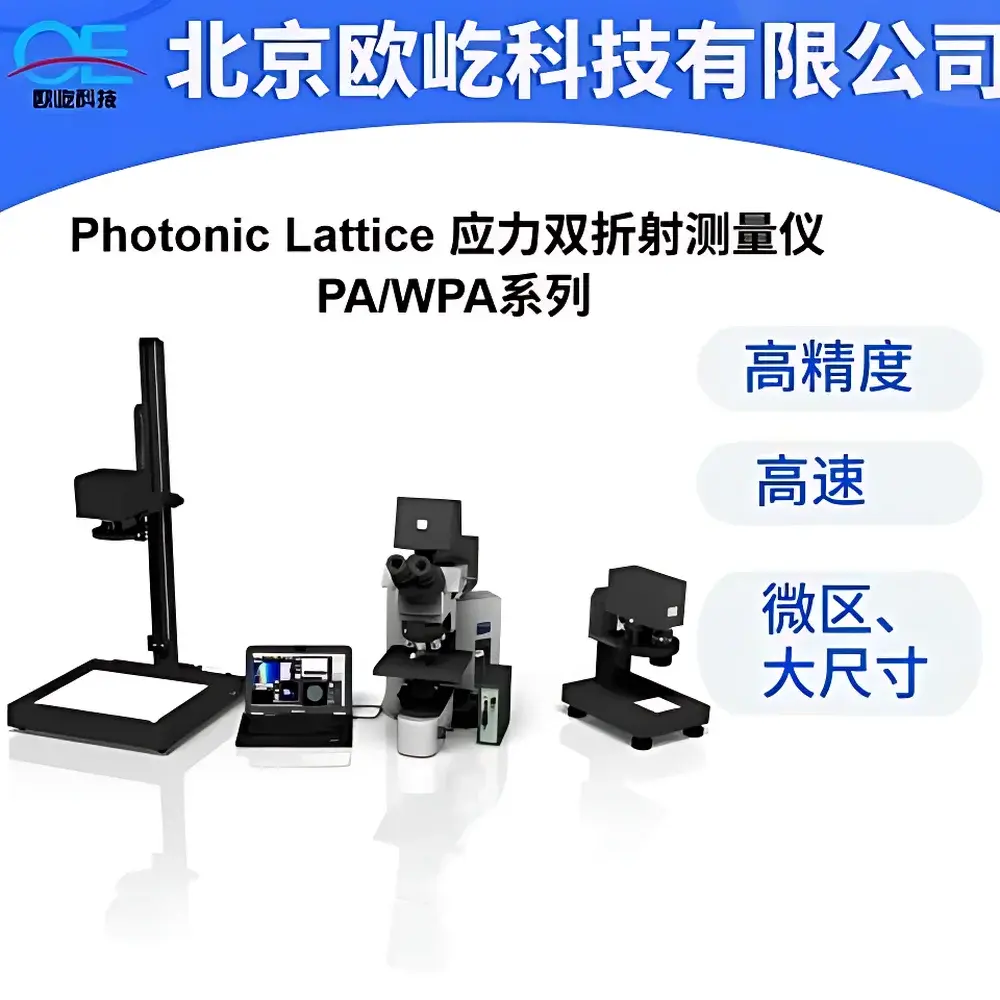
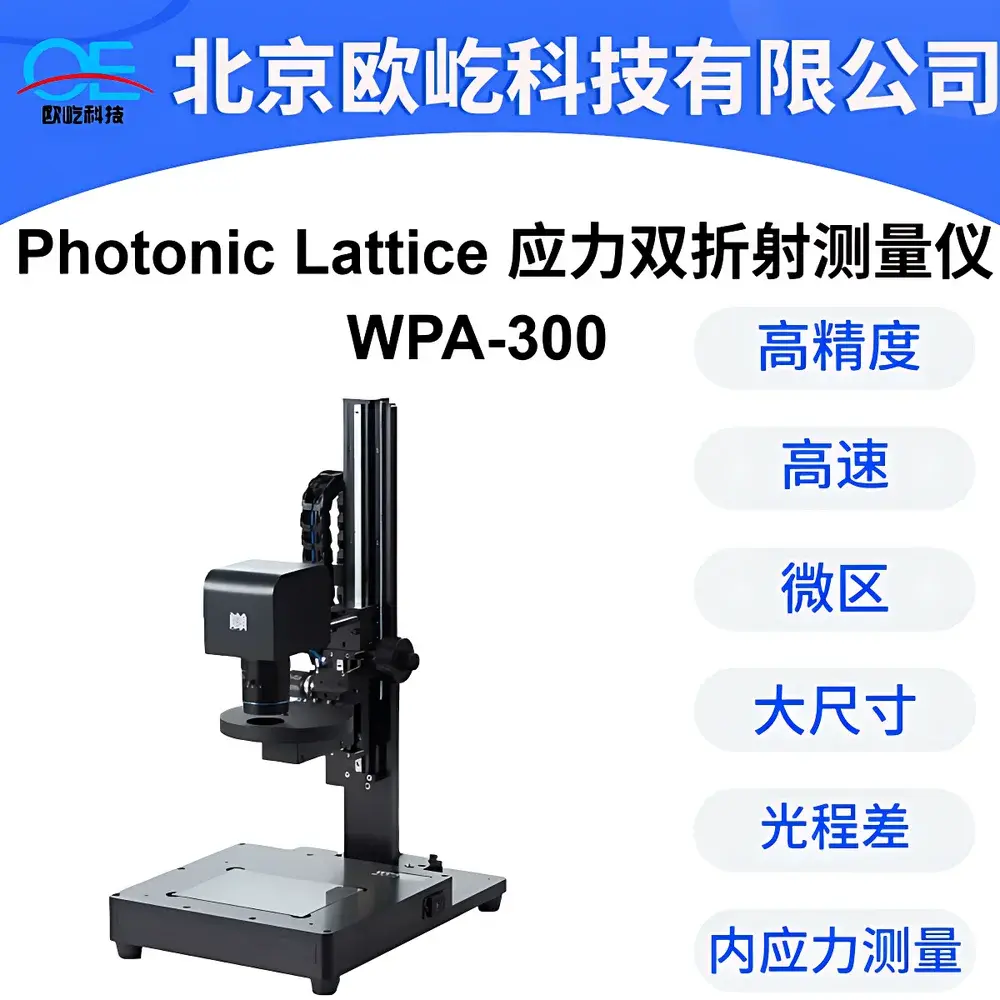
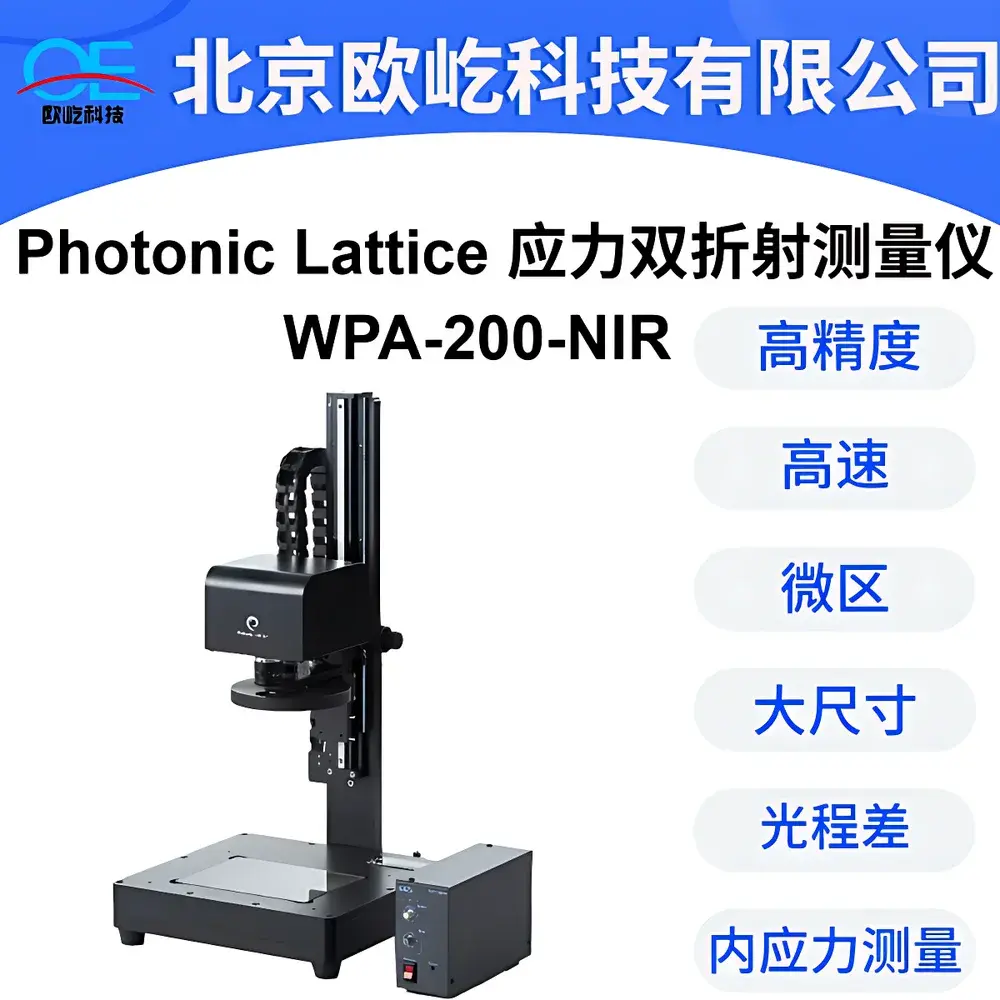
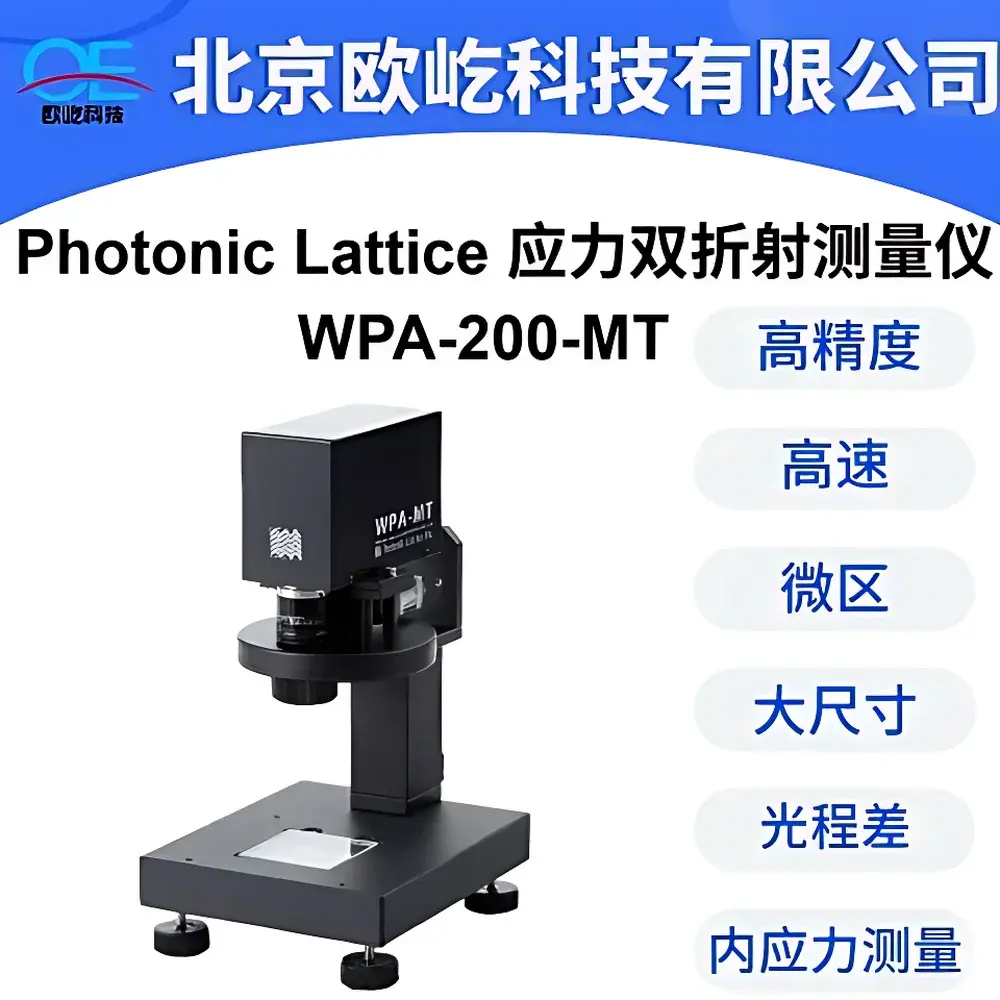
Photonic Lattice WPA Series Polarizing Stress Meter
| Brand | Photonic Lattice |
|---|---|
| Origin | Japan |
| Manufacturer Status | Authorized Distributor |
| Product Origin | Imported |
| Model | WPA Series |
| Price | USD 1,400 (approx. based on ¥10,000 at 1:7.1 exchange rate) |
Overview
The Photonic Lattice WPA Series Polarizing Stress Meter is a high-precision optical metrology instrument engineered for quantitative evaluation of stress-induced birefringence in transparent dielectric materials. Based on the principle of polarized light interference and phase-resolved retardation mapping, the system utilizes proprietary photonic crystal–enhanced polarization imaging sensors to measure optical path difference (OPD), fast-axis orientation, and spatially resolved birefringence distribution. Designed specifically for quality assurance in precision optics manufacturing—including injection-molded lenses, optical polymers, glass substrates, and encapsulated semiconductor components—the WPA Series delivers non-contact, non-destructive, and traceable measurements compliant with ISO 11431 (Optics and photonics — Measurement of stress birefringence in optical elements) and ASTM F2738 (Standard Practice for Measuring Birefringence in Transparent Plastics). Its core architecture integrates a three-wavelength LED illumination source (typically 525 nm, 635 nm, and 850 nm), enabling robust compensation for dispersion effects and extending effective measurement range up to 3500 nm OPD—with optional calibration kits supporting extension to 10,000 nm for ultra-high-stress applications.
Key Features
- Full-field, single-shot acquisition of retardation magnitude (0–3500 nm OPD), azimuth angle (0°–180°), and stress birefringence (nm/mm) across the entire field of view
- Triple-wavelength illumination system for dispersion-corrected, high-fidelity retardation quantification
- Proprietary photonic crystal–based polarization imaging sensor with <1 nm OPD resolution and <0.5° angular accuracy
- Automated analysis modes: point measurement, line profile extraction, 2D spatial mapping, and pseudo-3D stress visualization via surface-normal projection
- Real-time measurement output in SI-compliant units: nanometers (nm) for optical path difference, degrees (°) for polarization orientation, MPa for stress (via material-specific stress-optic coefficient input), and nm/mm for stress birefringence
- Compact, vibration-insensitive optical bench design suitable for cleanroom integration and inline QC stations
Sample Compatibility & Compliance
The WPA Series accommodates flat or gently curved transparent samples with thicknesses ranging from 0.1 mm to 50 mm and lateral dimensions up to 200 × 200 mm (model-dependent). Compatible substrates include polycarbonate (PC), polymethyl methacrylate (PMMA), cyclic olefin copolymer (COC), borosilicate glass, fused silica, and epoxy-based optical adhesives. All measurement protocols support GLP/GMP-aligned documentation workflows, including user-accessible audit trails, timestamped raw image export (16-bit TIFF), and calibration certificate traceability to NIST-traceable retardation standards. The system meets electromagnetic compatibility requirements per IEC 61326-1 and safety standards per IEC 61010-1. Optional software modules provide 21 CFR Part 11–compliant electronic signatures and data integrity controls for regulated pharmaceutical and medical device manufacturing environments.
Software & Data Management
The bundled WPA Control Suite (v4.x) provides intuitive GUI-driven operation, real-time false-color retardation visualization, and batch-processing capability for production-line throughput. Raw polarization images are stored with embedded metadata (exposure time, wavelength ID, calibration timestamp, operator ID). Export formats include CSV (for statistical process control integration), HDF5 (for MATLAB/Python post-processing), and PDF reports with customizable templates aligned to internal QA forms or ISO/IEC 17025 accreditation requirements. Advanced users may access low-level API (C++/Python SDK) for integration into MES or LabVantage platforms. Calibration files are digitally signed and version-controlled; recalibration intervals are tracked automatically and flagged upon expiry.
Applications
- Injection molding process validation: correlation of mold temperature gradients, packing pressure, and residual stress distribution in polymer lenses
- Optical assembly QA: detection of mounting-induced stress in bonded doublets or cemented prisms
- Thin-film coating uniformity assessment: interfacial stress mapping at substrate-coating boundaries
- LED/OLED encapsulant characterization: quantification of thermal mismatch stress during reflow cycles
- Academic research in photoelasticity, viscoelastic relaxation kinetics, and anisotropic polymer crystallization
- Failure analysis of brittle fracture initiation sites in tempered glass or sapphire windows
FAQ
What is the minimum measurable retardation and its typical uncertainty?
The system achieves a base resolution of ≤0.8 nm OPD under standard illumination; expanded uncertainty (k=2) is ±1.5 nm for measurements below 100 nm and ±0.5% of reading above 100 nm.
Can the WPA Series measure curved or non-planar surfaces?
Yes—within limits of depth-of-field and surface normal deviation; optional telecentric lens adapters and motorized Z-stage modules support controlled focus stacking for mildly convex/concave optics (radius ≥50 mm).
Is material-specific stress-optic coefficient (C) required for MPa conversion?
Yes; the software prompts entry of C (units: m²/N) during setup—values for common materials (e.g., PMMA: 3.9×10⁻¹² m²/N; BK7 glass: 2.6×10⁻¹² m²/N) are preloaded in the database.
Does the system support automated pass/fail judgment against user-defined thresholds?
Yes—threshold-based binary masking and SPC charting (X-bar/R) are available in the Production Mode module, with configurable alarm outputs (TTL/RS-232) for integration with PLCs.
How often does the system require recalibration?
Factory calibration is valid for 12 months under normal operating conditions; annual verification using supplied NIST-traceable quartz retardation standards is recommended and logged within the software audit trail.




