
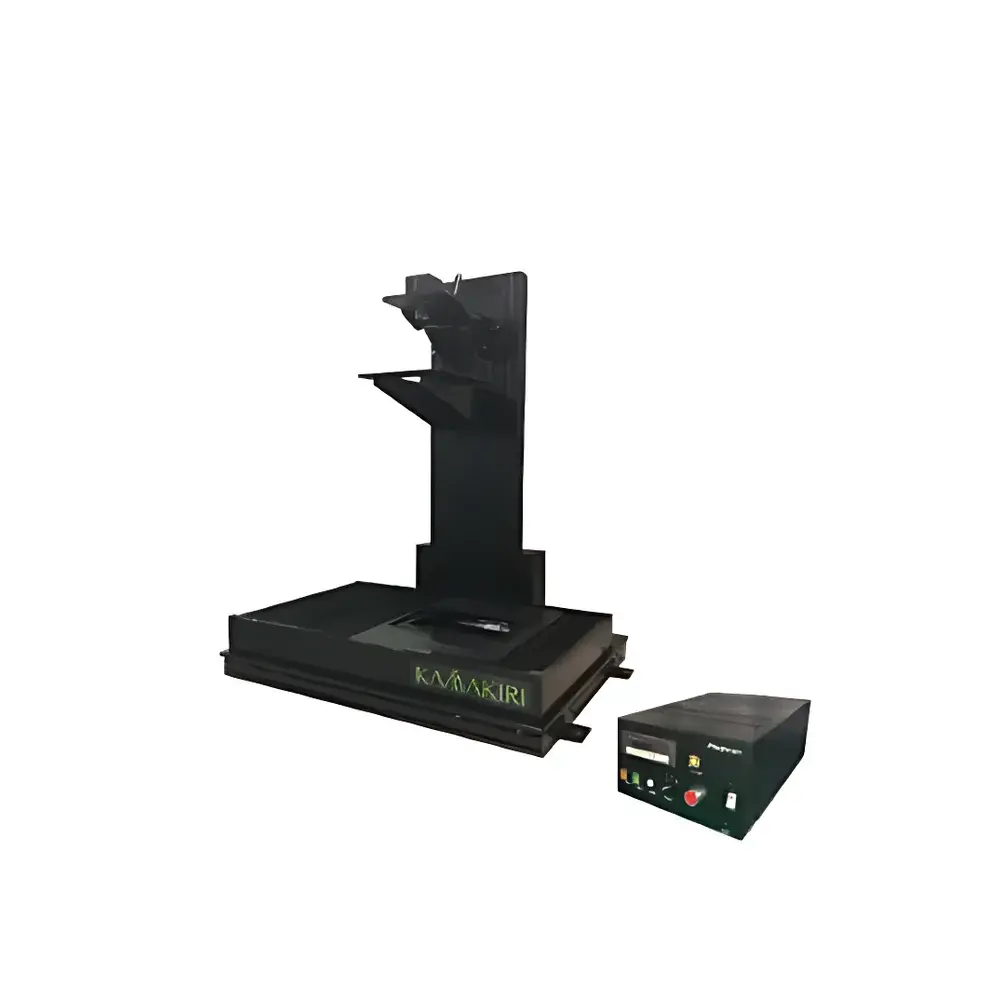
Photonic Lattice KAMAKIRI-X Stage Photoelastic Stress Analyzer
| Brand | Photonic Lattice |
|---|---|
| Origin | Japan |
| Model | KAMAKIRI-X Stage |
| Measurement Output | Retardation (nm), Fast Axis Orientation (°) |
| Wavelength | 543 nm (customizable) |
| Retardation Range | 0–260 nm (customizable) |
| Fast Axis Range | 0–180° |
| Repeatability | <1 nm (σ) |
| Standard Measurement Area | A4 format |
| Stage Options | Custom large-area translation stage available |
| Compliance | Designed for ISO/IEC 17025-aligned optical metrology workflows |
Overview
The Photonic Lattice KAMAKIRI-X Stage is a high-precision, full-field photoelastic stress analyzer engineered for quantitative birefringence mapping of transparent and semi-transparent materials. It operates on the principle of polarization-resolved imaging interferometry, integrating a custom-designed micropolarizer array sensor with a high-sensitivity monochrome CCD camera synchronized to a stabilized 543 nm He–Ne laser source. This architecture enables simultaneous pixel-level acquisition of both retardation magnitude (in nanometers) and fast-axis orientation (in degrees) across the entire field of view—without mechanical rotation or sequential polarization filtering. Unlike conventional rotating polariscope systems, the KAMAKIRI-X Stage delivers true real-time, non-contact, and non-destructive stress characterization with sub-nanometer repeatability (σ < 1 nm), making it suitable for in-line quality control and R&D validation in optically anisotropic polymer and glass substrates.
Key Features
- Monolithic micropolarizer array sensor enabling snapshot acquisition of both retardation and axis orientation—no moving parts, no scan delay.
- Calibrated 543 nm illumination optimized for high signal-to-noise ratio in common optical polymers (e.g., TAC, PC, COP, PVA); wavelength can be customized upon request for specific material absorption profiles.
- Standard A4 measurement area (210 × 297 mm) with motorized X-stage for precise sample positioning and stitching-capable multi-field acquisition.
- Real-time color-coded birefringence visualization using industry-standard hue-saturation-value (HSV) encoding: hue represents fast-axis angle (0°–180°), saturation maps retardation magnitude (0–260 nm).
- Scalable platform architecture: The KAMAKIRI-X Stage serves as the foundation unit compatible with future upgrades to the full STS (Stress Tomography System) configuration, including Z-axis scanning and 3D stress reconstruction modules.
- Robust thermal and mechanical design compliant with ISO 10110-5 for optical component stress evaluation and ASTM D896 for plastic film birefringence testing.
Sample Compatibility & Compliance
The KAMAKIRI-X Stage is validated for use with planar, isotropic-to-weakly-anisotropic specimens up to 25 mm thickness and refractive index range 1.45–1.65. Typical applications include phase-difference films (TAC, PC, PMMA, COC), protective layers (PET, PEN, PS, PI), injection-molded resin optics, tempered glass substrates, and laminated display components. All measurement outputs conform to traceable calibration protocols aligned with JIS K 7120 and ISO 11477 for birefringence quantification. Data files retain embedded metadata (wavelength, exposure time, calibration timestamp) to support GLP/GMP audit trails and FDA 21 CFR Part 11-compliant electronic records when integrated with validated laboratory information management systems (LIMS).
Software & Data Management
The proprietary KAMAKIRI Control Suite (v4.2+) provides intuitive GUI-driven operation, real-time live imaging, and batch processing of multi-sample datasets. Raw data exports are provided in HDF5 format with standardized metadata schemas (NIEMO-compliant), ensuring interoperability with MATLAB, Python (via h5py), and commercial CAE platforms such as ANSYS Polyflow and COMSOL Multiphysics. Advanced analysis modules include spatial gradient mapping, ROI-based statistical reporting (mean, std dev, max/min), and overlay comparison against reference stress templates. Audit logs record all user actions—including parameter changes, calibration events, and export operations—with time stamps and operator IDs to satisfy regulatory documentation requirements.
Applications
- Process optimization of roll-to-roll coating lines for TAC and PVA films used in LCD and OLED circular polarizers.
- Residual stress profiling in injection-molded optical lenses and smartphone cover glass to predict warpage and delamination risk.
- Quality assurance of laminated touch panels where interfacial stress induces moiré or viewing-angle artifacts.
- R&D validation of annealing protocols for polycarbonate automotive glazing under controlled thermal gradients.
- Failure analysis of brittle fracture initiation sites in tempered glass displays using localized retardation anomaly detection.
FAQ
What is the minimum detectable retardation step size?
The system achieves effective resolution of 0.2 nm under standard operating conditions (SNR > 40 dB), limited primarily by photon shot noise and sensor quantum efficiency—not by software interpolation.
Can the KAMAKIRI-X Stage measure curved or non-planar samples?
It is designed exclusively for flat, parallel-faced specimens. Curved surfaces require collimated beam correction optics and are supported only in the STS upgrade configuration with integrated telecentric imaging.
Is NIST-traceable calibration included?
Yes—each unit ships with a certificate of calibration against NIST-traceable quarter-wave and half-wave standards, valid for 12 months from date of shipment.
How is axis orientation accuracy verified?
Fast-axis accuracy is validated using precision-aligned sapphire reference wedges with known crystallographic orientation; typical uncertainty is ±0.3° (k = 2) over the full 0–180° range.
Does the system support automated pass/fail grading against user-defined stress thresholds?
Yes—threshold-based masking and binary classification output (e.g., “Accept” / “Reject”) can be scripted and exported via API integration with factory MES systems.




