
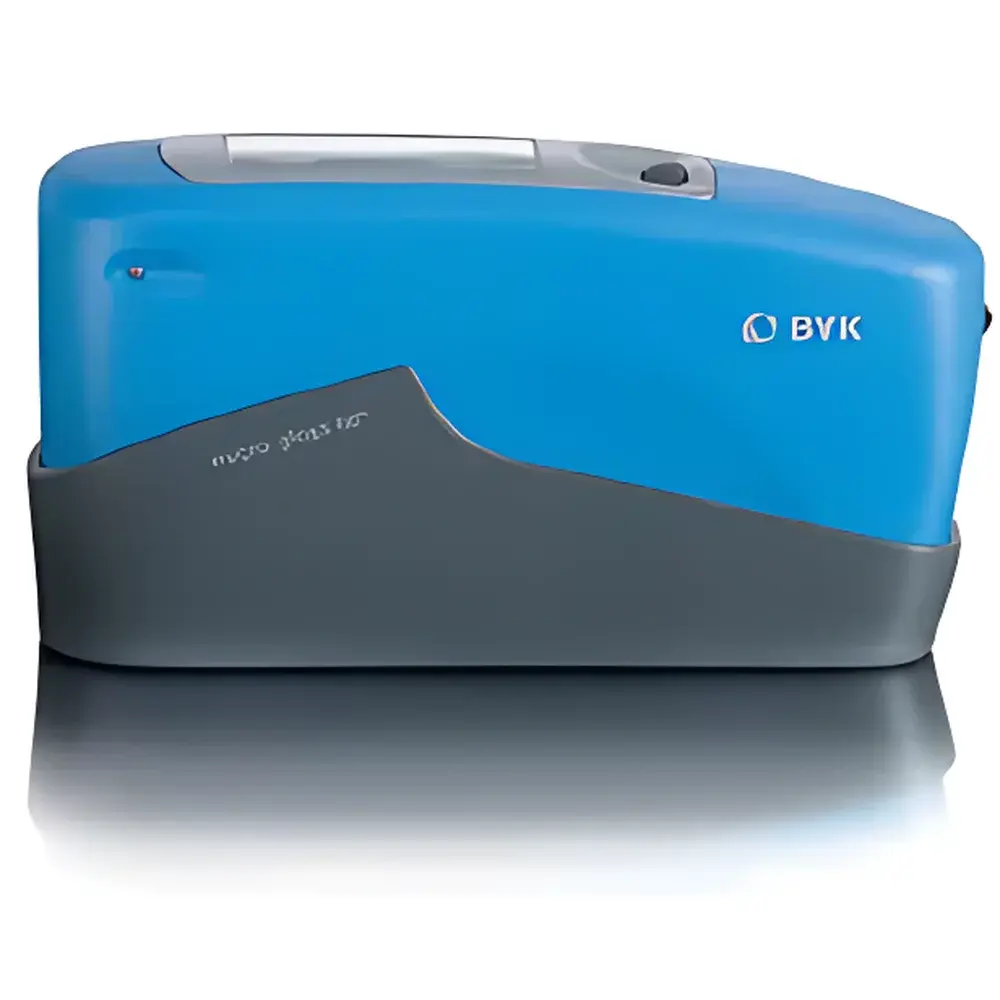
BYK-GARDNER micro-TRI-gloss 4565 Portable Gloss Meter
| Brand | BYK-GARDNER |
|---|---|
| Country of Origin | Germany |
| Model | BYK 4565 |
| Type | Automatic Tri-angle Gloss Meter |
| Measurement Angles | 20°, 60°, 85° |
| Gloss Range | 0–2000 GU |
| Repeatability | ±0.1 GU (0–20 GU), ±0.2 GU (20–100 GU), ±0.2% (100–2000 GU) |
| Compliance | ISO 2813, ASTM D523, DIN 67530, JIS Z8741, GB/T 9754 |
| Display | Full-color TFT touchscreen |
| Interface | Bluetooth 5.0, USB-C |
| Data Storage | Internal memory (≥10,000 readings), SD card slot |
| Software Compatibility | smart-chart™ v5.x, smart-lab™ Gloss |
Overview
The BYK-GARDNER micro-TRI-gloss 4565 is a handheld, tri-angle gloss meter engineered for precision surface reflectance measurement across industrial quality control environments—particularly in automotive OEM and Tier-1 supplier laboratories, paint formulation R&D, and high-end consumer electronics manufacturing. It operates on the principle of specular reflectance: a collimated beam of visible light (CIE standard illuminant D65) is directed at a defined incident angle onto the sample surface, and the intensity of reflected light measured within the mirror-reflection geometry is converted into gloss units (GU) per ISO 2813 and ASTM D523. Unlike single-angle instruments, the 4565 integrates three standardized measurement geometries—20° for high-gloss surfaces (e.g., clearcoats, polished metals), 60° for medium-gloss applications (e.g., basecoats, plastics, leather), and 85° for low-gloss or matte finishes (e.g., instrument panels, textured composites)—within a single compact, ergonomic housing. Its optical architecture features thermally stabilized LED sources, precision-machined aperture plates, and a calibrated photodiode array to ensure long-term stability and inter-instrument agreement. The device meets GLP-aligned operational requirements, including full audit trail support when paired with smart-lab™ Gloss software under FDA 21 CFR Part 11-compliant configurations.
Key Features
- Ergonomic, one-handed operation with tactile roller navigation and intuitive color touchscreen interface
- Simultaneous triple-angle measurement (20°/60°/85°) in under 1.2 seconds per reading—no manual angle switching or recalibration required
- Extended gloss range up to 2000 GU with enhanced low-gloss resolution: ±0.1 GU repeatability in the critical 0–20 GU range (per ISO 2813 Annex B)
- Integrated automatic diagnostic system: real-time verification of calibration status, standard tile cleanliness, and optical path integrity
- Dual-mode probe design supports both magnetic (steel substrates) and non-magnetic (aluminum, plastic) base material measurements without accessory swaps
- On-device statistical analysis: calculates mean, standard deviation, min/max, and uniformity index from ≥3 readings per sample location
- Continuous scan mode for spatial gloss profiling—ideal for evaluating large-area coating homogeneity (e.g., automotive body panels)
Sample Compatibility & Compliance
The micro-TRI-gloss 4565 accommodates diverse substrate classes—including solvent-borne and waterborne coatings, thermoset and thermoplastic polymers, anodized and electroplated metals, leather, laminated composites, and printed paperboard—without requiring surface preparation beyond standard cleaning per ISO 8501-1. Its 9 × 15 mm measurement aperture (60° mode) ensures representative sampling even on moderately textured surfaces, while optional accessories enable adaptation to curved geometries (radius ≥25 mm). Regulatory alignment includes full conformance with ISO 2813:2014, ASTM D523-14, DIN 67530, JIS Z8741:2016, and GB/T 9754–2007. For GMP-regulated environments, firmware v3.2+ enables electronic signature capture, user-level access control, and tamper-evident data export logs compliant with 21 CFR Part 11 Subpart B.
Software & Data Management
smart-chart™ v5.4 and smart-lab™ Gloss software provide end-to-end traceability for gloss metrology workflows. smart-chart™ supports real-time wireless synchronization (Bluetooth 5.0), customizable report templates (PDF/Excel), batch-level SPC charting (X-bar/R, Cp/Cpk), and multi-instrument fleet calibration tracking. smart-lab™ Gloss extends functionality with project-based data archiving, time-series trend analysis, automated pass/fail flagging against user-defined tolerances, and secure cloud backup (AWS-hosted, SOC 2 Type II certified). All raw measurement metadata—including timestamp, operator ID, environmental temperature/humidity (via optional external sensor), instrument serial number, and calibration certificate expiry—is embedded in exported files. Audit trails record every parameter change, calibration event, and data deletion—retained for ≥36 months by default.
Applications
- Automotive: Clearcoat gloss validation per OEM specifications (e.g., VW TL-52203, GMW14872); interior trim consistency monitoring across leather, TPO, and PU surfaces
- Packaging: Gloss uniformity assessment of metallized PET films, UV-cured offset inks, and laminated cartons per TAPPI T 480 om-19
- Architectural Coatings: Batch release testing of façade paints and powder coatings per EN 13523-2
- Consumer Electronics: Aesthetic matching of injection-molded housings (ABS/PC blends), anodized aluminum frames, and vapor-deposited glass surfaces
- Research & Development: Correlation studies between gloss, film thickness (when used with compatible BYK thickness gauges), and accelerated weathering performance (ISO 11341)
FAQ
What standards does the BYK 4565 comply with for gloss measurement?
It conforms to ISO 2813, ASTM D523, DIN 67530, JIS Z8741, and GB/T 9754—covering methodology, instrument calibration, and result reporting requirements.
Can the 4565 measure curved surfaces?
Yes—within curvature radii ≥25 mm using the standard foot; optional convex/concave adapters extend capability to radii as low as 10 mm.
Is the device suitable for low-gloss matte finishes commonly used in automotive interiors?
Yes—the 85° mode delivers ±0.2 GU repeatability down to 0 GU, and the S-version firmware upgrade enhances noise rejection in sub-5 GU measurements.
How is calibration traceability maintained?
Each unit ships with a NIST-traceable calibration certificate (valid 12 months); field recalibration uses proprietary ceramic standard tiles with documented uncertainty budgets per ISO/IEC 17025.
Does the instrument support automated data export to LIMS or ERP systems?
Yes—via CSV/XML over USB-C or Bluetooth; smart-lab™ Gloss provides ODBC connectivity and configurable API endpoints for enterprise integration.




