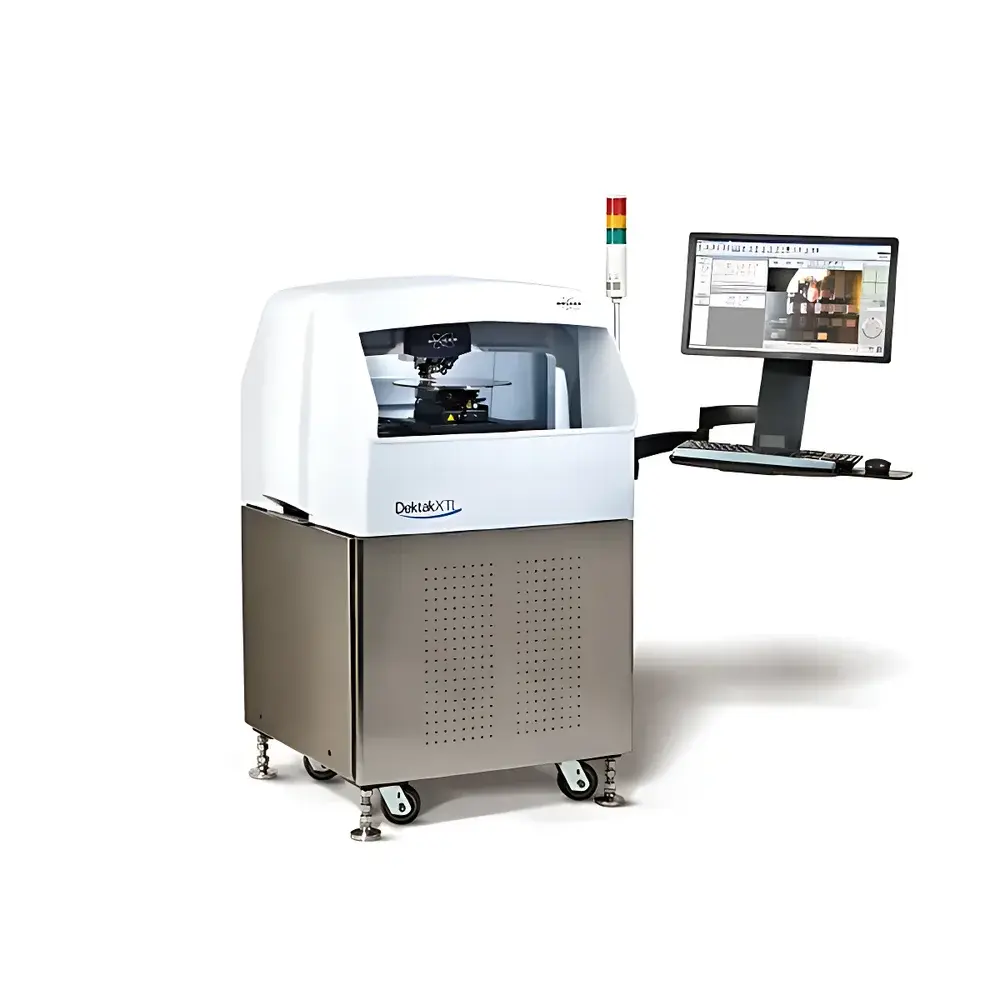
Bruker Dektak XTL Probe-Based Profilometer
| Brand | Bruker |
|---|---|
| Origin | Germany |
| Manufacturer Type | Authorized Distributor |
| Product Origin | Imported |
| Model | Dektak XTL |
| Measurement Principle | Capacitive Sensing |
| Measurement Capability | 2D Surface Profilometry (Optional 3D) |
| Accuracy | ±0.5% |
| Probe Tip Radius | 50 nm – 25 µm |
| Normal Force Range | 0.3–15 mg |
| Scan Length | 55 µm |
| Step Height Repeatability | 5 Å (1σ, on 1 µm step) |
| Vertical Resolution | Up to 1 Å (within 6.55 µm vertical range) |
| Maximum Sample Size | 300 mm diameter |
Overview
The Bruker Dektak XTL is a high-precision, motorized probe-based profilometer engineered for nanoscale step height, surface roughness, and thin-film thickness metrology in semiconductor, display, MEMS, and advanced packaging manufacturing environments. It operates on capacitive displacement sensing—where the vertical deflection of a diamond-tipped stylus is transduced into an analog voltage signal proportional to surface topography—with closed-loop feedback ensuring linear response and long-term stability. Designed specifically for production-integrated metrology, the Dektak XTL integrates air-bearing vibration isolation, a fully enclosed interlocked workstation, and robust mechanical architecture to maintain measurement integrity in high-noise cleanroom and fab-floor settings. Its 300 mm high-resolution encoded XY stage supports full-wafer and large-panel inspection without tiling or stitching artifacts, while the dual-camera optical system enables precise spatial registration and rapid point-of-interest navigation.
Key Features
- Capacitive sensor with 1 Å vertical resolution (at 6.55 µm vertical range), enabling sub-nanometer repeatability for critical dimension control
- Interlocked, fully enclosed workstation with integrated air-spring vibration isolation—certified for operation in ISO Class 5–7 cleanrooms
- Dual-camera imaging system: one wide-field camera for macro sample positioning and one high-magnification camera for micro-feature targeting; both synchronized with real-time video overlay and click-to-move functionality
- N-Lite low-force probing technology (0.3–15 mg selectable force) with soft-touch mode and 1 mm vertical range—enabling simultaneous characterization of delicate films and high-aspect-ratio structures
- Self-aligning, quick-change probe mount with standardized shank geometry—reducing setup time and minimizing tip misalignment error
- Single-arch structural design optimized for stiffness and thermal stability; no moving optics or external sensor arms that compromise reproducibility
Sample Compatibility & Compliance
The Dektak XTL accommodates substrates up to 300 mm in diameter—including silicon wafers, glass panels (Gen 2–Gen 8), ceramic substrates, and flexible polymer films—without requiring vacuum chucking or adhesive mounting. Its non-contact optical alignment and programmable Z-lift ensure compatibility with fragile, warped, or coated samples. The system complies with industry-standard metrology protocols including ASTM E1054 (stylus profilometry), ISO 25178-2 (surface texture parameters), and SEMI MF1529 (step height measurement for thin films). For regulated environments, Vision64 software supports 21 CFR Part 11-compliant audit trails, electronic signatures, and role-based access control—fully traceable to GLP/GMP documentation requirements.
Software & Data Management
Vision64 is Bruker’s 64-bit metrology platform built on a modular, scriptable architecture supporting automated recipe-driven workflows, multi-site batch analysis, and cross-instrument data harmonization. It includes over 200 pre-validated analysis routines—covering step height, linearity, curvature radius, film thickness (via step-edge method), roughness (Ra, Rq, Rz), and slope metrics—and allows user-defined scripting in Python and VB.NET. All measurements are stored in a relational database with metadata tagging (operator ID, timestamp, process lot, equipment ID), enabling seamless integration with MES and SPC systems. Raw profilometry traces are saved in Bruker’s proprietary .pro format (lossless, time-stamped, with full calibration history embedded), and export options include CSV, ASCII, TIFF, and HDF5 for third-party statistical modeling.
Applications
- Semiconductor: Quantifying photoresist develop bias, etch depth uniformity, CMP dishing/erosion, and gate stack step heights on 300 mm wafers
- Flat Panel Display: Measuring pixel wall height, spacer protrusion, and ITO layer thickness on Gen 6+ glass substrates
- MEMS & Sensors: Characterizing release etch profiles, cantilever deflection, and cavity depth in pressure and inertial devices
- Advanced Packaging: Validating redistribution layer (RDL) step coverage, under-bump metallization (UBM) topography, and TSV planarity
- Research & Development: Supporting DOE-driven process optimization through statistically robust repeatability (5 Å 1σ on 1 µm steps) and traceable uncertainty budgets
FAQ
What is the maximum vertical measurement range of the Dektak XTL?
The system offers a standard vertical range of 6.55 µm at 1 Å resolution; optional extended-range configurations support up to 1 mm using N-Lite low-force mode.
Can the Dektak XTL perform 3D surface mapping?
Yes—when equipped with optional 3D scanning module and Vision64 3D analysis package, it generates true 3D topographic maps with calibrated lateral and vertical scaling.
Is probe replacement performed manually or automatically?
Probe exchange is manual but tool-free and self-aligning; the mount ensures repeatable tip positioning within ±0.5 µm lateral offset.
Does the system meet FDA or ISO calibration traceability requirements?
All factory calibrations are NIST-traceable; on-site verification kits and certified reference standards (e.g., NIST SRM 2101) are available for routine performance qualification.
How is operator-induced variability minimized during measurement setup?
Through dual-camera spatial guidance, pattern recognition-assisted auto-positioning, and vision-based feature detection—reducing reliance on manual alignment and improving inter-operator consistency.