
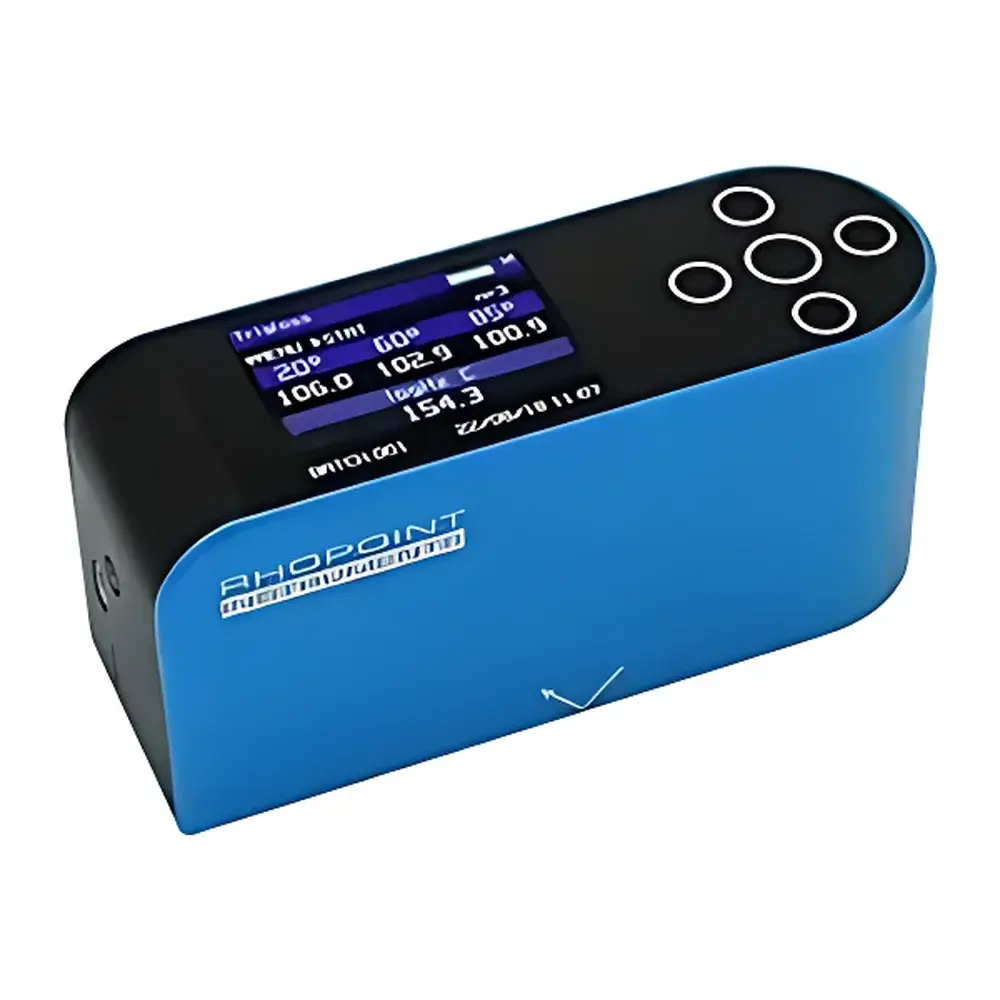
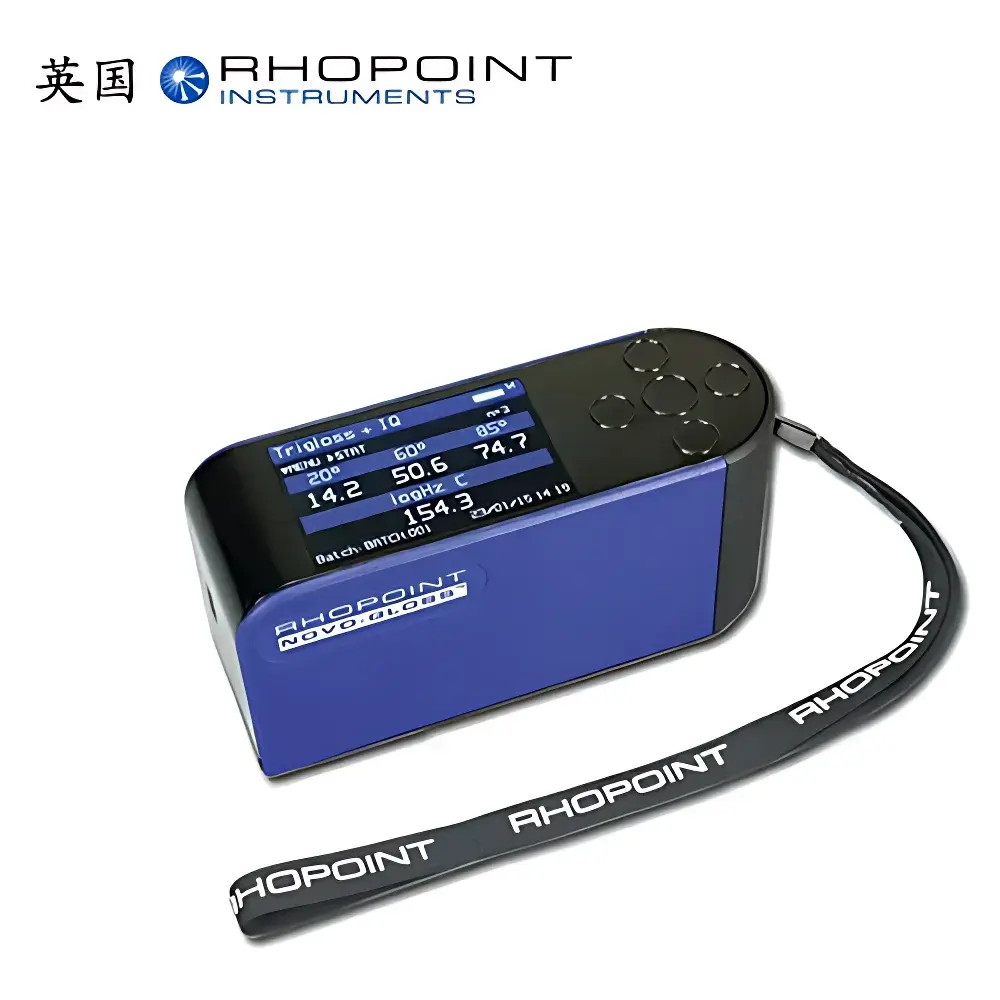
Rhopoint NG206085 NOVO-GLOSS 20/60/85 Tri-Angle Gloss and Haze Meter
| Brand | Rhopoint |
|---|---|
| Origin | United Kingdom |
| Model | NG206085 NOVO-GLOSS 20/60/85 |
| Type | Manual Portable Gloss & Haze Meter |
| Haze Range | 0–30% |
| Transmittance Range | 0–100% |
| Haze Repeatability | ±0.2% |
| Transmittance Repeatability | ±0.1% |
| Gloss Measurement Angles | 20°, 60°, 85° |
| Gloss Range | 0–100 GU (standard), 100–2000 GU (extended) |
| Gloss Resolution | 0.1 GU |
| Gloss Repeatability | ±0.2 GU |
| Gloss Reproducibility | ±0.5 GU |
| Compliance | ISO 2813, ISO 7668, ASTM D523, ASTM D2457, DIN 67530, JIS Z 8741 |
| Measurement Areas | 20°: 6 mm × 6.4 mm, 60°: 6 mm × 12 mm, 85°: 4.4 mm × 44 mm |
| Operating Temperature | 15–40 °C |
| Operating Humidity | <85% RH, non-condensing |
| Dimensions | 65 mm (H) × 140 mm (W) × 50 mm (D) |
| Weight | 530 g |
| Battery Life | >17 hours / >14,000 readings per charge |
| Internal Storage | 8 MB (>2000 readings) |
| Data Transfer | Bluetooth 4.0, USB interface, no driver required |
| Display | Full-color adjustable-brightness touchscreen |
| Calibration | Integrated positioning-detect calibration base with certified reference tiles |
Overview
The Rhopoint NG206085 NOVO-GLOSS 20/60/85 Tri-Angle Gloss and Haze Meter is a precision-engineered optical instrument designed for simultaneous, traceable measurement of surface gloss and haze in quality control and R&D environments. It operates on the principle of specular reflectance (gloss) and forward light scattering (haze), conforming to internationally recognized photometric standards including ISO 2813, ASTM D523, and ASTM D2457. Unlike single-angle glossmeters, this tri-angle configuration enables optimized resolution across the full gloss spectrum: 20° for high-gloss metallic and ceramic surfaces (e.g., automotive clearcoats, anodized aluminum), 60° as the universal reference angle for mid-gloss materials such as industrial paints and laminates, and 85° for low-gloss and matte substrates (e.g., architectural coatings, textured plastics, paperboard) where enhanced sensitivity below 10 GU is critical. The instrument integrates dual optical paths—separate collimated LED sources and silicon photodiode detectors calibrated per angle—to ensure angular independence and eliminate cross-talk between measurements.
Key Features
- Tri-angle gloss measurement (20°, 60°, 85°) with independent optical geometry and aperture sizing per angle—no mechanical switching or interpolation
- Simultaneous haze (0–30%) and transmittance (0–100%) measurement via integrated transmission mode compliant with ASTM D1003 and ISO 14782
- High-precision repeatability: ±0.2 GU for gloss, ±0.2% for haze, and ±0.1% for transmittance under controlled environmental conditions
- Full-color capacitive touchscreen with adjustable brightness and intuitive icon-based navigation—designed for gloved operation in production environments
- Integrated calibration base with auto-position detection ensures zero-error alignment during calibration using NIST-traceable reference standards
- Onboard statistical engine supporting real-time calculation of mean, min, max, standard deviation, and coefficient of variation per batch
- Lithium-ion battery delivering >17 hours of continuous operation and >14,000 readings per full charge
- 8 MB internal flash memory stores >2000 complete measurement records with timestamp, operator ID, sample ID, and environmental metadata
Sample Compatibility & Compliance
The NG206085 accommodates flat, curved, and textured surfaces within its specified measurement footprints: 6 mm × 6.4 mm (20°), 6 mm × 12 mm (60°), and 4.4 mm × 44 mm (85°). Its compact form factor (65 × 140 × 50 mm, 530 g) supports handheld use on large panels, inline spot checks, and benchtop QC stations. The device meets GLP-aligned data integrity requirements through immutable audit trails, user-access levels (operator/administrator), and timestamped calibration logs. All firmware and measurement algorithms are validated against ISO/IEC 17025–accredited reference laboratories. Regulatory compliance includes full support for FDA 21 CFR Part 11 electronic record and signature requirements when used with Novo-Gloss software v5.2+, enabling secure user authentication, electronic signatures, and change-controlled audit history export.
Software & Data Management
Rhopoint’s Novo-Gloss PC software (included) provides comprehensive data management for laboratory and manufacturing execution systems (MES). It supports direct import of .csv and .xlsx files, automated report generation with customizable templates (PDF/Excel), and trend analysis across shifts, batches, or suppliers. Bluetooth 4.0 and USB-C connectivity enable seamless synchronization without proprietary drivers. Raw data exports include full spectral metadata: angle-specific gloss values, haze %, transmittance %, measurement date/time, ambient temperature/humidity (if logged externally), and calibration status. Software modules support SPC charting (X̄-R, Cpk/Ppk), outlier detection, and integration with LIMS via ODBC-compliant database connectors. Firmware updates are delivered over-the-air via Bluetooth or USB, maintaining version traceability and validation documentation per ICH Q9/Q10 principles.
Applications
This instrument is deployed globally in industries requiring rigorous surface appearance specification and process validation. In automotive OEM and Tier-1 supply chains, it verifies gloss uniformity across painted body panels and interior trim components per GMW14872 and Ford WSS-M2P177-A2. Coating manufacturers use it to qualify solventborne and waterborne formulations against ISO 12944 performance tiers. Plastics processors apply it to monitor extrusion line consistency for films, sheets, and injection-molded parts—especially where anti-glare or soft-touch finishes demand precise haze control. Printing and packaging facilities rely on its 85° capability to quantify matte varnish performance on folding cartons per TAPPI T 480. Additional applications include evaluation of anti-fog films for medical devices (ISO 15022), optical clarity of display cover glass, and surface degradation studies in accelerated weathering protocols (ASTM G154, ISO 4892-3).
FAQ
What standards does the NG206085 comply with for gloss measurement?
It complies with ISO 2813, ASTM D523, ASTM D2457, DIN 67530, and JIS Z 8741 for gloss; and ASTM D1003 and ISO 14782 for haze and transmittance.
Can the instrument measure curved or irregular surfaces?
Yes—its compact probe design and low-profile measurement foot allow stable contact on convex radii ≥25 mm; concave surfaces require optional curvature compensation fixtures.
Is calibration traceable to national metrology institutes?
All supplied calibration tiles are certified by UKAS-accredited laboratories with NIST-traceable uncertainty statements included in the certificate of calibration.
How is data integrity maintained for regulated environments?
Through password-protected user roles, electronic signature workflows, immutable audit logs, and 21 CFR Part 11–compliant software modules with digital signature encryption.
What is the recommended recalibration interval?
Annual recalibration is recommended; however, daily verification using the onboard reference tile is mandatory per ISO/IEC 17025 and internal quality procedures.



