
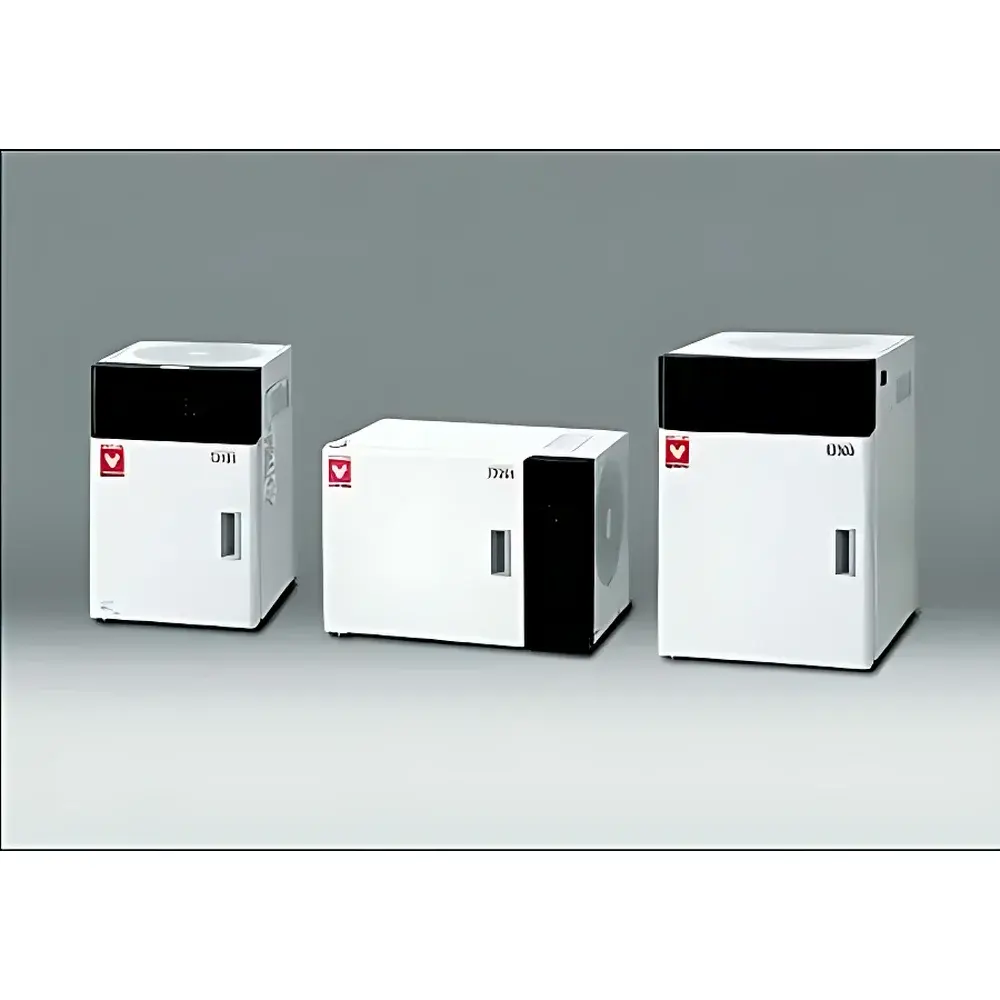
YAMATO IJ300 Low-Vibration Refrigerated Incubator
| Brand | YAMATO |
|---|---|
| Origin | Japan |
| Model | IJ300 |
| Temperature Range | 5–60°C |
| Temperature Uniformity | ±1.0°C |
| Humidity Control | Not equipped |
| Chamber Capacity | 15.6 L |
| Cooling Method | Thermoelectric (Peltier) |
| Vibration Level | Low |
| Refrigerant | CFC-free |
| Power Supply Interface | Integrated side-mounted outlet (optional slide-out shelf with vibrator available) |
| Safety Features | Self-diagnostic system, independent over-temperature prevention device, over-temperature limiter, earth-leakage circuit breaker, over-current protection |
Overview
The YAMATO IJ300 is a compact, low-vibration refrigerated incubator engineered for precise temperature-controlled storage and cultivation of biological samples under stable, non-cryogenic conditions. Unlike compressor-based systems, the IJ300 employs solid-state thermoelectric (Peltier) cooling technology—eliminating chlorofluorocarbon (CFC) and hydrochlorofluorocarbon (HCFC) refrigerants while minimizing mechanical vibration transmission to sensitive cultures or assays. Its operational range spans 5°C to 60°C, making it suitable for both chilling-sensitive reagents and mesophilic microbial growth studies. The unit’s rigid stainless-steel interior, double-layer semi-tempered glass observation window, and optimized thermal insulation architecture collectively ensure high thermal stability and minimal heat ingress—critical for long-term sample integrity in academic labs, QC environments, and biotech R&D workflows.
Key Features
- Thermoelectric (Peltier) cooling system: Provides CFC-free, oil-free, and maintenance-light temperature regulation with inherently low mechanical vibration—ideal for suspension cultures, enzyme kinetics, and microplate-based assays requiring minimal perturbation.
- Precision programmable temperature controller: Enables multi-step ramp/soak profiles and real-time deviation monitoring; supports user-defined setpoint retention during power interruption (with optional battery backup).
- Compact 15.6 L chamber: Optimized footprint (W320 × D390 × H420 mm) fits seamlessly into benchtop workflows without compromising internal volume-to-surface-area ratio for efficient thermal homogeneity.
- Dual-pane semi-tempered observation window: Reduces radiant and conductive heat transfer by >40% compared to single-glazed alternatives—enhancing energy efficiency and minimizing ambient influence on chamber stability.
- Integrated safety architecture: Includes redundant over-temperature protection (independent hardware limiter + software-based cut-off), self-diagnostic startup sequence, earth-leakage circuit interrupter (ELCI), and over-current protection compliant with IEC 61010-1.
- Modular expandability: Supports vertical stacking with identical IJ-series units (e.g., IJ101, IJ300); optional slide-out shelf with integrated vibration module enables controlled agitation of flasks or tubes during incubation.
Sample Compatibility & Compliance
The IJ300 accommodates standard laboratory vessels including Petri dishes (up to 150 mm), culture flasks (T25–T75), microcentrifuge tube racks, and PCR strip holders. Its absence of humidity control renders it unsuitable for long-term cell monolayer maintenance but optimal for short-term reagent storage, bacterial pre-culture, enzyme stock stabilization, and environmental simulation where moisture-induced condensation must be avoided. The unit conforms to JIS B 7952 (Japanese Industrial Standard for incubators), meets CE marking requirements under Directive 2014/30/EU (EMC) and 2014/35/EU (LVD), and supports GLP-compliant documentation through its event-log-capable controller (optional RS-232/USB data export). While not certified for ISO 13485 or FDA 21 CFR Part 11 out-of-the-box, audit-ready operation is achievable via validated external data logging and change-control procedures.
Software & Data Management
The built-in digital controller features a 4-digit LED display, keypad navigation, and non-volatile memory for up to 10 user-defined programs (each with up to 8 segments). Real-time temperature readings are logged at 1-minute intervals internally (max. 30 days of data); historical records can be exported via optional USB interface to CSV-compatible spreadsheet software. No proprietary cloud platform is required—raw time-series data integrates natively with LabArchives, ELN systems, or custom Python/MATLAB analysis pipelines. Firmware updates are performed locally via USB stick; version history and calibration logs are retained in device memory for traceability.
Applications
- Short-term storage of temperature-sensitive reagents (e.g., restriction enzymes, antibodies, oligonucleotides) at 4–8°C.
- Pre-incubation of bacterial cultures (E. coli, Bacillus spp.) prior to transformation or fermentation.
- Controlled-temperature reaction staging for immunoassays, ELISA plate incubation, and lateral flow test development.
- Environmental stress testing of electronic biosensors or polymer-based diagnostic substrates.
- Benchtop cold room alternative for small-volume sample conditioning in regulated QC labs (e.g., pharmaceutical raw material stability checks per ICH Q1A).
FAQ
Does the IJ300 support humidity control?
No—the IJ300 is a dry-air incubator with no integrated humidification system. It is intended for applications where condensation or water vapor interference must be avoided.
Can the unit operate continuously at 5°C in ambient environments above 30°C?
Yes, provided adequate ventilation clearance (≥10 cm on all sides) and ambient relative humidity remains below 80% RH; continuous operation at minimum setpoint is validated per JIS B 7952 Annex B.
Is the slide-out shelf with vibrator compatible with all IJ300 configurations?
The vibratory slide-out shelf (Option Code: IJ-SH-VIB) requires factory installation and is only available with the IJ300W variant (wide-window model); retrofitting post-purchase is not supported.
What calibration standards does YAMATO recommend for routine verification?
YAMATO recommends annual verification using NIST-traceable PT100 probes (e.g., Fluke 1523 or equivalent) placed at geometric center and three corner positions; deviation from setpoint must remain within ±0.8°C across all locations.
How is firmware updated, and is version history accessible?
Firmware updates are performed offline via FAT32-formatted USB drive; version number, update timestamp, and checksum are displayed in the “System Info” menu and retained in non-volatile memory for audit review.




