
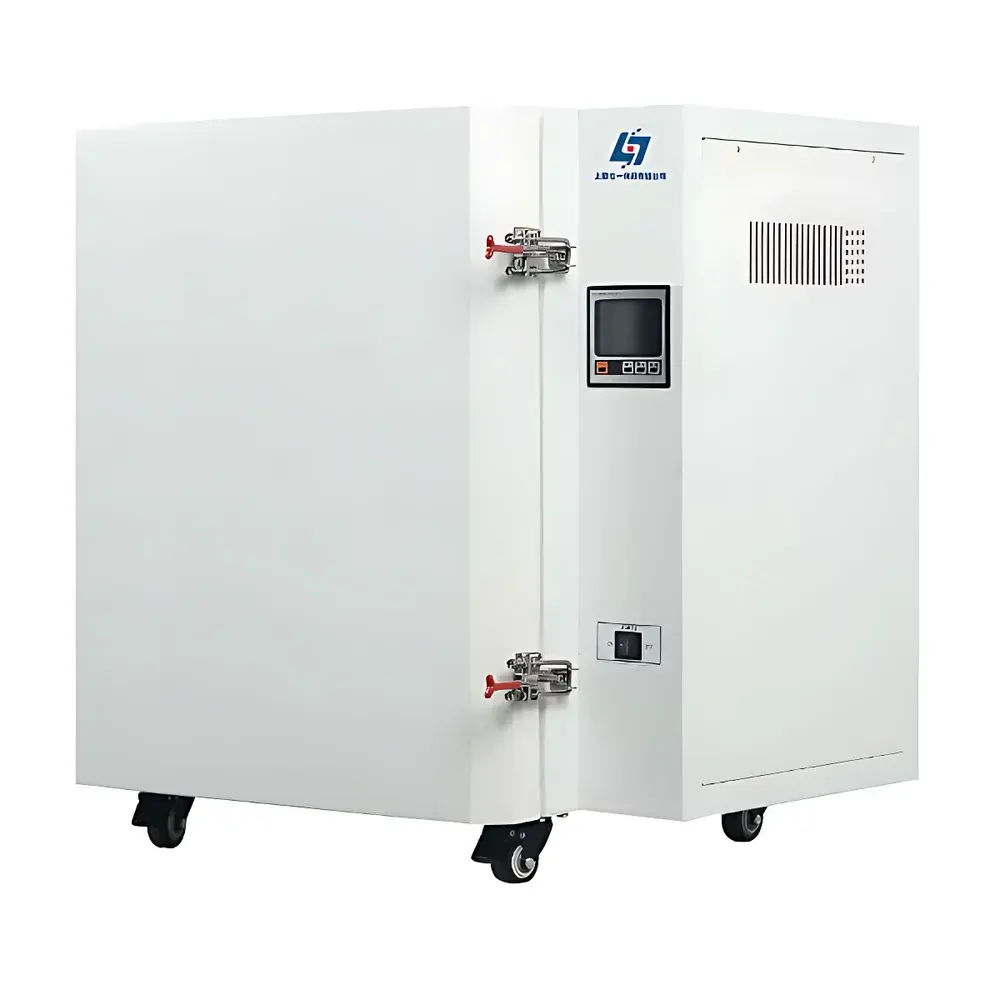
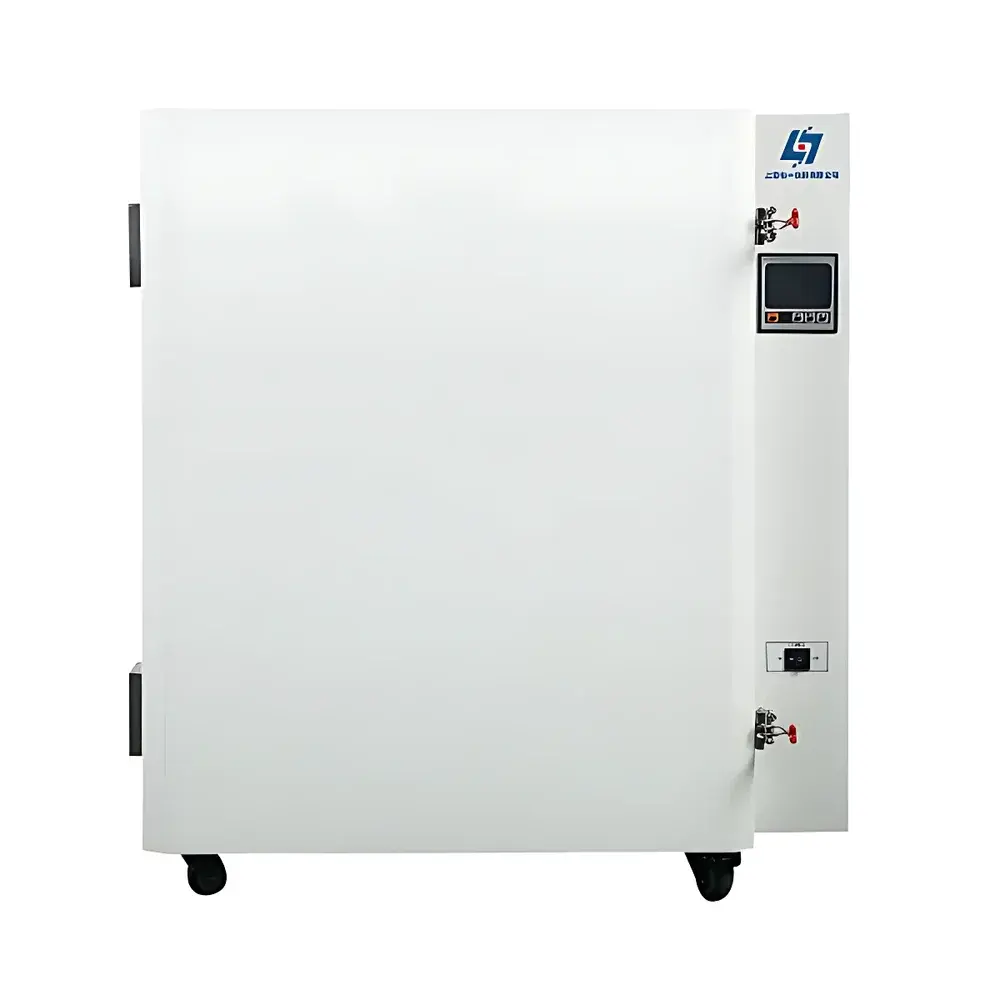
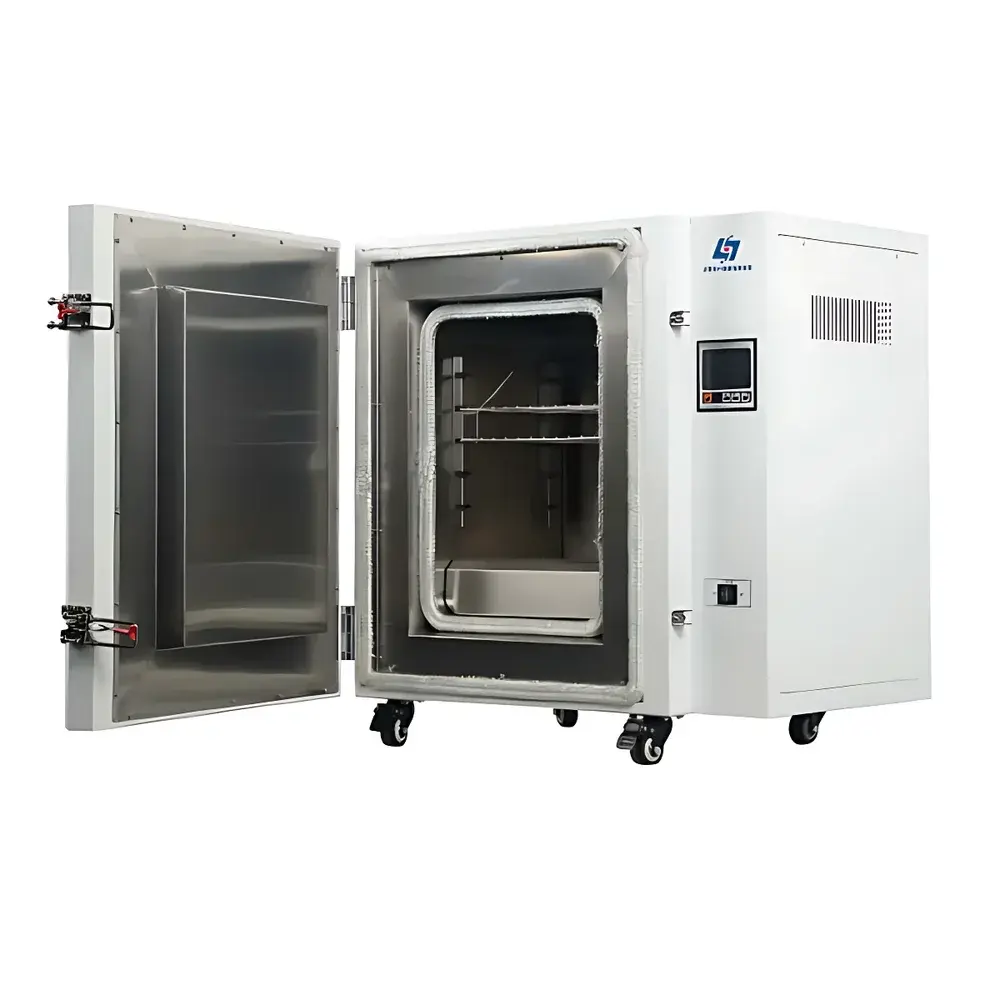
Yoyi DGG-149C High-Temperature Nitrogen-Purged Forced-Air Oven
| Brand | Yoyi |
|---|---|
| Model | DGG-149C |
| Temperature Range | RT+20 °C to 500 °C |
| Temperature Resolution | 1 °C |
| Temperature Uniformity | ±2.5% (at 100 °C, non-purged) |
| Interior Material | Mirror-Finish Stainless Steel |
| Heating Method | Preheated Air Injection via Dual-Stage Air Circulation System |
| Inert Gas Interface | Φ10 mm Quick-Connect Port with Adjustable Rotameter (0–10 L/min) |
| Insulation | High-Density Glass Fiber + Ceramic Fiber Door Gasket |
| Control System | Microcomputer-Based PID Controller with LCD Menu Interface |
| Power Supply | AC 380 V, 50 Hz |
| Rated Power | 4400 W |
| Internal Chamber Dimensions (W×D×H) | 450 × 550 × 550 mm |
| Net Volume | 140 L |
| Standard Shelving | 2 Adjustable Stainless Steel Trays |
| Timer Range | 1–9999 min |
| Operating Ambient Temperature | +5 °C to +40 °C |
Overview
The Yoyi DGG-149C is a high-temperature, nitrogen-purged forced-air oven engineered for precision thermal processing under controlled inert atmospheres. Designed for laboratories and industrial R&D facilities requiring stable, repeatable heating up to 500 °C, it employs a dual-stage air circulation architecture: ambient air is first preheated in an isolated chamber, then mixed and injected directly into the working space via a shielded axial fan and optimized baffle system. This configuration minimizes thermal lag and ensures rapid, uniform heat distribution—critical for applications where oxygen-induced oxidation, decomposition, or surface degradation must be eliminated. Unlike standard convection ovens, the DGG-149C integrates a dedicated inert gas management subsystem—including a calibrated rotameter, quick-coupling interface, and pressure-balanced inlet design—to maintain consistent N₂ flow (0–10 L/min) without compromising temperature stability or chamber integrity.
Key Features
- Microprocessor-based PID temperature controller with real-time LCD display showing setpoint, actual chamber temperature, and elapsed/remaining time—all simultaneously visible on a single screen.
- Mirror-finish 304 stainless steel interior chamber with radius-corner geometry to eliminate dead zones and facilitate cleaning; removable, height-adjustable stainless steel shelves (2 included).
- Dual-layer thermal insulation: high-density glass fiber between outer casing and inner chamber, plus ceramic fiber door gasket rated for continuous operation at 500 °C—reducing external surface temperature and energy consumption.
- Robust mechanical design featuring double-pivot, dual-latch hinges with silicone-free high-temp sealing; door closure verified by positive-pressure retention test during nitrogen purging.
- Power-loss recovery function: automatically resumes prior operating parameters (set temperature, timer, gas flow state) after unexpected power interruption—compliant with GLP documentation requirements for process continuity.
- Preheated air injection system eliminates cold air ingress during door opening and supports faster ramp rates (typical 20 °C/min from RT to 300 °C under load).
Sample Compatibility & Compliance
The DGG-149C accommodates a broad range of sample formats—including crucibles, quartz boats, ceramic setters, metal trays, and polymer molds—within its 140 L workspace. Its inert atmosphere capability enables safe processing of oxygen-sensitive materials such as lithium battery cathode precursors, metal-organic frameworks (MOFs), reduced graphene oxide, and thermally labile catalysts. The unit meets structural and electrical safety requirements per IEC 61010-1:2010 (Safety Requirements for Electrical Equipment for Measurement, Control, and Laboratory Use). While not certified to UL or CE for standalone sale in North America/EU, its design principles align with ASTM E145–22 (Standard Specification for Gravity-Convection and Forced-Ventilation Ovens) and ISO 17025 traceability expectations when used with calibrated reference thermocouples. Optional RS485 interface supports integration into centralized lab monitoring systems compliant with FDA 21 CFR Part 11 for electronic records and signatures.
Software & Data Management
The base controller provides local data logging of temperature profiles (time-stamped at 1-second intervals) stored internally for up to 30 days. With the optional RS485 communication module and配套 software, users can configure multi-segment temperature ramps, export CSV-formatted datasets, and generate audit-ready reports including operator ID, start/stop timestamps, deviation alerts, and gas flow logs. All parameter changes are timestamped and attributed—supporting ALCOA+ data integrity principles. Optional embedded thermal printer delivers hard-copy output of cycle summaries with QR-coded batch identifiers for laboratory notebook linkage.
Applications
- Thermal stabilization and binder burnout of advanced ceramics and sintered metal components.
- Controlled pyrolysis of carbon composites and precursor fibers under nitrogen blanket.
- Drying and curing of high-purity electrode slurries for Li-ion and solid-state battery development.
- Moisture removal from hygroscopic reagents and calibration standards without hydrolytic side reactions.
- Accelerated aging studies of encapsulants, conformal coatings, and flexible electronics substrates.
- Pre-conditioning of reference materials prior to XRD, TGA, or SEM analysis—ensuring reproducible baseline states.
FAQ
What inert gases are compatible with the DGG-149C?
Nitrogen (N₂) is the primary gas supported; argon (Ar) may also be used provided the rotameter is recalibrated for its specific density and viscosity.
Is the temperature uniformity specification valid under nitrogen flow?
The ±2.5% uniformity rating is measured at 100 °C in static air; under active N₂ purge (5 L/min), uniformity remains within ±3.0% across the working volume per internal validation protocol.
Can the oven operate continuously at 500 °C?
Yes—the chamber, heating elements, and insulation system are rated for uninterrupted operation at maximum temperature, with mean time between failures (MTBF) exceeding 8,000 hours under nominal load conditions.
Does the unit include overtemperature protection?
Yes: independent mechanical overtemperature cut-off (OTC) set at 520 °C, plus digital alarm threshold configurable within the PID interface.
How is calibration traceability maintained?
The controller accepts input from external Class A Pt100 probes; users may perform in-situ verification using NIST-traceable reference thermometers inserted through the optional 25 mm test port.



