
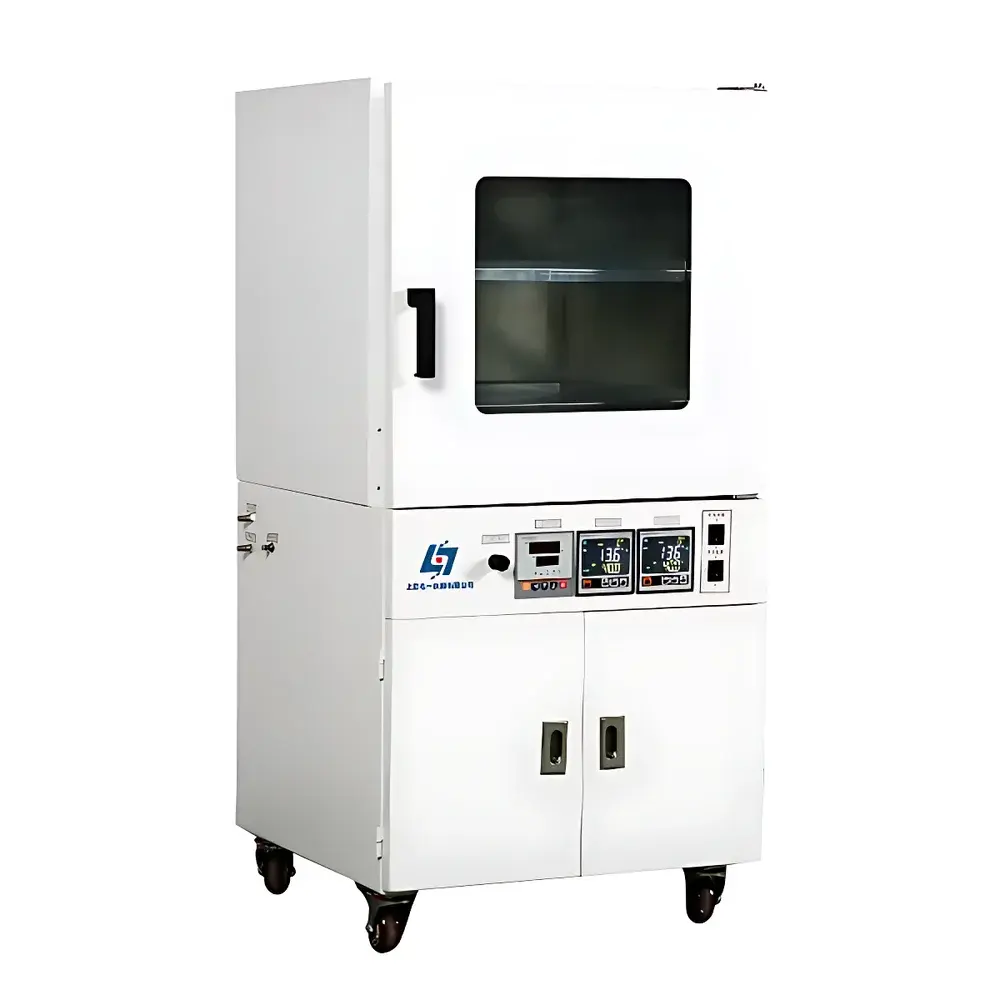
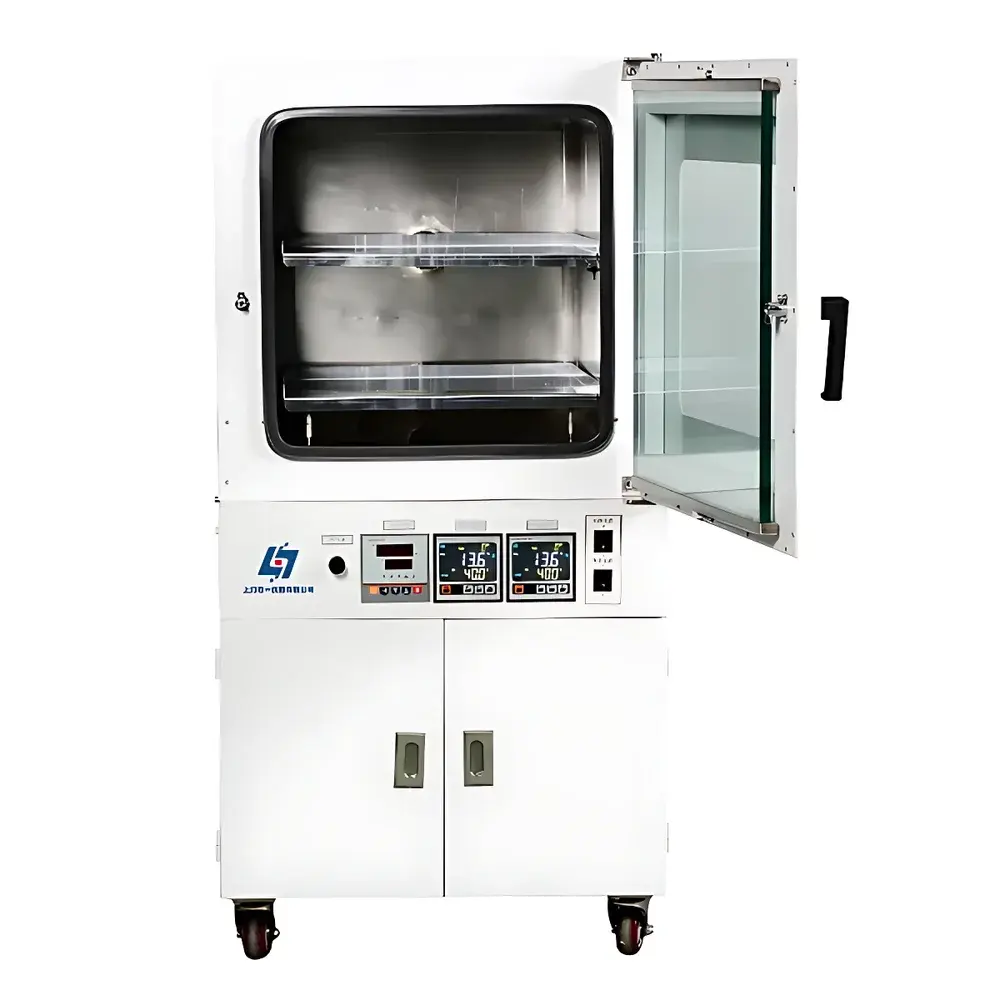
Yoyi DZF-6090SC Automatic Nitrogen-Purged Vacuum Drying Oven
| Brand | Yoyi |
|---|---|
| Origin | Shanghai, China |
| Manufacturer | Yes |
| Type | Vacuum Drying Oven |
| Model | DZF-6090SC |
| Temperature Range | RT+10°C to 250°C |
| Temperature Uniformity | ±1°C |
| Temperature Resolution | 0.1°C |
| Vacuum Level | ≤133 Pa |
| Chamber Dimensions (W×D×H) | 450×450×450 mm |
| External Dimensions (W×D×H) | 615×660×1440 mm |
| Interior Material | Stainless Steel |
| Heating Power | 1400 W |
| Programmable Vacuum Control | 5-stage, 5-segment (0–9999 min per stage) |
| Nitrogen Inlet | Quick-connect Φ10 mm port with solenoid valve control |
| Door Seal | Molded silicone gasket |
| Insulation | Ceramic fiber blanket between chamber and outer casing |
| Viewing Window | Double-layer tempered glass |
| Safety Features | Over-temperature alarm, power-failure parameter retention, auto-recovery |
Overview
The Yoyi DZF-6090SC Automatic Nitrogen-Purged Vacuum Drying Oven is an engineered solution for controlled thermal processing under inert or low-oxygen environments. It integrates vacuum drying, programmable pressure maintenance, and automated nitrogen purging into a single platform—designed to prevent oxidation, thermal degradation, and moisture reabsorption during drying of sensitive materials. Operating on the principle of reduced-pressure evaporation—where lowering ambient pressure decreases the boiling point of solvents—the system enables efficient dehydration at lower temperatures than conventional ovens. Its dual capability to maintain stable vacuum levels (≤133 Pa) and precisely regulate internal pressure via nitrogen backfilling makes it suitable for applications requiring strict atmospheric control, such as drying oxygen-sensitive catalysts, pharmaceutical intermediates, battery electrode slurries, or polymer precursors.
Key Features
- Microprocessor-based PID temperature controller with real-time digital display, offering ±1°C uniformity across the 450×450×450 mm stainless steel chamber and 0.1°C resolution.
- Five-stage, five-segment vacuum programming: each segment supports independent setpoints for vacuum level and dwell time (0–9999 minutes), enabling complex drying profiles compliant with ASTM E145 and ISO 12099 protocols.
- Automated nitrogen management system featuring electromagnetic valve-controlled Φ10 mm quick-connect inlet, enabling repeatable inert gas dosing, pressure stabilization, and automatic venting—critical for GLP/GMP-aligned workflows.
- Double-layer tempered glass observation window with reinforced frame, allowing visual monitoring without compromising vacuum integrity or thermal stability.
- Ceramic fiber insulation layer between inner chamber and cold-rolled steel exterior ensures low thermal conductivity (<0.05 W/m·K), reducing standby energy consumption by up to 35% versus standard mineral wool-insulated units.
- Integrated safety architecture includes over-temperature cut-off, non-volatile memory for parameter retention during power interruption, and molded silicone door gasket ensuring long-term vacuum seal integrity (leak rate <0.5 Pa·m³/s).
Sample Compatibility & Compliance
The DZF-6090SC accommodates heterogeneous sample types—including powders, thin films, granular composites, lyophilized biological matrices, and coated substrates—without cross-contamination or structural collapse. Its stainless steel interior resists corrosion from acidic vapors or halogenated solvents, supporting extended use in QC laboratories handling USP , ISO 10993, or ICH Q5C-compliant materials. The unit meets CE marking requirements for electrical safety (EN 61010-1) and electromagnetic compatibility (EN 61326-1). Optional validation packages support IQ/OQ documentation aligned with FDA 21 CFR Part 11 data integrity expectations, including audit-trail-enabled software logs for vacuum cycles, temperature ramps, and nitrogen purge events.
Software & Data Management
While the DZF-6090SC operates via embedded firmware rather than PC-connected software, its front-panel interface supports full traceability: all vacuum segments, temperature setpoints, hold durations, and nitrogen injection timestamps are stored in non-volatile memory with time/date stamping. Data export is enabled via optional RS485/Modbus RTU interface (add-on module), permitting integration into centralized LIMS or MES platforms. The system records up to 10,000 event entries—including alarms, door openings, and power interruptions—with configurable retention policies. All operational parameters comply with ALCOA+ principles (Attributable, Legible, Contemporaneous, Original, Accurate, Complete, Consistent, Enduring, Available) when used with validated procedures.
Applications
This oven serves critical functions across regulated and research-intensive domains: drying heat-labile APIs prior to tablet compression; removing residual NMP solvent from lithium-ion cathode coatings; stabilizing metal-organic frameworks (MOFs) under argon; conditioning humidity-sensitive reference standards per ISO/IEC 17025; and dehydrating nanocellulose suspensions without aggregation. Its ability to sustain sub-133 Pa vacuum while dynamically adjusting partial pressure via nitrogen infusion supports accelerated aging studies per ASTM F1980 and shelf-life modeling for sterile barrier systems. Universities utilize it for graduate-level materials science labs focusing on controlled-atmosphere thermogravimetry coupling.
FAQ
Does the DZF-6090SC include a vacuum pump?
Yes—the unit ships with a dedicated oil-free scroll vacuum pump mounted in an integrated lower cabinet, rated for ultimate vacuum ≤100 Pa and continuous duty at 133 Pa.
Can the nitrogen purge sequence be synchronized with temperature ramps?
Yes—vacuum stages and nitrogen backfilling are independently programmable but can be sequenced to coincide with heating phases using the 5-segment timer logic.
Is the chamber volume calibrated and certified?
Chamber dimensions are factory-verified per ISO 17025-accredited dimensional metrology; volumetric calibration certificates are available upon request.
What maintenance intervals are recommended for the vacuum system?
The scroll pump requires filter replacement every 6 months under typical lab usage; silicone door gaskets should be inspected quarterly for compression set.
Is remote monitoring supported?
Remote status readout (temperature, vacuum level, cycle phase) is supported via optional Ethernet-to-Modbus gateway; full remote control requires third-party SCADA integration.
Related Products



